The frost in October 1931 had a way of biting through the soles of cheap boots, turning the soles of Franziska’s feet into blocks of numb wood. She was nineteen, her knuckles were raw and chapped like cracked porcelain, and her stomach was a perpetual, hollow ache that no amount of boiled potato water could soothe. She sat in the wooden shack near the gate of St. Marx, the smell of damp earth and rotting autumn leaves clinging to her woolen shawl like a shroud.
She was not there for the ghosts. She was there for the four schillings a night, a wage the cemetery board paid because no man wanted to guard a place where the dead were so casually crowded together. The city outside the walls was starving in elegant silence; inside St. Marx the hunger was at least honest. It didn’t pretend to be anything else.
Franziska kept her hands tucked into her armpits, watching the fog roll between the lichen-covered monuments. The lantern on the table cast a weak, yellow circle that barely reached the door. Outside, the cemetery was a sprawling, neglected garden of stone and decay. Biedermeier angels with broken noses leaned drunkenly over graves that had sunk unevenly into the clay. Ivy choked the marble cherubs until their faces looked suffocated. It was a place where the city’s forgotten had been dumped in communal pits, marked by crumbling limestone and the occasional crooked wooden cross that someone had hammered into the ground with more resentment than reverence.
She liked the silence here. In the city center, people lied about their hunger — they smiled with tight lips and said “It will get better soon.” In St. Marx, the decay was transparent. The soil didn’t pretend. It took what was given and slowly, patiently, turned it into nothing.
Her hands were the worst. The skin on her knuckles had split weeks ago and refused to heal. Every time she gripped the iron handle of the gate or the heavy lantern, the cracks opened again, leaking thin threads of blood that froze almost instantly in the night air. She had tried rubbing them with lard she stole from the butcher’s scraps, but the cold always won. Now they looked like the hands of a woman twice her age — red, swollen, permanently chapped. She sometimes caught herself staring at them in the weak lantern light, wondering how long it would take before they simply stopped working altogether.
The wind moved through the cemetery like a tired civil servant doing his rounds. It rattled the loose iron chains on the older vaults, whispered through the ivy, and carried the faint, sweet-rot smell of leaves that had fallen months ago and were now turning into black sludge. Franziska pulled her shawl tighter. The wool was thin and smelled of the previous watchman — a sour, male smell she had never quite managed to wash out.
She stood up, her knees popping like dry twigs, and stepped outside the shack. The cold wrapped around her instantly, pressing against her ribs, sliding down the back of her neck. She walked the familiar path along the perimeter wall, her boots crunching on the frozen gravel. The beam of her lantern swung left and right, catching glimpses of names and dates that no one visited anymore. Alois Huber, 1842–1897. Grete Müller, 1903–1928. The dates blurred together after a while. All of them ended the same way: in the dirt, under a stone that would eventually tilt and sink.
She stopped near a cluster of graves from the cholera year of 1831. The stones here were smaller, cheaper, many of them unmarked. The city had simply dug long trenches and filled them. A hundred bodies per trench, layered like cordwood. Franziska sometimes wondered if they still fought for space down there, pushing and shoving in the dark, refusing to accept that their turn was over.
The fog grew thicker as she moved deeper into the older section. It clung to her legs like damp fingers. The air tasted of wet stone and something sweeter, almost like rotting flowers left too long in a vase. She passed the grandiose mausoleum of a forgotten industrialist — a grotesque marble palace with columns and a bronze lion that looked permanently constipated. She hated that grave. The man had probably never worked a day with his hands, yet he lay there in eternal luxury while honest people got a simple stone and a plastic flower that faded in one season.
She kept walking. Her breath came in white plumes that dissolved almost immediately. The lantern light flickered, fighting against the wind. Somewhere in the distance, a dog barked once and then fell silent, as if it had remembered where it was.
Franziska stopped at the edge of a small clearing where the weeds grew thickest. The ground here felt different under her boots — softer, almost spongy. She shone the lantern down. The beam caught nothing unusual, just the usual tangle of ivy and fallen leaves. Yet something in the air felt heavier.
She stood very still, listening.
The cemetery exhaled.
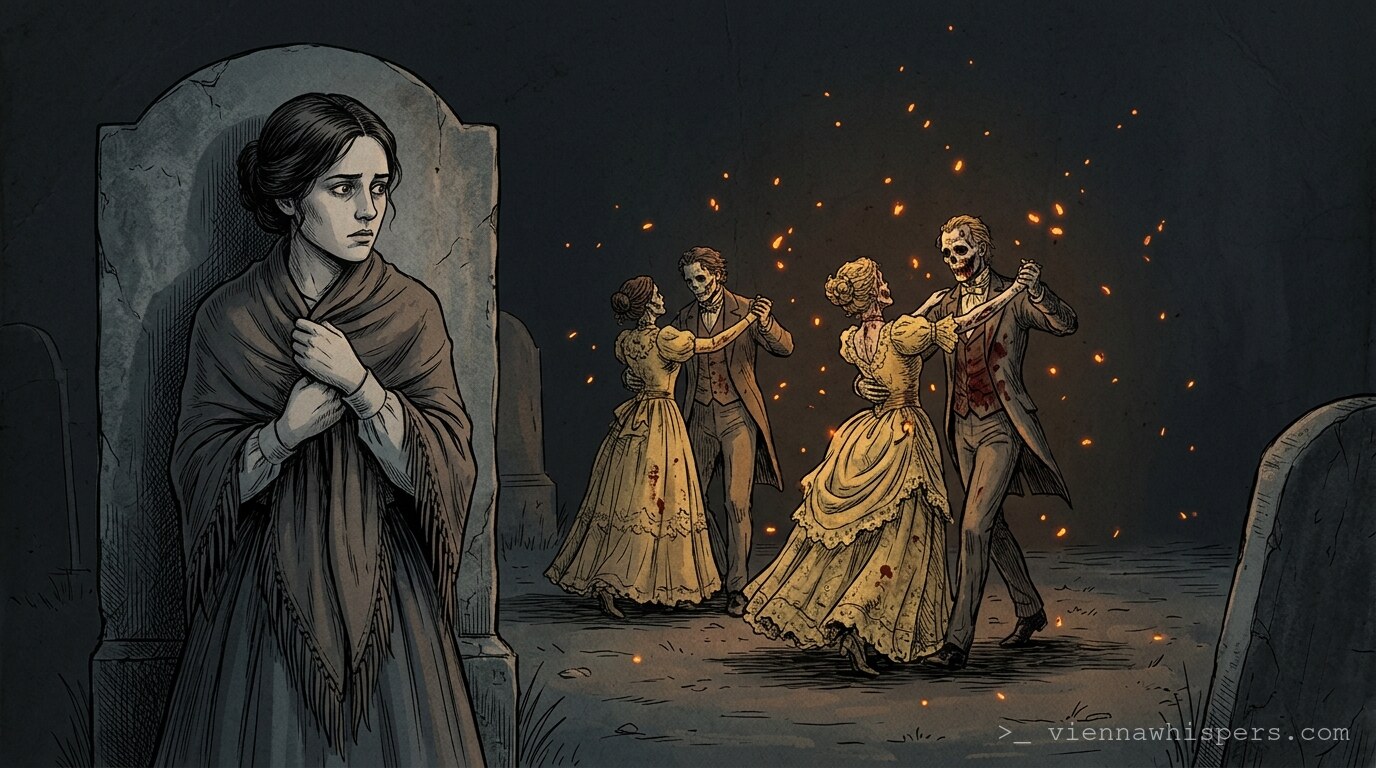
Franziska stood very still, the lantern trembling slightly in her grip. Then the sound began.
It was not a moan, nor the rattling of chains. It was the dry, delicate clack-clack of dancing shoes against wet flagstones, followed by the high, thin scraping of gut strings — like mice chewing on silk. The fog in the clearing thickened, then parted, as if someone had drawn a curtain.
In the center, where the weeds grew thickest, the air itself began to glow with a pale, silver luminescence that bled from the marrow of the tombstones. Dozens of figures materialized, substantial yet ruined. A woman in a gown of yellowed lace moved with the frantic, jerky precision of a marionette whose strings were pulled by memory alone. Her skin had the color of a bruised plum. Beside her, a man in a blood-stained waistcoat argued with a woman in a faded empire dress, his hands moving as if threading an invisible needle.
They were the elite of the forgotten.
Franziska recognized fragments of them from the faded plaques and half-erased names she had traced with her eyes on colder nights. There was the actress whose name had been forgotten even before her funeral mass. There was the inventor who had died in the poorhouse after giving the world the sewing machine. And at the edge of the clearing, leaning on a cane fashioned from a human radius bone, stood an old man in a threadbare tailcoat. His eyes were milky, sightless spheres, yet he stared directly at her.
The music swelled — a thin, scratchy violin melody that sounded like it was being played inside her own bones.
“You’re late,” the old man rasped. His voice was dry leaves skittering over cobblestones. “We have been waiting for a pulse.”
Franziska took one step back. Her heel caught on a root. The lantern swung wildly, casting long, distorted shadows across the dancers.
The old man smiled, his parchment-thin lips stretching until they bled. “The waltz requires a living heart to keep time. Without it, we simply… scatter.” He held out his hand. It was impossibly cold, smooth as marble left too long in the rain. “One night only, Fräulein. One quadrille. Then you may return to your little shack and your four schillings.”
Behind him, the dancers watched her with a hunger that had nothing to do with warmth. Charlotte Wolter, the once-celebrated tragedienne, floated closer, her gown trailing like smoke. Her eyes held a strange, knowing pity. Mozart — or what remained of him — lowered a jagged sliver of wood that had once been a baton and regarded Franziska with the clinical detachment of a conductor evaluating a new instrument.
She felt it then: the terrible arithmetic of the place. They were not celebrating. They were burning off the last dregs of their identities, dancing desperately to keep from dissolving into the black mud. And they needed her — not as a partner, but as fuel. A warm, living battery to keep the music playing for one more night.
The old man with the bone-cane stepped closer. “You are cold, Franziska. You are hungry. You are nineteen and already erased. Here, you would be remembered. At least for the length of a melody.”
For one treacherous second, the offer felt like mercy.
Then she saw it: as one of the young soldiers from 1848 spun past, his form flickered, thinned, and began to flake away like ash. The space he left behind rippled, hungry for something to fill it. The old man’s smile widened.
Franziska shoved the hand away. The cold burned where it had touched her.
She ran.
She ran past the Biedermeier angels with their broken noses, past the grandiose mausoleum of the constipated industrialist, past the cholera trenches where a hundred bodies still lay layered like cordwood. Her boots slammed against the frozen gravel. Behind her, the music rose to a discordant, glass-shattering crescendo, then fractured into silence.
She reached her wooden shack, slammed the door, and bolted it with trembling hands. She sat on the floor, gasping, her breath coming in ragged white plumes. The lantern lay beside her, the flame guttering.
Outside, the cemetery was silent again. The fog had settled, thick and indifferent.
Franziska looked at her hands. The chapping was worse. The skin was red and raw, the knuckles bleeding from the cold. She shivered, a deep, bone-rattling tremor she couldn’t control. She was hungry, and she was poor, and she was entirely, wretchedly alone.
She huddled in the corner, staring at the door.
In the morning, the foreman would come. She would say the night was quiet. She would take her pay, buy her bread, and wait for the next night to fall.
She tucked her hands into her armpits, trying to conserve what little heat remained.
She would never really be warm again.
Support us
Vienna Whispers is free to read. If you enjoy the stories, we’d be grateful for your support.