The Last Concession
July in Vienna does not arrive; it settles. It descends like a damp woolen blanket over the basin of the city, thickening the air until breathing becomes a conscious, slightly exhausting effort. By the time the afternoon sun begins its long, golden descent, the light takes on the consistency of warm honey. It catches in the dust kicked up by passing cars and turns the edges of the buildings the color of old brass.
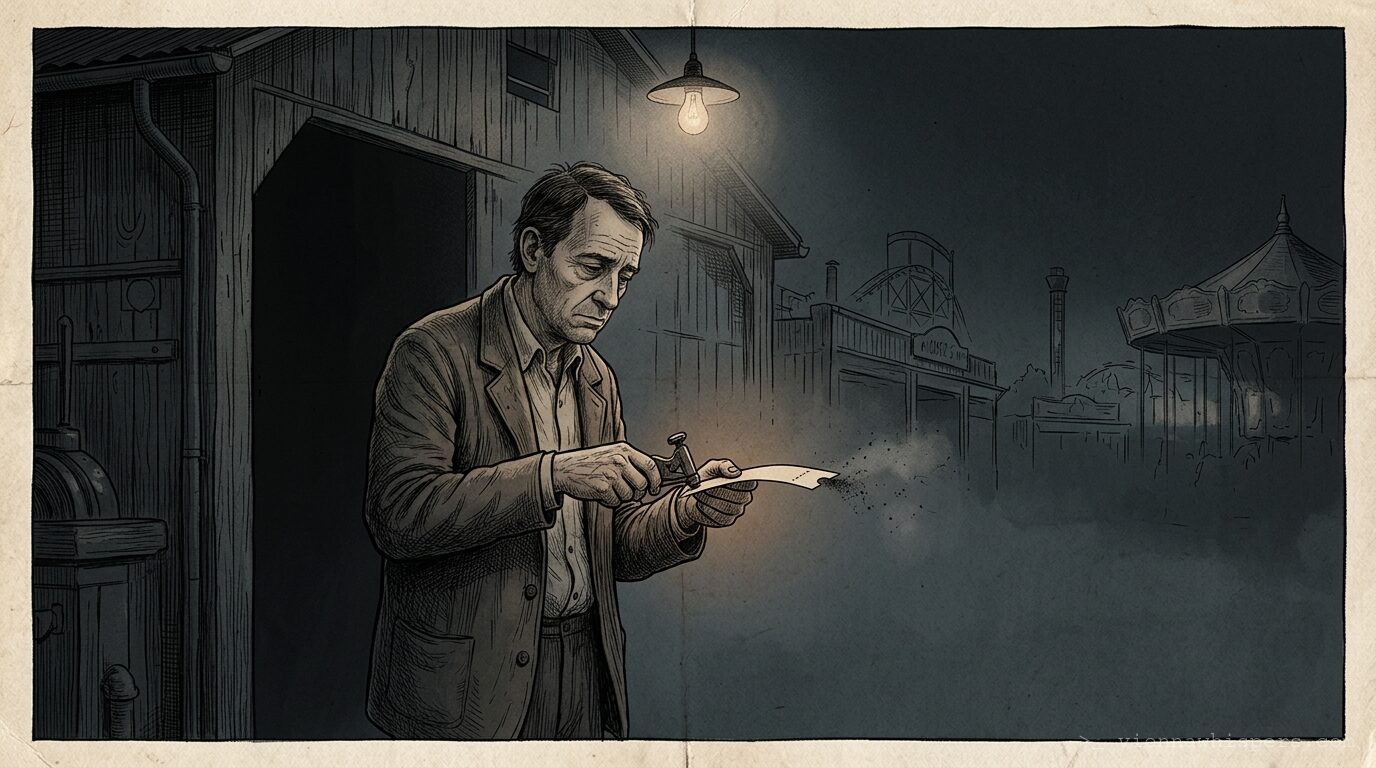
At the edge of the Böhmischer Prater, where the woods begin to reclaim the city’s margins with aggressive weeds and creeping ivy, there is a small, flat-roofed brick shed. It was once a relief depot for the tramway, a place where drivers could smoke a quick cigarette and where a minor clerk sat behind a sliding glass window. The tracks outside have long since been paved over. The asphalt is cracked, though, and if you look closely, the parallel iron spines of the old rails still push through the black crust, refusing to stay buried. Vienna is a city that only takes things away if they are useful. If something is completely useless, it is granted eternal life.
Hubert unlocked the padlock on the shed’s rear door. The lock was seized with rust, but he knew exactly how to angle the key and apply a short, sharp upward jerk. He stepped inside, pulling the heavy door shut behind him to block out the high, irritating whine of a distant carousel playing a synthesized accordion tune.
The air inside the shed was baking hot, smelling intensely of baked dust, pigeon droppings on the skylight, and ancient grease.
Hubert took off his linen jacket, hung it carefully over the back of a crippled wooden chair, and rolled up the sleeves of his short-sleeved shirt. He was seventy-four, a man constructed entirely of right angles and stubbornness. He possessed the specific, rigid posture of a man who had spent forty years wearing a uniform, even though he had been retired for twelve. For four decades, he had worked for the transport authority. He had not been a driver, nor a high-ranking official. He had been a maintenance supervisor for the mechanical validation machines—the heavy, cast-iron beasts that once devoured paper tickets with a satisfying, violent clack.
In the center of the shed, bolted to a heavy wooden workbench, sat the last of them.
It was a Model 4 stationary puncher, enameled in a municipal green that had darkened over the decades to the color of a bruised leaf. When the depot was abandoned in 1998, the transport authority simply locked the doors and walked away. The machine was too heavy to move easily, and too obsolete to repurpose.
Hubert had kept a copy of the key. Every summer, in July, he returned. No one asked him to. No one knew he was doing it. If the property management department had known, they would have sent him a strongly worded letter citing liability issues.
He opened his small leather satchel and took out a rag, a small brass brush, and a glass bottle of machine oil.
Hubert believed, with the quiet fanaticism of a man who lives alone, that machines possessed memory. Not a digital memory—he despised computers—but a physical, kinetic one. To punch a heavy cardboard ticket in a Model 4 required precisely six kilograms of downward force on the lever. The steel teeth bit through the fiber; the ink ribbon snapped against the paper. Hubert believed that energy did not just disappear. It accumulated in the iron casing. Millions of tiny human transactions, moments of permission to travel from one point in the city to another, stored in the metal.
He wiped down the casing. The golden light from the dirty skylight illuminated the dust motes dancing around his head. He applied three drops of oil to the primary hinge. He worked the lever back and forth. It groaned, then smoothed out, moving with a heavy, oiled grace.
Grief, if left entirely to itself, eventually becomes a bureaucratic procedure.
Hubert did not weep for his wife, Traude, who had died twenty-three years ago. He did not visit her grave more than the socially mandated twice a year. He missed her, but he missed her primarily as a structural element of his life. Without her, he was just an old man oiling a dead machine in a hot shed. With her, he had been an old man mildly annoying his wife by oiling a dead machine in a hot shed. The irritation had been the proof of life.
When he was satisfied with the tension of the lever, Hubert reached into his satchel and pulled out a stack of blank, light-blue cardboard tickets. He had liberated three boxes of them from a supply room decades ago. They were stiff and smelled faintly of vanilla and dry rot.
He set the manual dials on the side of the machine. The day: 26. The month: 07. The year: 26. The zone: 100.
He slid the first blank ticket into the narrow slot. He curled his fingers around the black Bakelite handle of the lever. He pulled down.
Clack-ching.
It was a perfect sound. It sounded like order.
Hubert pulled the ticket out and brought it to the light to inspect the mechanical health of the needles. The ink was a pale violet, fading but legible. He adjusted his reading glasses.
He frowned.
He looked at the date ring. He looked at the hole pattern.
The ink on the ticket did not say 26.07.26.
It said 14.08.03.
Below the date, the zone matrix had punched its pattern. It was supposed to be a neat grid of nine tiny holes. Instead, there were eight. The third needle was missing, leaving a blank space. And the number ‘3’ in the year ’03’ had a distinct, jagged chip missing from its upper curve.
Hubert stood perfectly still. The heat of the shed suddenly felt oppressive, pressing against his eardrums.
He knew that chipped ‘3’. He knew that missing third needle.
On August 14, 2003, Traude had taken the tram to the hospital for a biopsy. She had stamped her ticket in a Model 4 at the terminal. That afternoon, they told her about the pancreas. She never took the tram again. She died the way she lived—with an annoyed resignation, as if death were simply a severely delayed D tram.
Hubert had kept her last ticket in his wallet. He had stared at it so often that he had memorized the flaws in the stamp. A few years later, he had personally replaced the defective needles and the chipped date ring in that exact machine, before moving the heavy bastard out to this shed when it was decommissioned.
The needles currently inside the machine were perfect. The date ring was set to 2026.
Hubert ran his thumb over the freshly punched holes. The edges of the cardboard were sharp. The violet ink was still slightly damp.
“Ridiculous,” he said aloud. His voice sounded thin and dry in the dusty room.
He took another blank ticket. He checked the dials. 26.07.26.
He slid it in. He pulled the lever.
Clack-ching.
He pulled it out.
14.08.03. The chipped ‘3’. The missing hole. The shape of a bruised half-moon in the fiber.
Hubert carefully set the ticket down next to the first one. He picked up his screwdriver. He did not panic. He was a mechanic. If the world was behaving incorrectly, it was a mechanical fault.
He unscrewed the faceplate of the machine. He removed the heavy metal housing. The inner workings lay exposed: a complex architecture of gears, springs, and steel pins, smelling of fresh Ballistol.
He checked the date cylinder. The metal numbers staring back at him clearly read 26.07.26. He ran his fingernail over the ‘6’. It was perfectly smooth. He checked the needle matrix. All nine pins were present, straight, and sharply pointed.
He left the faceplate off. He took a third ticket, slid it between the exposed jaws, and pressed the lever down slowly, watching the mechanics engage. The cylinder rotated slightly to meet the paper. The needles pushed through the cardboard.
He withdrew the paper.
14.08.03. The chipped ‘3’. The missing pin.
Hubert exhaled slowly. He briefly considered calling the Wiener Linien customer service line to report a temporal anomaly, but decided they would only transfer him to the department for lost property.
He sat back down on his chair. The golden light from the skylight had deepened to a burnt orange. It hit the metal of the machine, making it look briefly, violently alive.
The machine was not broken. The machine was simply remembering louder than the present could shout.
It held Traude’s last outbound journey. It had absorbed the six kilograms of force she had applied with her small, arthritis-swollen hand on that hot August morning. It had kept it. And now, for whatever reason the iron had decided, it was giving it back.
Hubert looked at the stack of blank tickets.
A normal man would have run. A normal man would have been terrified of the ghost in the gears. But Hubert was Viennese, and he understood bureaucracy.
Traude had stamped an outbound ticket. She had gone to the end of the line, and she had never returned. She was stranded. Her journey was left open, unclosed in the ledger.
It was a violation of the rules.
Hubert picked up a blank ticket. He didn’t bother trying to change the date ring. The machine had made its position clear. He slid the card into the slot. He did not pull the lever.
He thought of her face that morning twenty-three years ago. She had been wearing a terrible floral blouse that she bought on sale, a blouse he had hated and she had worn precisely because he hated it. He realized, with a sudden, uncomfortable clenching in his stomach, that he did not want her back so they could speak of love. He wanted her back so he could complain about the heat, and so she could tell him to stop whining and drink a glass of water.
He needed to validate a return journey. He needed to stamp a ticket that matched hers, so he could board the same phantom tram, on the same phantom date, and ride it out to the hospital to bring her home.
He closed his eyes. He wrapped his hand around the black Bakelite handle. He tried to mimic the exact force she would have used. Not his own heavy, mechanical pull, but a sharper, more irritable jerk.
He pulled the lever.
Clack-ching.
He kept his eyes closed for a long moment. The cicadas in the weeds outside had begun their evening screaming, a sound like a thousand tiny needles vibrating against metal.
He opened his eyes and looked at the ticket in his hand.
It read 26.07.26. The matrix was a perfect, unbroken square of nine holes.
Hubert stared at it. The present tense. The machine had reverted.
He shoved another ticket in, yanking the lever down hard.
26.07.26.
He grabbed another. And another. He fed them into the slot in a frenzy, his breath whistling through his nose, his elbow protesting with sharp spikes of pain.
Clack-ching. Clack-ching. Clack-ching.
26.07.26.
26.07.26.
26.07.26.
A pile of perfectly valid, utterly useless present-day tickets began to accumulate on the dusty workbench, spilling over the edge and fluttering to the concrete floor.
The iron had closed the window. It had offered him a glimpse of her outbound train, and then it had shut the doors in his face. It was not a magical conduit. It was just a machine that had momentarily forgotten what year it was, and had now corrected itself.
Hubert stopped. His arm was trembling. His shirt was glued to his back with sweat.
The shed was growing dim. The golden hour had passed, leaving behind the heavy, bruised purple of early twilight.
He looked down at the three tickets bearing the date of 2003. They lay neatly in a row on the bench, separate from the scattered mess of the present.
Slowly, his breathing slowed. He wiped his forehead with his oily rag, leaving a dark streak across his brow.
He picked up the three 2003 tickets. He placed them carefully in his satchel, slipping them into the interior zipper pocket next to his wallet.
He did not put the faceplate back on the machine. Let the dust get in. Let the gears seize up. He didn’t care anymore.
Hubert picked up his linen jacket. He walked to the door, pulled it open, and stepped out into the humid evening. He locked the rusty padlock behind him, taking the key and dropping it straight down into the storm drain grid by the corner of the shed. It made a tiny, final splash in the dark water below.
He walked away toward the tram stop, carrying three tickets for a train that had departed twenty-three years ago, fully intending to wait on the platform until it arrived.
Support us
Vienna Whispers is free to read. If you enjoy the stories, we’d be grateful for your support.