The Midnight Passenger
The meter ticked with the dull, mechanical heartbeat of a city that had long stopped caring about the cost of anything. It was 3:14 a.m. on a Tuesday in 1987. I was leaning against the hood of my Mercedes, nursing a lukewarm coffee, when the man stepped out of the shadows of the Soviet War Memorial.
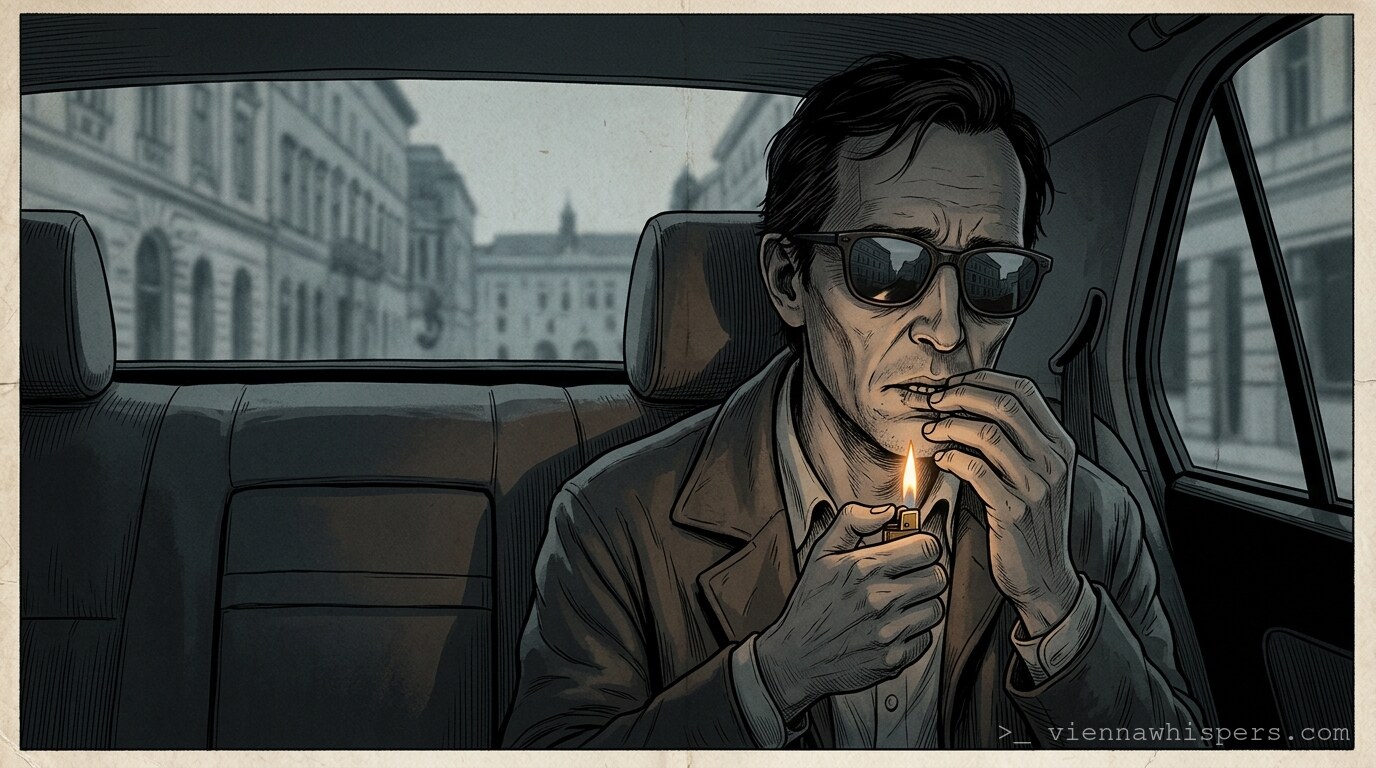
He didn’t hail me. He simply opened the rear door and slid inside, a silhouette of sharp angles and expensive, slightly rumpled fabric. His collar was turned up against the damp, and even in the gloom, the lenses of his sunglasses held the reflection of the passing world like two opaque, dark pools.
I didn’t need to see his face. We have a way of recognizing our own in Vienna — especially those the city has already begun to chew up and spit out.
“Just drive,” he said. His voice was a rasp, filtered through cigarette smoke that smelled of clove and something chemical. “Once around the city. Keep the lights low.”
I engaged the gear. The leather seat creaked beneath his shifting weight. In the rearview mirror, his eyes were static, unblinking, fixed on the passing geometry of the buildings.
We pulled onto the Ringstraße. The parliament building looked like a tomb, cold and neoclassical. He leaned forward, his reflection trapped in the mirror — a mask of bravado that, in the harsh neon of the shop windows, looked like a death mask.
“Amadeus,” he whispered, the name of his own albatross. He chuckled, a dry, jagged sound. “People think it’s a song. It’s a cage. A golden cage, and the bars are made of record sales and cocaine dust. Rock me, they say. I’d rather they just let me sleep.”
He reached into his pocket and pulled out a gold lighter, turning it over in his manicured fingers. His nails were bitten to the quick — a child’s habit kept into middle age. He flicked it once, the brief orange flare illuminating the hollows of his cheeks.
“You like the fame, then?” I asked, eyes on the road.
“I like the noise,” he said, exhaling a plume of grey. “I like the way the crowd screams because they’re terrified of the silence. Vienna… she’s a beautiful, decaying old dame, isn’t she? She knows how to bury you in velvet. She loves the tragedy. Sie liebt den Untergang.”
We circled the inner city. The ride was a slow-motion orbit of his own obsolescence. Every street corner carried the ghost of his younger self, desperate to be noticed, and the ghost of his future self, already decomposing under a desert sun.
When we reached Schwarzenbergplatz again, he tapped the glass divider. “Here.”
I pulled over. The meter clicked to a stop. He didn’t ask for a receipt. He reached into his coat and slapped a thick wad of banknotes onto the seat — far more than the ride was worth.
“Keep the change,” he said.
He opened the door. The cold air rushed in, smelling of exhaust and frozen dust. For a moment he paused, one foot on the pavement, his silhouette framed by the harsh glare of a streetlamp.
“You’ll be alright?” I asked.
He didn’t look back. The sunglasses masked his eyes, but his mouth was set in a line of weary, jagged arrogance.
“I am an Austrian export,” he said, his voice drifting into the gloom. “We don’t get to be alright. We just get to be remembered.”
He walked toward the darkness of the trees, his stride uneven, shoulders hunched against a winter that had not yet arrived. I watched him until the shadows swallowed his coat.
I sat there for a long time. The meter remained blank. My hands were shaking, not from the cold, but from the realization that I had spent the night driving a man who was already mourning his own funeral.
I looked at the money on the seat. It was crisp, clean, and entirely useless.
I put the car into drive and pulled away. The engine coughed once, twice, before settling into its mechanical hum. I drove until the sun began to bleed over the rooftops, turning the gold of the city into the dull, rusted copper of another working day.
I never saw him again.
But for weeks, I found myself smelling clove and burnt hair every time I opened the door.
Support us
Vienna Whispers is free to read. If you enjoy the stories, we’d be grateful for your support.