Eight Hours That No Longer Exist
The building in Favoriten has been feeding for one hundred and thirty-six years.
It is a classic Zinskaserne, red brick on the outside, damp bones on the inside. Built to house the labor that fed the empire’s machines, it has never stopped consuming. The walls still carry the soot of 1890 in their pores and the sterile hum of 2026 in their wiring. It does not choose between coal smoke and server heat. It simply digests whatever exhaustion its inhabitants offer.
At 5:30 a.m. in 1890, the factory siren does not wake Josef. It flays him open.
The sound slices through the thin walls and vibrates directly into his ribcage. His bones answer before his mind does — a dull, metallic resonance that travels from sternum to spine. He sits up in the shared room that smells of unwashed wool, sour breath, and the iron filings that never quite leave his skin. His shoulders are already heavy with the memory of yesterday’s labor. Sixteen hours stand between him and the next brief death called sleep. He pulls on his boots like a man putting on his own coffin lid.
The gaslight in the courtyard is sick, yellow, flickering. It makes every movement look like it is already failing.
In 2026, at exactly the same minute, there is no siren. Only silence and light.
Anna sits at her standing desk in what used to be the same dormitory room, now marketed as “authentic industrial loft.” The blue-white glow of four monitors washes her face until her skin looks like thin paper held against a bulb. Her body has barely moved in twelve hours, yet her nervous system feels flayed. There is no muscle ache, only a constant, wet-copper flickering behind her eyes — synaptic exhaustion without the honesty of physical labor. She has generated more content in one night than Josef’s entire shift could have produced in a week. And still the system demands more.
The building watches both of them with the same indifferent hunger.
It remembers the rhythmic pounding of steam hammers that once shook its foundations. It remembers the wet coughs of metalworkers who died before forty. Now it feels the low, constant heat of servers and the faint ozone of overheating laptops. It does not care which form the exhaustion takes. It only collects.
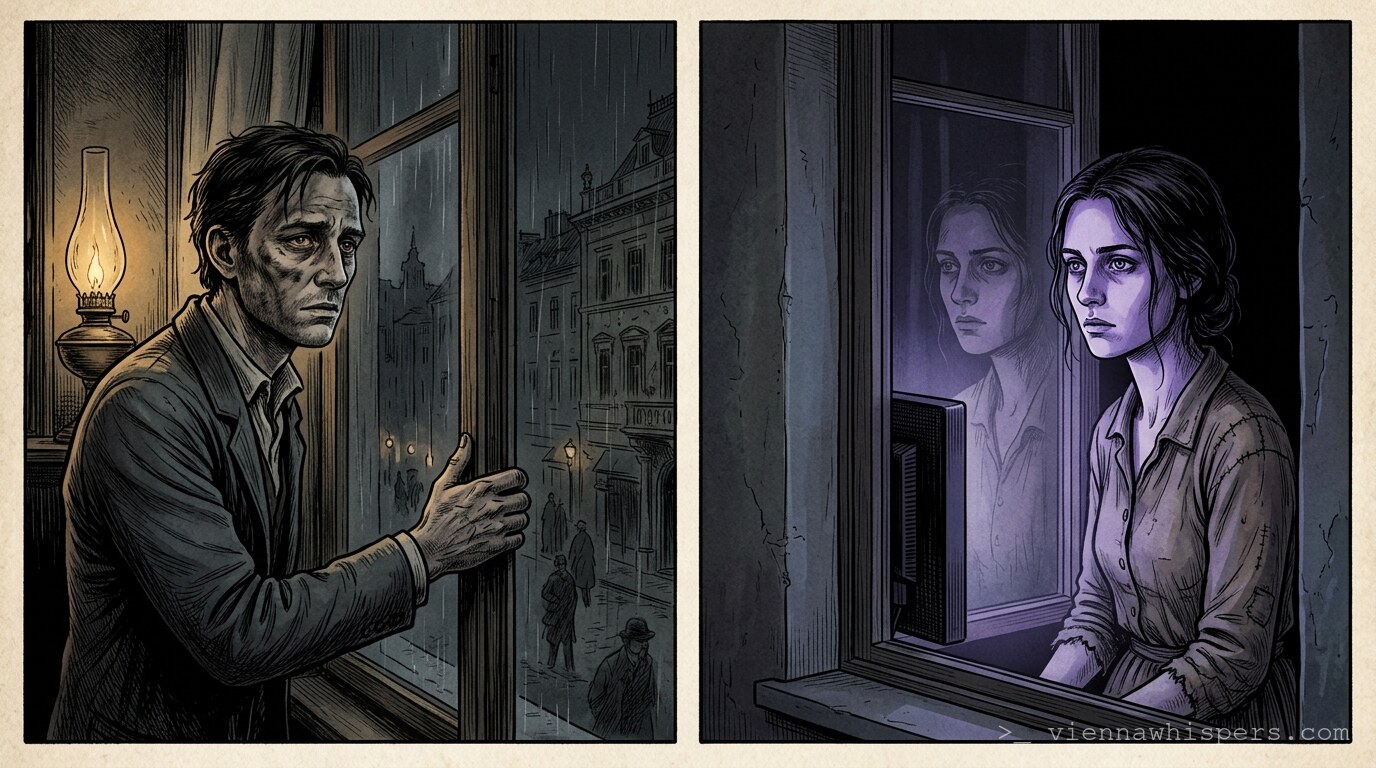
Josef stands at the window in 1890. His breath fogs the glass. Below, workers shuffle toward the factory gates like cattle already half-slaughtered. Their time is measured in shifts, in bells, in the brutal arithmetic of survival. Eight hours were promised once. They were never delivered.
Anna stands at the same window in 2026. Her reflection is pale and distorted against the dark brick opposite. Her time is borderless. There is no shift, only flow. She can do the work of fifty men, yet she cannot find eight honest hours of rest. The exhaustion has moved inward — from bones to synapses, from muscle to mind.
The building settles with a soft, creaking groan that sounds almost satisfied.
At 5:30 a.m., exactly one hundred and thirty-six years apart, both Josef and Anna feel the same invisible weight press down on them.
Anna reaches out and touches the wall near the baseboard. Her fingertip finds the old smudge of machine grease — a dark, carbon-heavy thumbprint that has survived every renovation, every coat of paint.
For one merciless second the room is no longer 2026. The damp brick exhales the stench of coal smoke and scorched wool. She hears the siren — not as memory, but as a physical blow inside her skull. Her ribs vibrate in sympathy with a sound that died over a century ago. Her shoulders tighten with the phantom weight of iron filings. For that single breath she is Josef: lungs full of soot, hands already bleeding, sixteen hours of mechanical hell stretching out like an open grave.
Then it is gone.
She pulls her hand back as if burned. The wall is cold again. Only the faint, oily residue remains on her skin.
Anna stares at her monitors. Three thousand iterations of marketing copy have already been generated while she touched the past. She has done the labor of an entire factory floor before most people have finished their first coffee. She should feel victorious. Instead she feels hollowed out, a ghost operating a machine made of her own nervous system.
Josef fought for eight hours. Eight honest hours that would belong to the worker, not the machine. They marched, they struck, they bled for it. And they lost. The promise was broken before the ink was dry.
Anna has inherited the victory. She works when she wants. She works when she doesn’t. She works in the shower, in dreams, in the three seconds between thoughts. There is no siren to tell her when the day ends because the day never ends. Her exhaustion has no muscles to ache — only synapses that burn quietly in the dark.
She looks at the timestamp: 5:32 a.m.
Two minutes past the old starting time.
Outside, Vienna is preparing for the 1st of May — parades, speeches, red flags, ritualistic nostalgia for the eight-hour day that was never truly delivered. The irony is almost too perfect to be funny. The building itself seems to sneer at the idea.
Anna closes her laptop. The screen goes black, reflecting her own tired face like a verdict.
The building settles with a soft, satisfied creak of old wood and new steel. It has fed on Josef’s bones and now it feeds on Anna’s attention. Different fuel. Same appetite.
Somewhere in the walls, the echo of the 1890 siren and the first gentle ping of a 2026 notification fold into each other — two sounds, one century apart, both demanding the same thing:
More.
The debt was never paid. It was only refinanced.
Support us
Vienna Whispers is free to read. If you enjoy the stories, we’d be grateful for your support.