The Evidence Room
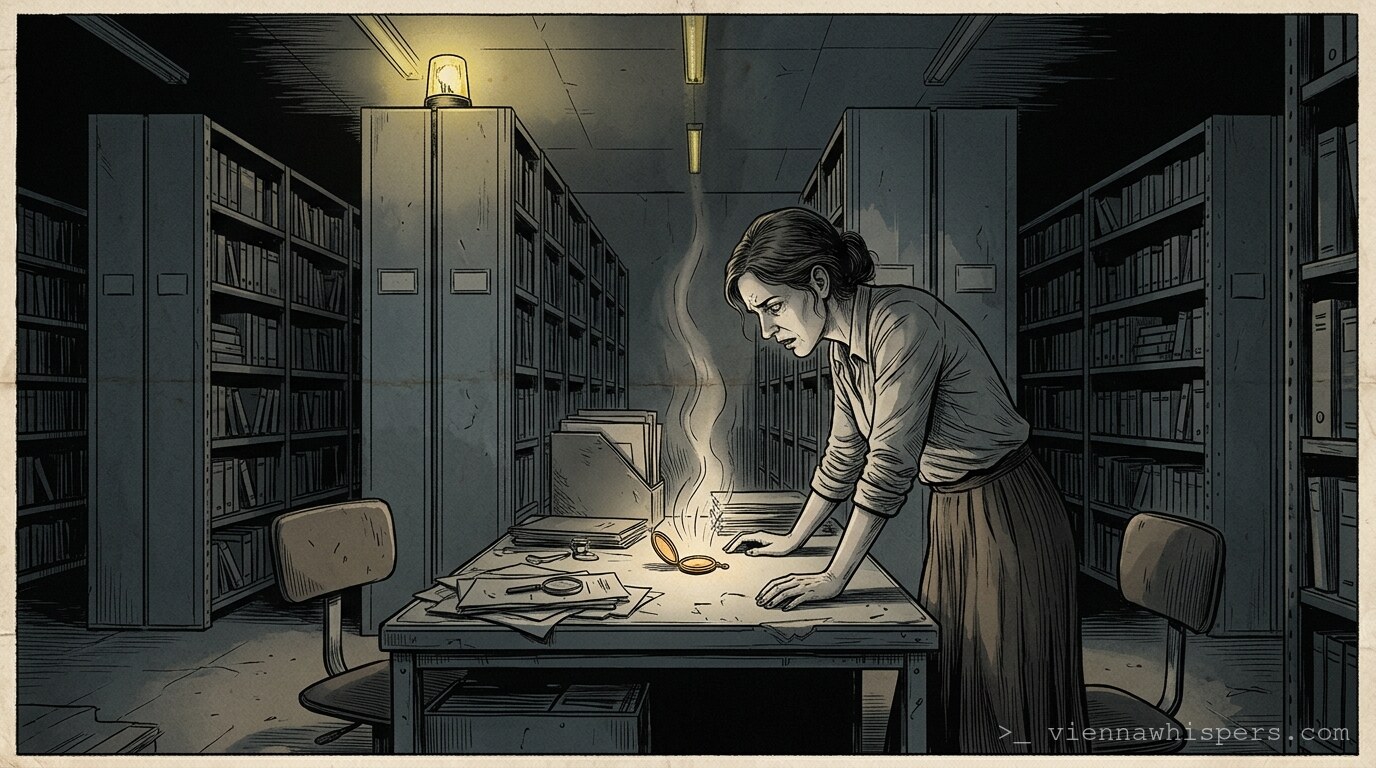
Lisi Haber, forty-nine years old and sustained primarily by stale Manner wafers, bitter coffee, and twenty-seven years of accumulated professional resentment, stared at the silver cigarette case lying on her desk. It was dented at the left corner and still warm — the kind of warmth that suggested it had only moments ago been pressed against someone’s frantic pulse.
The year was 2033. The police evidence archive beneath the Landespolizeidirektion had been renovated into a climate-controlled bunker with automatic inventory drones and perfect lighting. None of it changed the fact that it still smelled of wet wool, old blood, failed investigations, and the particular despair of Viennese bureaucracy at three in the morning.
Lisi picked up the case. She knew it immediately. It belonged to the Arndt file — a suicide-or-maybe-not from three years ago that had never quite added up. According to the digital manifest it was still safely sealed in Box 88-Beta, three kilometers of shelving and several security doors away. Yet here it was, radiating heat like a living thing.
She opened it. One cigarette remained inside, smelling of Turkish tobacco and the specific, sour nervousness of a man who realizes too late that the game is over. Lisi rolled it slowly between her gloved fingers, then tossed the entire case into the incinerator chute with the casual indifference of someone who had long stopped believing that protocol mattered when it became inconvenient.
Ten minutes later her terminal chimed softly.
Discrepancy detected in Inventory 402-A. Item: Personal gold locket, confiscated 2018. Status: Missing.
Lisi sighed, the sound disappearing into the long, silent rows of metal shelves. She walked down the aisle anyway, came back, and found the locket lying neatly in the center of her desk, open. Inside was a photograph of her ex-husband, taken on the morning he told her that her cynicism wasn’t a personality trait but a form of emotional rigor mortis. The metal was hot enough to sting her palm.
She sat down slowly. Her knees clicked like old typewriter keys.
A little later, while she was looking away, her dead partner’s favorite pen appeared — the heavy one he used to tap against his teeth when he was thinking. The moment she touched it, it snapped cleanly in half with a dry, final sound.
Lisi leaned back in her creaking chair and lit the Turkish cigarette she had tried to destroy earlier. The smoke curled upward in lazy, mocking spirals toward the ventilation grate.
She was not being haunted. She was being catalogued. Piece by piece.
The ventilation fan hummed its indifferent rhythm above her. Somewhere deeper in the dark aisles a quiet, wet sound echoed — like a match striking, or perhaps a heart giving up for good. Lisi didn’t turn around. She had been a detective long enough to know that when the evidence starts arriving before the crime, there is very little point in running.
She took another drag, tasting ash and old regret, and watched as the gold locket slowly began to melt into a dark, glistening pool on her desk. It was, she thought with a kind of tired amusement, a remarkably efficient way to clear shelf space.
She wondered, almost idly, whether the incinerator would take her next, or whether she would simply be folded into a cardboard box one day, mislabeled as Case 000: Unclaimed Regret.
The fan skipped a single beat. The silence that followed was heavy, patient, and entirely unimpressed by her existence.
Lisi Haber waited for the next item to arrive. She didn’t bother checking her pockets. There was no need.
It was probably already there.
Support us
Vienna Whispers is free to read. If you enjoy the stories, we’d be grateful for your support.