The First Time I Realized the City Was Older Than Me
The packing tape gave way with a long, synthetic shriek that tore a strip of silence out of the room. It bounced off the four-meter ceilings and died somewhere near the stucco rosette.
I was twenty-four. Three hours earlier, a landlord with a smoker’s cough and a silk tie had handed me a brass key heavy enough to double as a weapon. It was my first real apartment. Ottakring. Three flights up, no elevator, overlooking a street where the 44 tram ground metal against metal every seven minutes.
At twenty-four, you suffer from the terminal delusion that you are the first person to ever truly experience life. I had carried my cardboard boxes up those stone stairs with a grim, heroic purpose. My hands were gray with the specific, greasy dust that accumulates only in Viennese stairwells—a compound of floor wax, damp cellar wood, and a phantom trace of Tuesday’s goulash. I had arranged my boxes of poorly folded sweaters, my cheap Ikea glasses, and my unread paperbacks to project a personality I did not yet possess. I was entirely exhausted by the sheer weight of my own potential. I thought the walls were waiting for me.
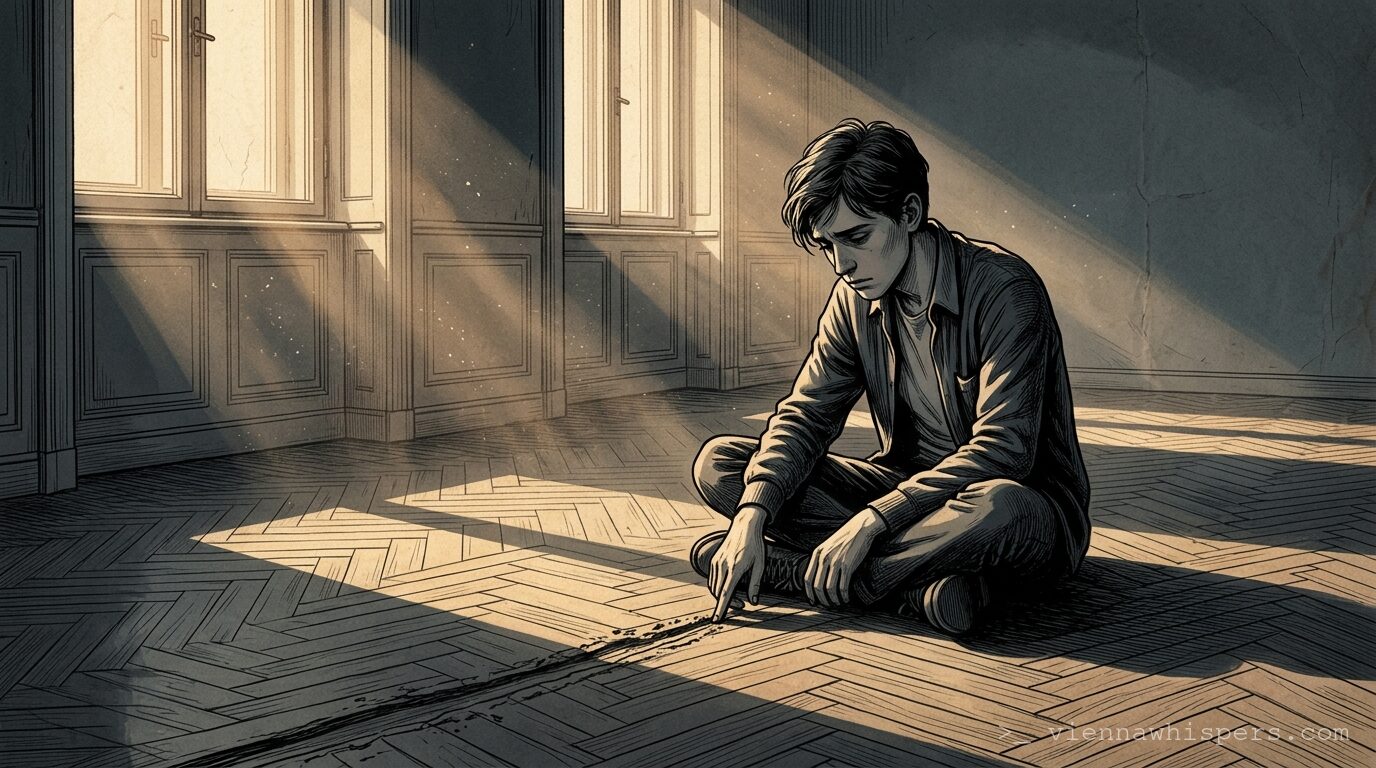
It was late October. The golden hour had just breached the tall Kastenfenster, the double windows that rattled gently whenever a truck passed. The light came through thick and syrupy, casting long, distorted squares across the floor. It illuminated the dust motes, turning them into a suspended galaxy of dead skin and pulverized brick hanging motionless in the cold air.
I sat back on my heels, my hands resting on my thighs. My knees ached.
I looked down. The parquet was arranged in a classic herringbone pattern, but it was uneven. I traced the wood with my index finger. Right near the corner of the window, there was a smooth, shallow dip in the oak. It was a depression worn into the solid wood by decades of friction. By human weight.
Someone had stood there. A lot.
I looked closer at the window frame. Beneath the flaking topcoat, there were geological strata of paint. White, then a sickly cream, then a pale, hospital green, then white again. Trapped in the layers were microscopic bristles from a cheap brush used in 1982, a speck of ash from 1954, a stray hair from 1930.
I did the math. The building went up in 1904. One hundred and twenty years.
The air in the room suddenly shifted, becoming incredibly dense. Not haunted. Vienna does not do ghosts; it does bureaucracy and residue. But I felt the suffocating, physical mass of the time that had pooled in these forty-two square meters.
People had died in this room. That was a statistical certainty. People had screamed at each other until their throats bled, throwing porcelain against the very wall where I planned to hang a framed poster of a band that would be forgotten in three years. They had wept over telegrams on a Tuesday morning. They had chopped up the wardrobe to burn in the stove when the coal ran out in 1946. They had cooked desperate, watery meals out of potato peels, and they had conceived children they couldn’t afford on a mattress placed exactly where my taped-up boxes now sat.
There had been a man in this room with a darker, more magnificent ruin in his soul than my petty, therapy-polished anxieties about finding a job in graphic design. There had been a woman who loved with a ferocity that would have burned my cautious, heavily curated heart to ash. There had been laughter here, loud and unmannered, echoing off the stucco—stucco that was now thick with a century of paint, the sharp edges of the floral pattern softened into pale, tumorous lumps.
I realized, with a sudden and staggering clarity, that I was profoundly mediocre.
I was not the start of a story. I was not the protagonist of this space. I was just the newest, thinnest coat of paint. In ten years, or three, I would pack my boxes, hand back the heavy brass key, and the apartment would instantly forget my name.
A short, breathy sound escaped my throat. A laugh, though it sounded slightly like a cough in the empty room.
It was funny. The absolute, staggering arrogance of thinking I was going to leave a mark on a building that had survived the collapse of an empire, two world wars, and four currencies. I was nothing but a temporary custodian of the floorboards.
I looked at the half-open box beside me. Inside were three frying pans and a stack of stiff towels. I was supposed to unpack. I was supposed to drag the rolled-up mattress away from the wall and assemble my bed before the sun dropped behind the Wilhelminenberg and the room turned freezing cold. That was the logical, necessary next step of adulthood.
Instead, I lay down.
I stretched out fully clothed on the bare, dusty parquet, shifting my weight until my right hip fit perfectly into the shallow, worn dip by the window. The wood was brutally cold against my ribs, but it cradled me. It made absolutely no sense to lie in the dirt of a century when a clean mattress was five feet away, but I did not want the mattress. I wanted the floor.
The pressure to be extraordinary drained out of the back of my skull and vanished into the oak. The desperate, exhausting need to matter simply evaporated.
The radiator pipes clucked like a flock of iron chickens, beginning to expand with the evening heat. Down on the Neulerchenfelder Straße, the tram rattled past, sending a microscopic tremor up through the foundation, through the bricks, and into my teeth. It was a rhythm the building knew by heart. I closed my eyes and let the dust settle on my skin.
Support us
Vienna Whispers is free to read. If you enjoy the stories, we’d be grateful for your support.