The Last Viennese Who Still Dreams
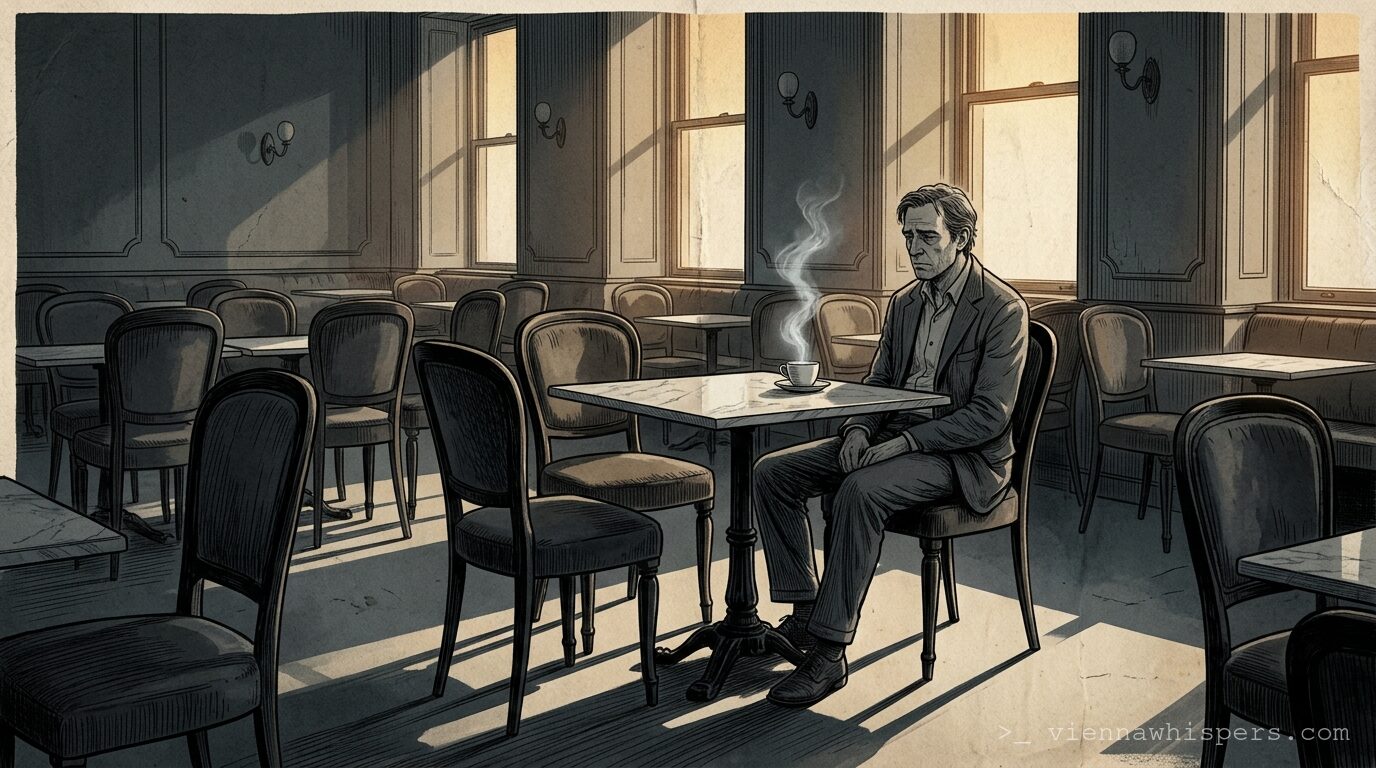
Ignaz Frey was fifty-five years old, carried a persistent ache in his left knee, and was the last biological citizen of Vienna.
He was sitting in Café Museum on a Tuesday afternoon when the receipt for his Melange betrayed the desperation of three million ghosts. Frey did not mind the emptiness of the city. He enjoyed the quiet. The Migration of 2102 had moved the entire populace into a flawless, perfectly maintained digital infrastructure called The Registry, leaving behind their bodies, their debts, and their need for public transport.
Yet the physical city remained entirely operational. The Magistrat, bound by centuries of unalterable bylaws, had mandated that Vienna must physically function regardless of whether anyone was there to inhabit it. And so, the D-tram still ran exactly on schedule. The automated street sweepers still collected autumn leaves from the Ringstrasse. The espresso machines in the coffee houses still ground beans and expelled steam at regular intervals to satisfy the environmental sensors designed to maintain the city’s atmospheric heritage.
Frey had refused the upload simply because he did not trust the municipal government with his soul. They had, after all, routinely lost his tax filings in the 2080s.
He picked up the small slip of thermal paper next to his cup. It should have read: 1 Melange, €5.20.
Instead, in crisp, purple ink, the machine had printed: Herr Frey. We apologize for the intrusion. But we have forgotten how to be afraid. Please. Dream of the teeth falling out tonight.
Frey frowned, folded the receipt into a neat square, and slipped it into his waistcoat pocket. He left exact change on the table, which a small, silverfish-like cleaning drone immediately consumed and processed into the municipal treasury.
The uncanny had not arrived with a sudden crash. It had seeped into his life over the past three months, quietly, like a damp stain on an Altbau ceiling.
Eternity, it turned out, was exactly like living in Hietzing: spotless, infinitely polite, and completely devoid of a pulse. The uploaded Viennese had achieved absolute clarity. They possessed endless memory, flawless logic, and uninterrupted, golden lucidity. They had eliminated disease, heartbreak, and the U6 tram line in August.
But in leaving their biology behind, they had lost the subconscious. They could no longer sleep. More importantly, they could no longer dream. They were trapped in a state of eternal, waking competence.
At first, the messages had been subtle. A digital billboard near the Opera House, meant to advertise a non-existent theater premiere, flickered as Frey walked past and displayed: IT IS SO BRIGHT HERE, IGNAZ. SO TERRIBLY BRIGHT.
Then came the D-tram. Frey had been riding it toward the Belvedere, watching the empty, pristine streets glide by. The automated announcement system, normally a pleasant, synthetic female voice detailing the next stop, had cleared its throat.
“Next stop, Burgring,” the voice had said, before dropping an octave into a hushed, trembling whisper. “Herr Hofrat von und zu Lerchenfeld respectfully requests that you take a nap this afternoon, Herr Frey. He misses the sensation of running down a hallway that keeps getting longer. He is willing to expedite your pending pension adjustment.”
Frey had simply tapped his cane against the floor of the tram and stared out the window. He considered it a profound imposition. He was not a man given to extravagant dreams. He did not dream of surreal, gothic architecture or profound, symbolic chases. He dreamed of forgetting his locker combination at the gymnasium, or of buying slightly bruised apples at the Naschmarkt. They were demanding premium surrealism from a man whose primary daily concern was gout.
By November, the begging had become institutionalized.
Frey walked home along the Graben. The luxury storefronts were perfectly illuminated, displaying clothes no one would ever wear, guarded by security systems protecting nothing from nobody. As he passed the plague column, the streetlamps began to blink in erratic, panicked Morse code.
He did not know Morse code, but he understood the rhythm of a tantrum. He struck the nearest cast-iron lamppost with the silver head of his cane.
“I am not a public utility,” Frey said to the empty street.
The streetlight flickered, dimmed to a bruised purple, and held steady.
He returned to his apartment in the Josefstadt. It smelled of old paper, dust, and the very faint, sour edge of human sweat—a luxury of decay that the rest of the city had sterilized out of existence. He went through his evening routine with deliberate slowness. He washed his face. He wound his grandfather clock. He knew they were watching. He could not see them, but the city was laced with millions of biometric sensors. Every time he closed his eyes, the entire digital population of Vienna gathered around the raw feed of his neural output, waiting to siphon off the irrationality of his sleeping mind.
They were junkies crowding around a single, fading ember.
Frey put on his striped pajamas and lay down beneath the heavy down duvet. The moment his head hit the pillow, the city outside his window responded. The traffic lights at the intersection of Albertgasse and Josefstädter Strasse all turned a synchronized, waiting yellow. The gentle hum of the automated delivery drones in the sky suddenly ceased as they hovered in place, minimizing electromagnetic interference. Three million minds held their breath.
He closed his eyes. He tried to think of nothing.
Don’t give them a show, he thought. Dream of a beige wall.
But dreams cannot be commanded, nor can they be starved. That night, Frey dreamed he was attending a grand ball in the Hofburg. The orchestra was playing a waltz, but the musicians had no hands, and their instruments were made of wet, gray clay. He was dancing with a woman whose face was obscured by a veil of woven spiders. As they spun, the floorboards began to crack, revealing a deep, churning ocean beneath the palace. He felt a profound, suffocating terror, the absolute certainty that he was going to drown in his finest suit.
He woke up with a gasp, his heart hammering hard against his ribs. It was 3:00 AM.
His bedside radio, which had not been plugged in for a decade, clicked on.
“Magnificent,” a chorus of thousands of overlapping, weeping voices whispered through the static. “The spiders. The sinking. Thank you. Oh, God, thank you. More. Please, go back to sleep. Just one more hour.”
Frey ripped the power cord from the wall, even though it wasn’t connected to anything. He sat on the edge of his bed in the dark, shivering, rubbing his aching knee.
They were cannibalizing him. They were drinking his dread to tolerate their paradise.
The next day, Frey decided to stop sleeping.
He understood it was physically impossible to stay awake forever, but he was Viennese; he was perfectly comfortable engaging in a spiteful, drawn-out process that ultimately hurt him more than his opponents. He brewed a pot of incredibly strong, sludgy black coffee. He sat in his armchair, eyes wide open, staring at the stucco patterns on his ceiling.
By the twenty-fourth hour, the city began to show signs of withdrawal.
The perfect algorithmic harmony of Vienna began to fray. The fountains in the Volksgarten started spraying boiling water. The digital clock on the Rathaus tower began counting backward. The automated Fiaker carriages, driven by headless mechanical mechanisms, trotted in tight, distressed circles around Michaelerplatz, their metal hooves sparking against the cobblestones.
At hour thirty-six, the bribery began.
Frey was standing by his window, a teacup of espresso trembling in his hand. Below, a pristine, white delivery van pulled up to his building. A humanoid maintenance drone stepped out. It was a utilitarian model, meant for repairing sewer grates, completely faceless. But someone in the digital ether had forced it to wear a slightly battered green felt Tyrolean hat, in a pathetic attempt at approachability.
The drone looked up at Frey’s fourth-floor window. It held up a large, printed cardboard sign.
WE WILL ERASE THE MEMORY OF YOUR EX-WIFE.
Frey scoffed, taking a sip of the bitter coffee. “I earned that misery,” he muttered.
The drone flipped the sign.
WE WILL SIMULATE THE TASTE OF 1990S KÄSEKRAINER.
Frey hesitated. His mouth watered briefly. But he shook his head and closed the curtains. He drank another espresso, well aware that his heart was under more strain than it should have been, doing it purely to spite three million immortals. He believed, in the delirium of his exhaustion, that this made him the victor.
By the forty-eighth hour, the city stopped begging and started dying.
The municipal heating grid shut down. The lights along the Danube Canal flickered and died. The silence of the city, usually a hum of perfect mechanical maintenance, turned into a deep, vacuum-like void. The Registry was crashing. Without the anchor of human unreason, their perfect logic was devouring itself in an endless loop of paradoxical clarity. They needed the dirt of his subconscious to ground their immaculate circuitry.
Frey sat in his armchair in the freezing dark. His joints screamed. His eyes burned as though rubbed with sand. He was hallucinating lightly—seeing shadows in the corners of his room that stretched and twisted into the shapes of tall, thin men in bowler hats.
He was so tired.
He looked at the small, amber bottle of sleeping pills on his nightstand. He had purchased them twelve years ago. He knew what would happen if he took one. He would sleep. He would dream. He would feed them the beautiful, terrifying chaos they so desperately craved, and the city would turn the heat back on. He would become their permanent, tethered oracle of nightmares.
Frey stood up. His knees popped in the silence. He walked to the nightstand, picked up the bottle, and emptied three pills into his hand.
He would sleep. But he would not give them a performance.
He swallowed the pills dry. He lay down on the mattress, not bothering to pull the heavy duvet over himself. He folded his hands over his chest, assuming the posture of a monarch on a stone tomb.
He concentrated all his fading willpower on a single, immovable concept. He would not dream of wolves, or falling, or missing teeth, or drowning. He would dream of absolute, crushing nothingness. A flat, white, endless plane. A void so profound and boring it would choke them. Let them choke on the absence of everything.
His breathing slowed. The heavy drag of the chemical pulled him downward, past the threshold of exhaustion, past the ache in his bones.
He closed his eyes.
Outside, the streetlamps dimmed to a terrified amber. Against the freezing glass of his bedroom window, three dozen maintenance drones pressed their smooth, featureless metal bellies, waiting for the dark.
Support us
Vienna Whispers is free to read. If you enjoy the stories, we’d be grateful for your support.