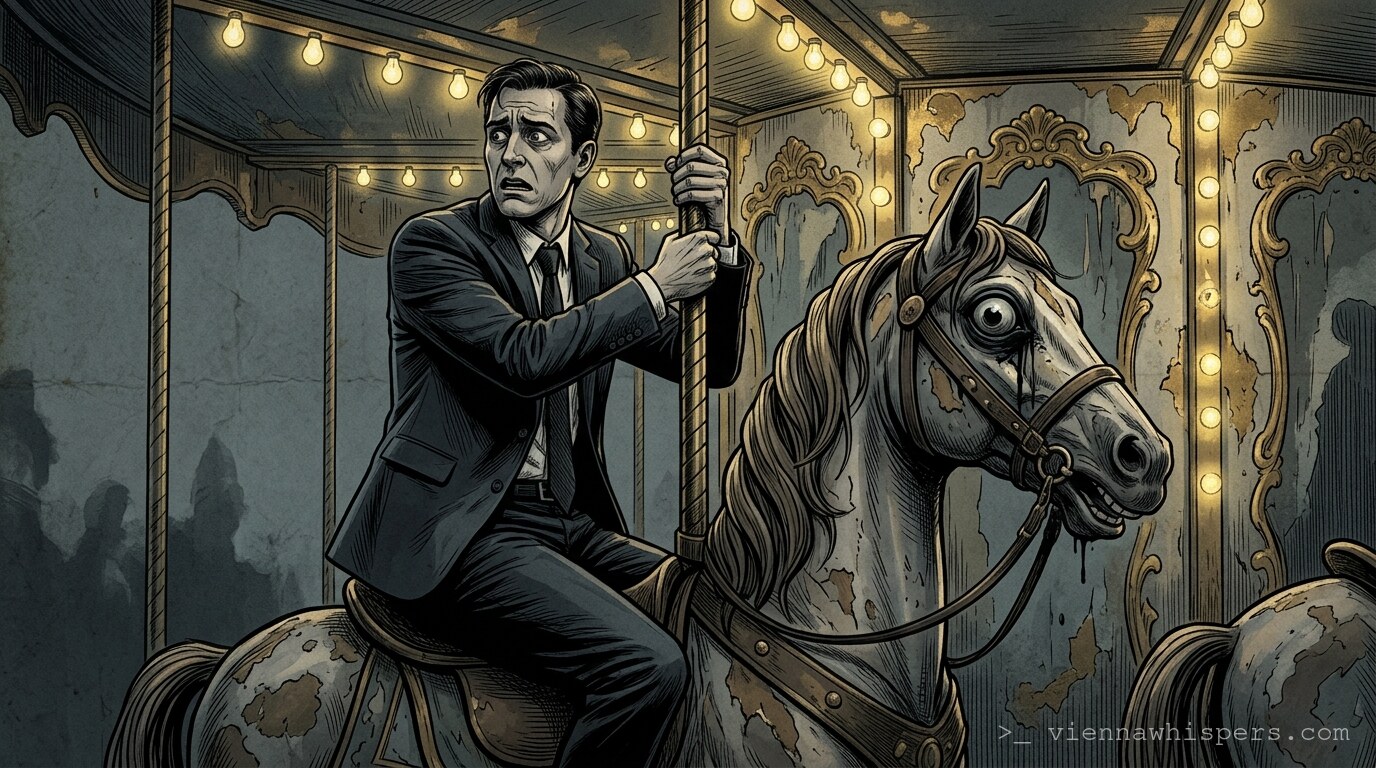
The Prater Carousel That Remembers
Herr Kozlik considered the human soul to be a matter of grease, friction, and the inevitable stripping of gears. For forty years he had stood by the central pillar of the Wurstelprater carousel — a 1908 relic of carved linden wood and peeling gold leaf — watching the city’s inhabitants orbit him in a dizzying, overpriced circle.
He was seventy-one, smelled perpetually of stale tobacco and ozone, and possessed a lower back that acted as a barometer for every storm system moving in from the Alps. He found people tedious. Specifically, he found their tendency to lie to themselves in the reflection of the carousel mirrors to be an administrative error of the highest order.
It began on a humid Tuesday in July. A man in a suit too expensive for his posture stepped onto a chestnut-colored stallion. He was holding a phone, telling someone in a hurried, pinched voice that he was “already at the airport, darling, just waiting for the boarding call.”
Kozlik engaged the clutch. The calliope shrieked its mechanical rendition of a Strauss waltz, and the carousel shuddered into motion. As the man swung past the control booth, the chestnut stallion — a creature of static wood and cracked paint — slowly, audibly rotated its head on its neck. It did not look at the track. It looked directly at the man, its painted glass eye widening until the socket seemed to leak a dark, viscous shadow.
The man stopped talking. He clutched the brass pole, his face draining of all color.
By the second week, it had become systematic. The carousel was no longer just a piece of fairground equipment; it had begun to judge. A young woman claiming to be a poet but currently employed in insurance found herself locked in a staring contest with a dappled grey pony that seemed to weep streaks of ancient, grime-stained varnish. A politician, mid-rant about his fiscal integrity, was forced to avert his gaze as the entire outer row of horses turned their wooden necks in unison, their carved nostrils flaring with the phantom scent of stable hay and 1908 decay.
The Prater authorities sent a technician. He was a young man with a tablet and an infuriatingly clean jumpsuit. He spent an hour crawling beneath the platform, tapping at the drive shaft, swearing under his breath about oxidation and “structural anomalies.”
“It’s just the timber,” Kozlik said, leaning against the turnstile, sipping a lukewarm coffee. “Wood is a fickle material. It holds memories. It holds grievances. You’re looking for a loose screw, son. You should be looking for a priest or a better class of customer.”
That evening, the park was quiet. The light over the Riesenrad was a bruised, sickly purple. Kozlik stood alone in the center of the machine. He walked up to the chestnut stallion and placed a hand on its cold, hard neck.
“You’re making the tourists nervous,” he whispered. “It’s bad for the bottom line.”
The horse didn’t move. But as Kozlik turned to leave, he felt a faint, rhythmic tapping against his spine — the sound of a hoof striking the wooden platform, even though the machine was dead still.
He walked home through the dark Prater. Halfway to his apartment in Brigittenau his neck began to ache with a stiff, unnatural twist. In the hallway mirror of his flat he finally stopped. His reflection stared back at him with the same wide, glassy eyes the carousel horses had perfected.
Kozlik didn’t scream. He simply unwrapped another butterscotch, pushed it between his lips, and stood there for a long time, listening to the faint, mechanical wheezing of a waltz that no longer existed anywhere except inside his own spine.
He had no teeth left to chew it.
Support us
Vienna Whispers is free to read. If you enjoy the stories, we’d be grateful for your support.