The Informer Who Polished the Silver
To destroy a man in the winter of 1828, one did not need a pistol, a vial of arsenic, or a particularly compelling political ideology. One only needed a flannel cloth, a jar of chalk paste, and the ability to become entirely uninteresting.
Alois had mastered all three. He was thirty-two, possessed the smooth, forgettable face of a boiled potato, and served as third footman in the State Chancellery of His Serene Highness, Prince von Metternich.
In Vienna, true power was not exercised through shouting. It was exercised through seating arrangements. The Biedermeier era had descended upon the city like a heavy, velvet suffocating-pillow. Everyone was intensely polite, everyone was passionately interested in the cultivation of indoor ferns, and absolutely everyone was terrified. To compensate, they drank enormous quantities of sweet wine and spoke in euphemisms so thick you could carve them with a butter knife.
Alois did not care about the fate of Europe. He cared about the spoons.
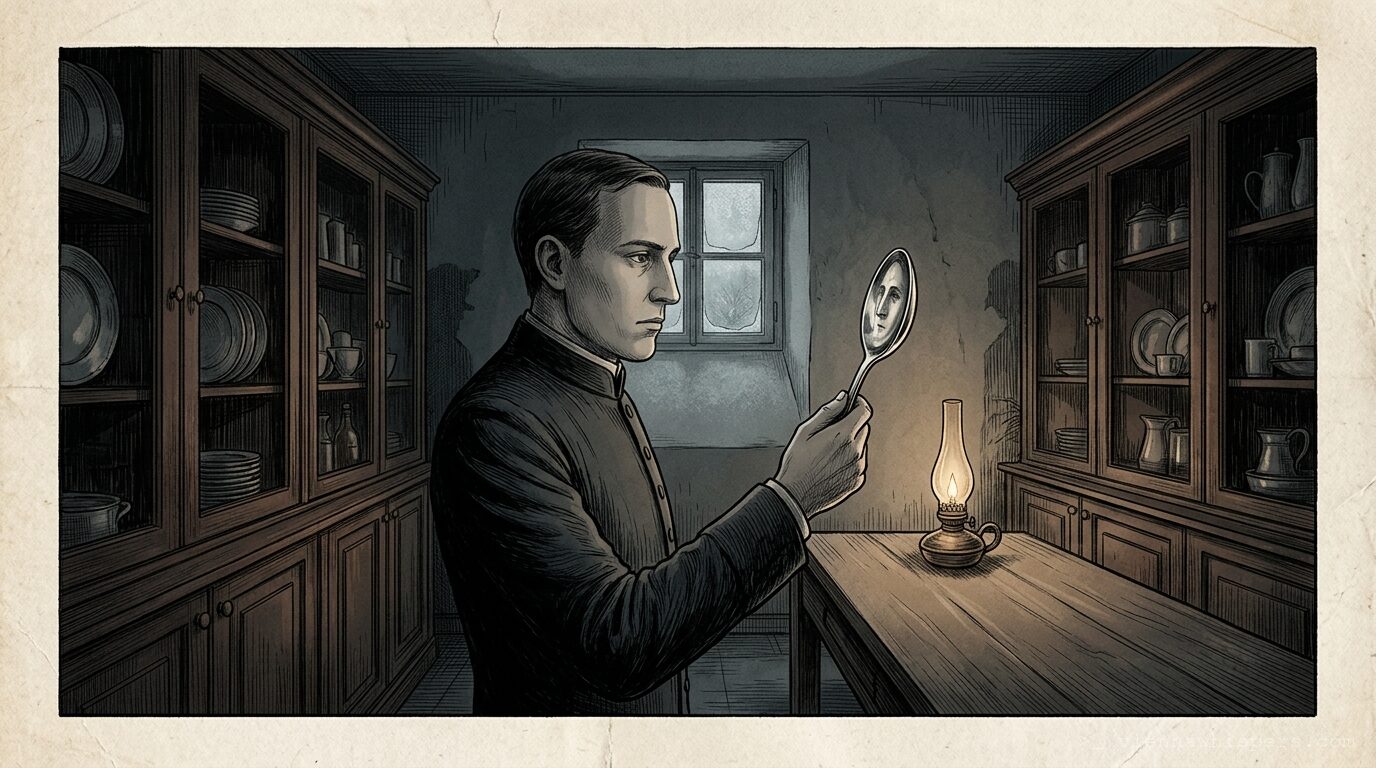
It was a Tuesday afternoon in November. Outside, the Ballhausplatz was locked in a bitter frost, the cobblestones slicked with ice and the city smelling of coal smoke and roasted chestnuts. Inside the silver pantry, the air was warm, smelling of beeswax and damp wool. Alois stood at the long oak table, working the chalk paste into the bowl of a soup spoon. He rubbed in small, hypnotic circles.
As the tarnish gave way to a gleaming mirror finish, Alois held the spoon up. In its convex surface, the reflection of the room bent outward, distorting the heavy mahogany cabinets into bloated shapes. He liked looking at the world this way. It prepared him for the dining room, where people’s faces often looked just as warped once they forgot they were being watched.
The secret police paid by the syllable, though the tariffs fluctuated. A whispered critique of the Emperor’s new tax fetched two Kreuzer. Mention of a banned French pamphlet brought three. Evidence of an illicit affair between two highly placed nobles was only worth one Kreuzer—affairs were tedious, ubiquitous, and useless for blackmail unless one of the participants was Russian. But reading Heinrich Heine aloud? That could buy a man a very decent pair of winter boots.
Alois did not consider himself a bad person. Treason is rarely a matter of philosophy; it is usually just a byproduct of boredom. He viewed his extracurricular work as an extension of his domestic duties. He removed spots from the silver, and he removed spots from the guest list. It was simply good housekeeping.
At eight o’clock, the formal dining room was lit by sixty wax candles. Alois stood by the second doorway, his white gloves resting exactly at the seam of his trousers. He was the absence of a person. He was a piece of upholstery that happened to breathe.
The guests numbered fourteen. Metternich himself was absent, called away to a crisis in the Hofburg, which left the table to minor diplomats, an over-jeweled baroness, and a young Attaché named von Rieden, who had recently returned from Paris. Von Rieden was handsome in a tragic, consumptive way that was currently very fashionable, and he had a terrible habit of dragging his chair across the parquet when he sat down.
Alois hated him instantly.
The first course was a clear beef broth with marrow dumplings. Alois moved behind the chairs, a phantom with a silver tureen. The choreography of serving soup requires absolute emotional deadness. One must not listen, one must not look, one must only pour.
“I hear,” the young Attaché said, his voice dropping to that specific, thrilling register people use when they are about to say something ruinous, “that the new printing presses in Leipzig are astonishingly fast.”
“Really?” The Baroness dabbed her lips with a damask napkin. “I care little for machines.”
“It is not the machines that are interesting, Madame,” von Rieden smiled, leaning closer. “It is what they are producing. I managed to acquire a small volume yesterday. A poet from Düsseldorf. Exiled, of course.”
Alois stood directly behind the Attaché. He held his breath, leaning down to ladle the broth. The steam rose, smelling rich and salty.
“He compares the German confederation to a sleeping dog,” von Rieden murmured, taking a sip of his wine. “And the State Chancellor to the heavy collar around its neck.”
The Baroness let out a sharp, nervous giggle. It sounded like glass breaking under a boot. “How terribly wicked. You must promise to lend it to me.”
“I would be honored.”
Alois finished pouring the soup. He stepped back, his expression as blank as an uncarved headstone. He had once condemned a minor diplomat to ten years in a damp Bohemian fortress for possessing a smuggled copy of Voltaire, though the man’s true crime had been coughing directly over the asparagus.
Von Rieden, unaware that his life was currently being weighed against the integrity of a wooden floorboard, shifted in his seat. The chair legs scraped viciously against the polished oak parquet.
Alois blinked slowly. Ten years, he decided. Minimum.
At midnight, the guests departed, their carriages rolling away into the freezing fog. The dining room was left to the servants. Alois gathered the silverware. He noticed that the Attaché had left a deep, purple crescent of spilled Burgundy on the immaculate white tablecloth.
An hour later, in his freezing attic room beneath the roof of the Chancellery, Alois lit a single tallow candle. His room contained a narrow bed, a washstand, and a small pine desk. Inside the desk was a leather-bound ledger and a stack of pre-stamped forms supplied by the Ministry of Police.
He sat down, uncorked his inkwell, and dipped his pen. The bureaucracy of destruction was comforting in its neatness.
Name of Subject: Attaché Leopold von Rieden.
Time of Incident: 8:40 PM.
Nature of Offense: Possession and distribution of banned seditious materials. Defamation of the State Chancellor.
Alois paused. He looked at the tip of his quill. He thought about the spilled Burgundy. He thought about the gouge in the parquet. He felt a sudden, profound surge of righteous indignation. These people believed they owned the world, yet they did not know how to sit in a chair without destroying it. They spoke of liberty, but they left their napkins crumpled on the floor.
He bent over the paper and added to the bottom of the form: Subject also demonstrated erratic, aggressive physical movements, suggesting a highly unstable and violent anarchist temperament.
It made absolutely no logical sense. Yet as Alois read it over, he felt a deep satisfaction. The police would appreciate the detail. It made the political charge feel more urgent. He dusted the wet ink with fine sand, waited exactly three seconds, and blew the excess away.
A drop of red sealing wax fell onto the paper, perfectly round, looking exactly like a freshly excised pupil. He pressed his blank brass seal into it.
The next morning, Alois was back in the silver pantry. The air smelled of chalk and wet flannel. Herr Sedlmayr from the Ministry had already come and gone through the servant’s entrance, leaving five heavy silver Kreuzer in Alois’s palm.
Alois picked up the soup spoon von Rieden had used the night before. It was slightly clouded. He applied the paste and began to rub in tight, rhythmic circles.
By noon, he heard the distant clatter of boots in the courtyard, the sharp bark of a police inspector, and the sound of a carriage door slamming shut. The Attaché was being taken away. He would lose his position, his reputation, and likely his youth in a Moravian prison cell. The sleeping dog of the German confederation would not miss him.
Alois lifted the spoon to the light. The tarnish was gone. The metal was perfect. He looked into the bowl and saw his own face reflected back, stretched wide and distorted, smiling a thin, metallic smile that belonged to someone else.
Support us
Vienna Whispers is free to read. If you enjoy the stories, we’d be grateful for your support.