The Man Who Never Paid Full Price
To pay the asking price in Vienna is to confess that you are a tourist in your own life.
Felix von Haug understood this before he could tie his own shoelaces. He was born into the kind of money that does not shout, but clears its throat softly from the back of the room, expecting the world to turn around. Over fifty-eight years, Felix had cultivated an existence completely insulated from retail. He possessed a staggering, encyclopedic network of favors, cousins, hunting partners, and men who owed his father.
He did not negotiate because he needed to save money. He negotiated because a discount was a spiritual necessity. Charity is a tax write-off; a discount is a validation of one’s sheer right to exist above the masses. Ten percent off a bespoke suit on the Kohlmarkt. Twenty percent off the imported truffles at Meinl. A complimentary upgrade to the penthouse suite in Venice. The money was irrelevant. The principle was absolute.
The first invoice arrived on a Tuesday in early November.
It was slipped inside his morning copy of Die Presse, printed on the pale, unmistakable recycled grey paper favored by the Viennese municipal government. It bore the crest of the city and the designation: Magistratsabteilung 0 – Metaphysischer Lastenausgleich (Department of Metaphysical Burden Equalization).
The itemized bill read:
Unearned ambient melancholy, consumption of. Location: Grinzing, late autumn, 2004.
Price: €1,450.00.
Dunning fee: €12.00.
Felix smiled, a thin, dry stretching of the lips. He assumed it was a prank by his brother-in-law, a man who possessed too much free time and an undeveloped sense of humor. Felix crumpled the pale grey paper, tossed it into the fireplace, and went to his club for lunch, where the manager miraculously struck the €80 bottle of Blaufränkisch from his tab.
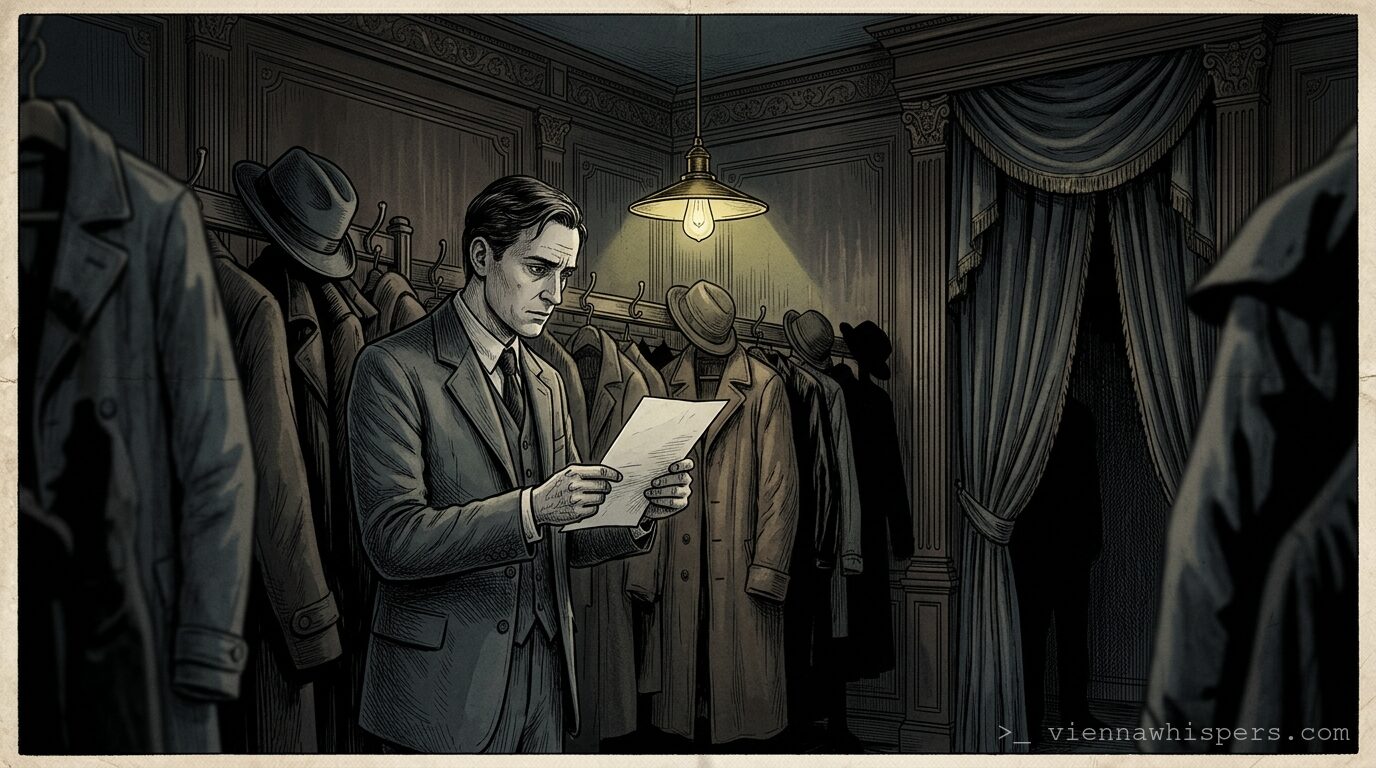
Two weeks later, he picked his cashmere coat up from the cloakroom at the Konzerthaus. In the left pocket, beneath his leather gloves, he found a yellow Erlagschein—a standard Austrian payment slip.
Unauthorized inhalation of historic gravitas. Location: Michaelerplatz. Duration: 1998–2015.
Subtotal: €14,000.00.
Late fee: €45.00.
Please transfer the exact amount within 14 days to avoid legal friction.
He did not smile this time. The paper smelled faintly of floor wax and stale cigarette smoke—the exact, uncounterfeitable aroma of a municipal district office. Felix called his lawyer, a ruthless man named Dr. Schostal, demanding he trace the IBAN on the payment slip.
Schostal called back four hours later. His voice sounded distinctly hollow. “Felix. The account belongs to the City Treasury. But the department… MA 0 does not exist. I had a contact in the mayor’s office check the directory. There is no Department of Metaphysical Burden Equalization.”
“Then who is trying to extort me?”
“No one,” Schostal said quietly. “I checked your private Raiffeisen account. The fourteen thousand euros was drafted this morning. Direct debit. Authorized by your signature.”
Felix slammed the phone down. He checked his banking app. The money was gone. The transaction description simply read: For services rendered without suffering.
The letters began to arrive with increasing, terrifying frequency. They bypassed the post. They appeared tucked inside the folds of his fresh towels. They slipped out of a sealed jar of Dijon mustard in his refrigerator. They were pinned to the windshield of his Mercedes, trapped under the wipers.
Incidental eavesdropping on genuine human tragedy (Tram Line D, May 2011) – €3,200.
Usage of the afternoon light filtering through the chestnut trees at the Prater, without adequate appreciation – €8,500.
Evasion of collective seasonal depression (Winters 2018–2022) – €22,000.
The city was auditing him.
Felix did not panic. Panic is for the middle classes. Felix became indignant. He hired private investigators. He spent seventy thousand euros in legal retainers to fight a series of invoices that totaled slightly less than that. He was acting completely against his own financial logic, but his ego was bleeding. He was Felix von Haug. He did not pay full price for the sun.
On a freezing January morning, having received a notice threatening the repossession of his “unearned posture,” Felix drove to a brutalist concrete municipal building in the Third District. The address had been printed in microscopic font on the back of the latest dunning letter.
The corridors were lined with brown linoleum. The air was thick with the scent of wet wool and Leberkäse. He found Room 404 at the end of a flickering fluorescent hallway.
Behind a scratched plexiglass window sat a man with skin the color of old oatmeal. He wore a grey cardigan and was meticulously stamping documents.
“I demand to speak to whoever is in charge of this extortion,” Felix snapped, sliding a stack of pale grey bills under the glass.
The official did not look up. He took the bills, flattened them, and sighed. “Herr von Haug. You are significantly in arrears.”
“This is absurd. I am not paying the City of Vienna for light. I am not paying for melancholy. I pay taxes. I demand these charges be dismissed, or at the very least, heavily reduced. I know the Deputy Mayor.”
The official finally raised his eyes. They were the flat, unreflective black of a winter Danube. “Herr von Haug. You have spent your entire life subsisting on a thirty-percent deficit. You have sidestepped the toll of living. The city subsidizes the poor, the artists, and the mad. It does not subsidize the comfortable. The balance is due. The universe does not offer a wholesale discount.”
“Everyone negotiates,” Felix said, leaning closer, his voice dropping into the intimate, conspiratorial purr that had opened doors for him across Europe. “Tell me what you need. A donation to the right cultural fund? A favor? Let us say… a fifteen percent reduction on the outstanding balance, and we consider the matter closed.”
The official stared at him. For a second, a small, uneasy smile twitched at the corner of the bureaucrat’s mouth.
“A fifteen percent reduction,” the official repeated softly.
“Exactly.”
“Very well.” The official stamped the top paper with a heavy, red thud. He slid a new printout under the glass.
Felix looked at it. The total had tripled.
Item added: the slip read. Luxury tax on attempting to negotiate with the inevitable. €150,000.
“The discount,” the official whispered, “has been applied.”
Felix von Haug fled the building. The cold air outside felt heavy, abrasive, as if he were suddenly being charged by the lungful. He checked his phone. His accounts were frozen. The bank’s automated message informed him that his assets were under review by an unspecified municipal authority.
He walked until his legs ached, finding himself eventually in a cramped, unremarkable café near the Landstraße station. He sat at a wobbly table. The mirror opposite him showed a man whose bespoke suit suddenly looked like a borrowed costume.
A waiter in a stained tuxedo shirt approached. “Yes?”
“A Melange,” Felix croaked.
He waited. He drank the coffee. It was bitter, scalding, entirely ordinary. When he finished, he signaled for the bill.
“Four euros ninety,” the waiter said.
Felix opened his wallet. He had a single, crisp ten-euro note left in the leather fold. He placed it on the silver tray. He looked at the waiter, his chest tight with a desperate, crushing surrender.
“Keep it,” Felix said loudly. His voice shook. “Keep the change. Full price. More than full price. I am paying in full.”
The waiter looked at the note. He looked at Felix.
With agonizing slowness, the waiter reached into his apron. He counted out a five-euro note, and a ten-cent coin. He placed the exact change on the tray, pushed it back toward Felix, and then reached into his pocket one last time.
He placed a pale grey envelope under the saucer.
“We don’t take tips from debtors,” the waiter said.
Felix sat in silence, staring at the envelope as the city outside the window continued to tally the exact, uncompromising weight of the afternoon.
Support us
Vienna Whispers is free to read. If you enjoy the stories, we’d be grateful for your support.