The American Rocket
Franz sat in his small kitchen in Leopoldstadt, the air thick with stale coffee and the sharper, metallic tang of aging saltpeter. He was eighty-two, a man composed largely of brittle joints and redundant knowledge of incendiaries. His neighbors knew him only as the old man who complained about loud music, but they did not know about the wooden crate under his bed.
The crate had belonged to his father, a k.u.k. fireworks master who had smuggled it home from an American supply depot in 1945. Inside were the last relics of a different empire — slender, olive-drab rockets with faded stenciled markings. They had never been meant for celebration.
It was 2026. Somewhere far across the Atlantic, people were watching neon streaks tear through the sky to celebrate another victory. Franz did not care for their digital fireworks. They were all light and no weight.
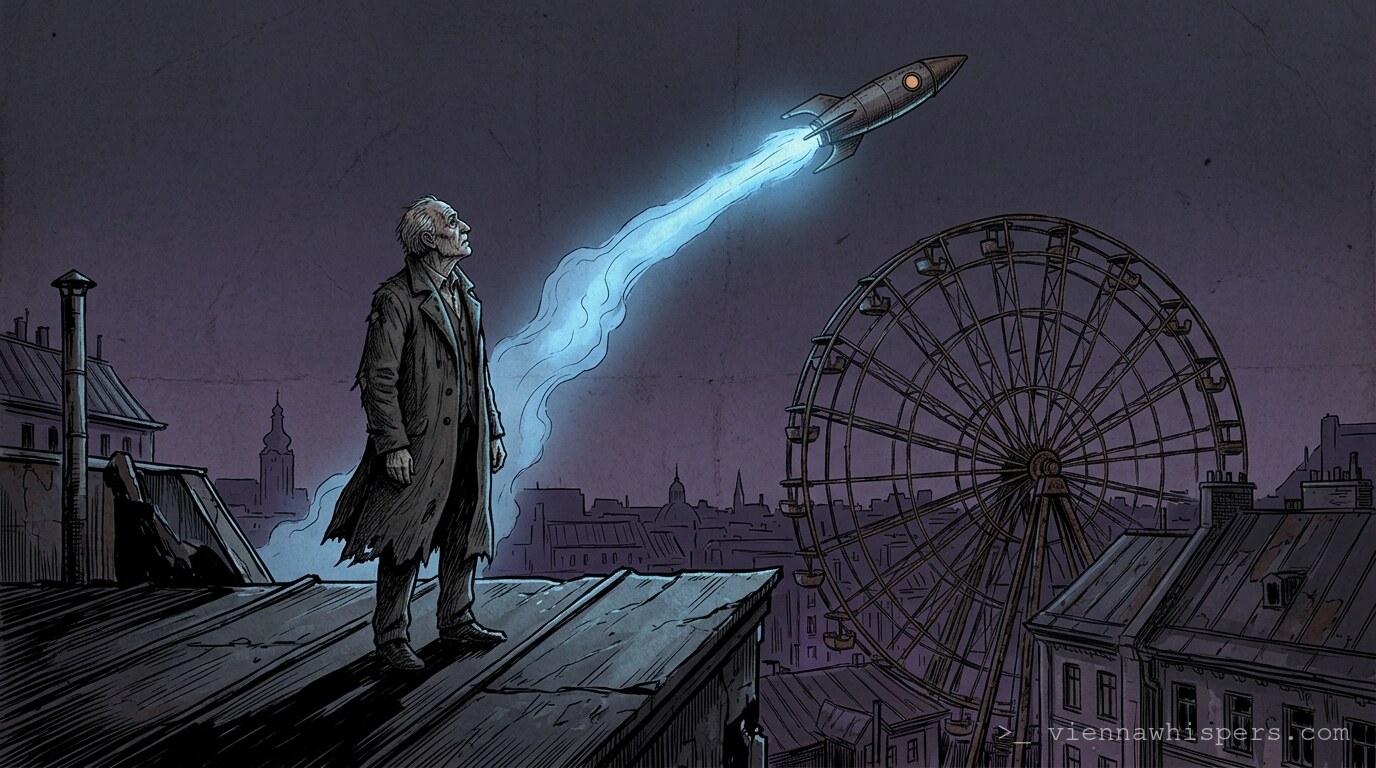
He reached under the bed and pulled out the final rocket. It was heavier than it looked, wrapped in oil-stained paper that felt like snake skin. He carried it up the narrow ladder to the roof.
The night air above the Prater was crisp. Before him, the Giant Ferris Wheel stood dark and skeletal against the bruised violet sky. Franz braced the rocket in an old iron pipe he had fixed to the chimney years ago. His hands, usually trembling, were steady.
He struck a match. The fuse caught with a sharp, stinging hiss.
The rocket rose with a strange, heavy grace, trailing a plume of smoke that smelled of damp attics and pressed flowers. It climbed toward the hub of the Riesenrad, a silver needle threading the eye of the city.
At the apex of its arc, it did not explode. There was no thunder, no shower of color. Instead, it sighed — a long, pressurized exhale — and released a pale, luminous blue mist that curdled the darkness.
For a few heartbeats, the Prater was illuminated by a cold, ghostly blue light. Franz gripped the chimney. Below him, the shadows suddenly gained substance. He saw them: the old showmen from the “Venice in Vienna” era with their waxed moustaches, the dancers with hollow eyes and swirling skirts, the soldiers in high-collared uniforms whose buttons glinted with light that had no source. They stood exactly where they had stood a century ago, engaged in the business of living, oblivious to the fact that they were echoes.
A girl in a lace bonnet reached for a phantom balloon. A man in a top hat checked a pocket watch that held no time.
Then the blue light thinned. The figures folded back into the architecture — the dancers dissolved into the brickwork, the soldiers slipped into the cracks of the asphalt. The darkness rushed back in, thicker than before.
The empty rocket casing rattled as it fell onto the gravel path below.
Franz remained on the roof for a long time, his knees aching from the cold. The city continued its indifferent breathing. Somewhere a police siren wailed, sharp and modern.
He looked down at his empty hands.
He had wanted to send something back — a small, defiant spark across time. Instead, he had only briefly made the past visible, like a photograph held too close to a flame.
Franz descended the ladder slowly. The smell of gunpowder still clung to his coat. He sat in his chair and stared at the wall, wondering whether he had really seen them, or whether he had finally succeeded in manufacturing his own memory.
Outside, the Riesenrad turned slowly in the dark, its empty cars swinging like bells that had forgotten how to ring.
Support us
Vienna Whispers is free to read. If you enjoy the stories, we’d be grateful for your support.