The Cat That Stayed After the Men Left
It was not a patriotic animal. It arrived in the stairwell of Hasnerstraße 14 sometime during the bitter frost of 1916, shortly after the government had unscrewed the brass door handles to melt them down for artillery shells.
He was a tomcat of indeterminate age and battered architecture. His fur was the color of old snow mixed with coal dust, and his left ear looked as though it had been trimmed with dull pinking shears. He did not ask for entry; he simply slipped past the heavy wooden door when the postman came to deliver the first wave of black-edged envelopes from the Isonzo front.
The tenants named him Ignaz. They did not know they were fighting a losing war yet, but they already understood that extra mouths were a liability. Still, nobody kicked him back out into the sleet.
By the autumn of 1918, the building in Ottakring was hollowed out. The stucco garlands above the entrance were shedding plaster like dead skin. The air inside the corridors tasted permanently of boiled turnips, damp ash, and the sharp, anxious tang of carbolic soap. There were no young men left. There were only women in gray shawls, feral children who stole briquettes from the railyards, and the returnees—men sent back from the east with pieces missing, coughing pale red spots into their handkerchiefs.
Ignaz possessed the slow, heavy-lidded indifference of a minor Habsburg bureaucrat. He did not belong to any single apartment. He governed the four floors through a strict rotation dictated entirely by the presence of caloric heat.
In the mornings, he sat on the lap of Frau Sattler on the ground floor. She was a woman of forty who suddenly looked sixty, her husband having vanished somewhere in the Carpathian mud two years prior. Frau Sattler kept her kitchen stove alive with rolled-up newspaper and the shattered remains of a Biedermeier footstool. When Ignaz climbed into her lap, she would weep into his dusty fur. She stroked him with frantic, desperate affection, whispering her husband’s name.
Ignaz purred. He purred not out of empathy, but because the vibrations trapped the heat of her thighs against his underbelly. The widows of the building loved the cat precisely because he was the only male thing left in their lives that did not require nursing, burying, or waiting for.
At noon, Ignaz would ascend to the second floor, his claws clicking rhythmically against the stone steps. Here lived Korporal Wenzel.
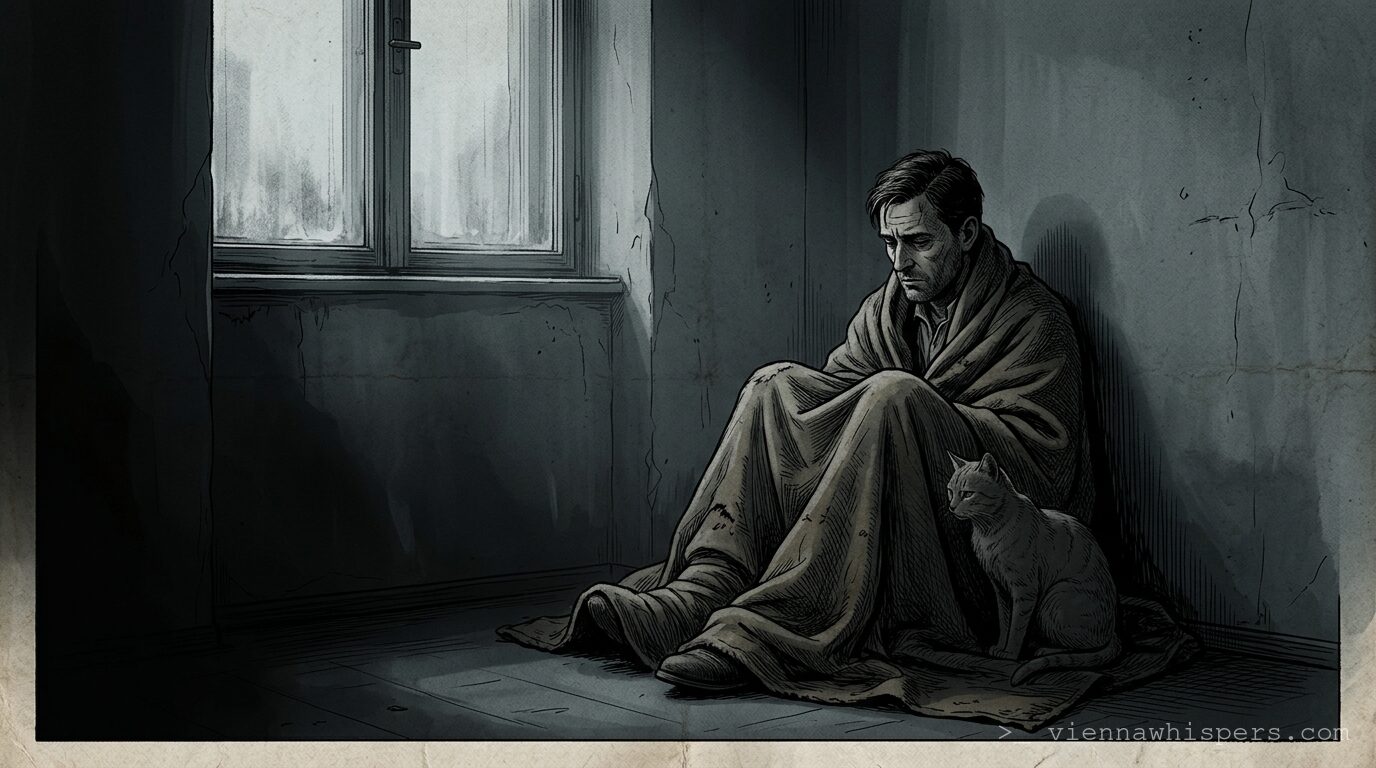
Wenzel had left Vienna a butcher’s apprentice and returned from the Trentino with a wooden peg beneath his right knee and a terrible, freezing silence in his throat. He sat by his window all day, wrapped in an army-issue blanket, watching the rain dismantle the city. When Ignaz pushed through the crack in the door, Wenzel would not speak. He would simply lift the edge of the blanket. Ignaz would crawl underneath, curl into a tight comma against the stump of Wenzel’s ruined leg, and go to sleep.
Wenzel believed the cat understood his phantom pain. He believed the animal curled there to draw the cold ache out of the severed nerves. Sometimes, Wenzel would share his meager ration of horsemeat with Ignaz, pushing the grayish scraps across the floorboards with his good foot. It was a profoundly illogical sacrifice—to starve oneself to feed a stray in a starving city—but Wenzel believed that if he kept the cat alive, God might eventually let him sleep through the night without dreaming of wire.
Ignaz ate the meat, washed his face, and went to sleep on the stump. He felt no gratitude. He only knew that Wenzel ran a fever most afternoons, and fever meant a temperature of thirty-nine degrees Celsius. To the cat, Wenzel was not a hero of the empire; he was a highly efficient radiator.
Vienna was falling apart, but the decay was incredibly slow, like a glacier made of exhaustion. In early November, word trickled down the Hasnerstraße that the Emperor had fled. The Republic was declared. Nobody in the building celebrated. Revolutions require calories, and no one had any to spare. The news was digested quietly, over cups of black liquid brewed from roasted acorns, which tasted faintly of burnt earth.
The children, the wild Polacek boys from the fourth floor, were the only ones who still had energy. They ran through the corridors like skinny ghosts in oversized boots. When they caught Ignaz, they would drag him into corners, burying their unwashed faces in his stomach. They were rough, their small hands pulling his tail, but Ignaz tolerated them with the stoic endurance of a weary saint. He allowed it because occasionally, they smelled of stolen bread.
It happened on the second Tuesday of November. The sky over Ottakring was the color of a bruised plum—a deep, bruised blue that promised an early winter.
Ignaz sat outside Wenzel’s door at noon, waiting for the crack to open. It did not. He scratched once, twice, ruining the veneer. No sound came from inside, not even the heavy, rattling cough that usually punctuated Wenzel’s afternoons. The Spanish Lady, as the flu was called, had been sweeping through the district, taking the people the artillery had missed.
Ignaz waited for ten minutes. The stone floor was freezing his paws. When the draft from the stairwell window became too sharp, he turned and padded heavily up the stairs to the third floor, where Frau Sattler was currently burning the last drawer of a dresser.
He did not mourn the Corporal. Grief is a luxury of those who know where their next meal is coming from.
That evening, the bells of the Votivkirche did not ring, for they had been melted down long ago. The city was completely silent, stripped of its titles, its empire, and its heat. In Frau Sattler’s kitchen, the fire finally died down to a dull, glowing orange.
Ignaz stretched, his joints popping slightly in the quiet room. He hopped onto the kitchen table and settled onto a stack of unsent letters written to a dead man. He tucked his nose beneath his tail, closed his remaining green eye, and waited for the humans to find something else to burn.
Support us
Vienna Whispers is free to read. If you enjoy the stories, we’d be grateful for your support.