Graveyard Shift
Herr Kanzler left the little Beisl in Simmering at half past two in the morning. The owner, a thick-necked man named Pepi, had poured him the last glass of cheap brandy and asked the same question he asked every night: “Why do you still do this shit, Kanzler? The dead don’t pay you extra.”
Kanzler had shrugged, downed the brandy in one go, and answered as he always did: “Because at least the dead don’t complain about the service.” In the corner, the old television was running without sound — a repeat of a 1990s crime show, the kind where everyone wore shoulder pads and shouted at each other. Pepi wiped the same spot on the counter he had been wiping since Kanzler arrived. The air was thick with cigarette smoke and the sour smell of spilled beer. When Kanzler pushed open the door, the cold Simmeringer night rushed in like an impatient creditor, cutting through the warm fug and making the smoke swirl like ghosts fleeing a raid.
He took the night bus to the Third Gate. The driver knew him and no longer asked for a ticket. When Kanzler stepped off, the cold hit him properly. The Zentralfriedhof was a sprawling, silent city of the dead, two and a half square kilometres of graves, trees, and unspoken resentments. From the Third Gate to Group 45 was almost two kilometres if you took the main paths. Kanzler preferred the smaller gravel trails that wound between the old Jewish section and the Russian war graves. Less traffic. More quiet. More time to think about how much he hated his own surname.
He had borne “Kanzler” for fifty-eight years with a quiet, private resentment that had nothing to do with the former head of state. Every new intern made the same joke. He had stopped correcting them long ago.
The full moon was particularly aggressive tonight. It bleached the granite markers until they looked like broken teeth against the dark treeline. Kanzler switched on his heavy industrial flashlight and began his round. The beam caught the usual offenders first: a marble angel in Group 41 whose head had turned another five degrees toward the path. A grave in the Protestant section where the flowers had been neatly rearranged into the shape of a question mark. Small rebellions. Manageable.
He passed the pompous mausoleum of an industrialist from the Gründerzeit — a grotesque marble palace with columns and a bronze lion that looked permanently constipated. Kanzler hated that grave. The man had probably never worked a day with his hands, yet he lay there in eternal luxury while honest people got a simple stone and a plastic flower. The dead had no shame when it came to hierarchy.
But in Group 45 the ground was moving again.
He stopped near a row of simple stones marked only with names and dates from March and April 1945. The earth here had a particular smell — deep clay mixed with something sweeter, almost like rotting lilies. A wooden cross tilted slowly, as if someone beneath it was adjusting their pillow. Then a pale, spindly protrusion broke the surface — not quite a finger, not quite a root — and waved once in the moonlight before withdrawing with a soft, wet sound.
Kanzler stood very still. He found it viscerally offensive, the way the dead refused to respect the neat perimeter of their plots. It was untidy. It was an administrative failure of the highest order. He had once written a memo to the administration about the problem. They had answered with a three-page form titled “Irregular Soil Movement – Reporting Procedure.” He had used it as a coaster for his coffee ever since.
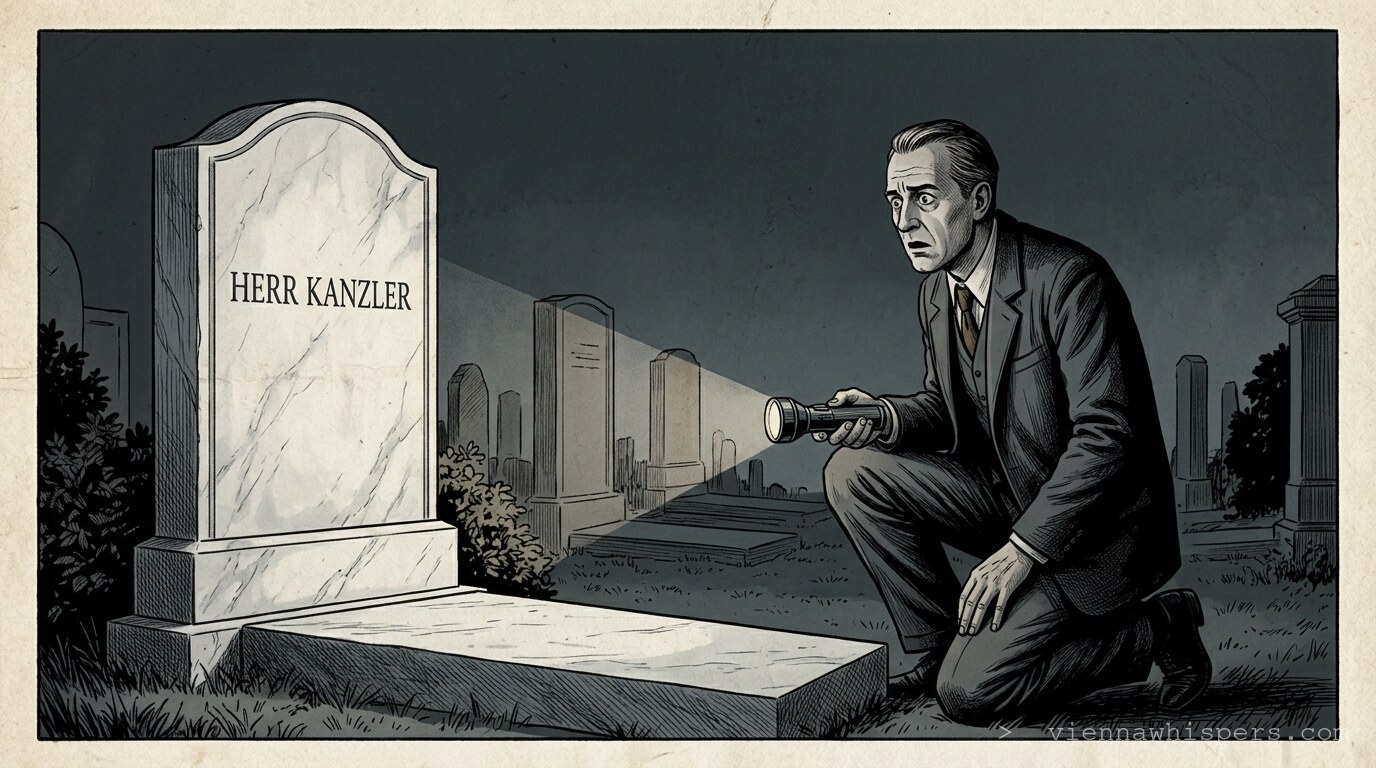
His beam swept across the newer section. It caught something that absolutely should not have been there: a clean, white marble stone, freshly cut, the edges still sharp. He walked closer. The inscription was crisp, the stone dust still clinging to the grooves.
HANS KANZLER 1966 – 2024
He stared at the date. Today was the 17th of October. The stone said tomorrow.
Kanzler touched his own cheek. The stubble was real. The slight tremor in his fingers was real. Somewhere behind him came a soft, wet clicking sound, like a tongue testing the roof of a mouth. He didn’t turn around.
Instead he sat down on the damp grass beside his own headstone, set the flashlight across his knees, and waited to see whether he would have to fill the hole himself when the time came.
It was, after all, his shift. He was responsible for the state of the grounds.
It wouldn’t do to leave a mess for the morning crew.
Support us
Vienna Whispers is free to read. If you enjoy the stories, we’d be grateful for your support.