The Clockmaker of the Ankeruhr
The brass gears of the Ankeruhr taste of ozone and neglect. To Leopoldine, the giant art nouveau clock spanning the bridge between the two buildings of the Hoher Markt is not a monument to history, nor a tourist attraction for people who eat overpriced schnitzel in the nearby cafes. It is a digestive system. It requires precise lubrication, a steady hand, and a refusal to acknowledge that the machinery occasionally attempts to digest its own occupants.
It was 3:00 a.m. The blue light of the pre-dawn winter hung over the square like an unwashed wool blanket. Leopoldine moved through the internal gantry, her fingers calloused from forty years of interacting with teeth and escapements. She wore a coat that smelled of industrial grease and lavender—a combination that, for most men, was a definitive deterrent to courtship. She didn’t mind. People were imprecise, prone to erratic emotional oscillations and inconvenient mortality. Gears, however, were honest. If they failed, it was a failure of physics, not of character.
The mechanism began its nightly parade. The copper figures slid along their tracks with the rhythmic, wet clatter of a heavy tongue against teeth. Leopoldine adjusted her headlamp, focusing on the main drive chain.
Then, the clicking stopped.
Not a stutter or a slip. A definitive, absolute cessation of movement. The silence that rushed into the gap was heavy, the kind of silence that usually precedes a structural collapse or a bureaucratic audit.
Leopoldine sighed. “Dammit, Walther,” she muttered, naming the clock for the engineer who had installed the current secondary drive. “You cheap, miserable hack.”
She expected a snapped pin or a jammed cam. Instead, she watched as the figure of Death—the skeletal, robed automaton with the gilded hourglass—reached the center of the arc and simply stopped moving. But the gear-teeth behind him didn’t lock. They shivered, then folded back like a biological iris.
Death stepped out.
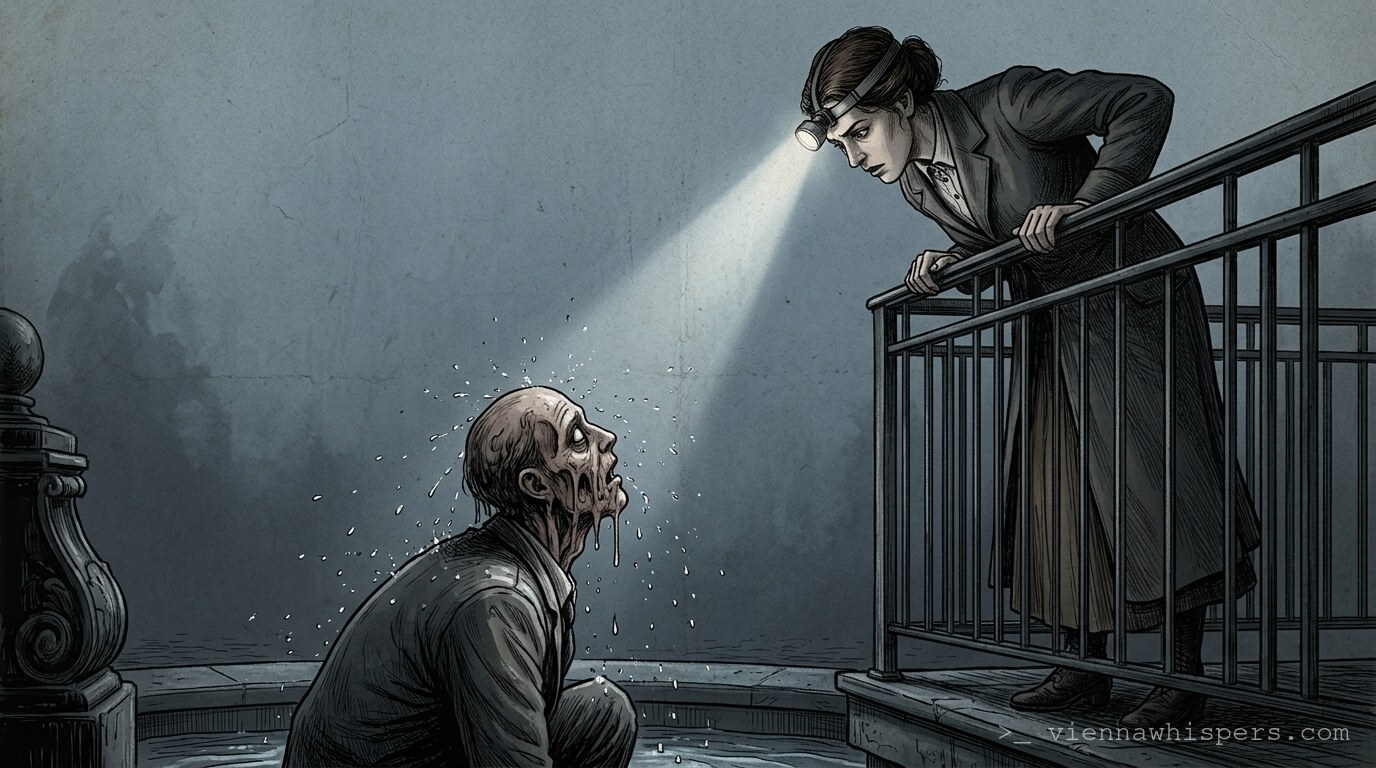
He did not shuffle or glide. He stepped with the heavy, awkward weight of a man climbing out of a bath. The wood and metal of his frame softened, blurred at the edges, and hardened into something that looked uncomfortably like pale, damp skin. He climbed down the maintenance ladder with a metallic groan, his joints sounding like a rusty gate.
Leopoldine leaned over the railing, her oil can gripped in her right hand. She watched as the figure walked toward the Vermählungsbrunnen. The fountain, a masterpiece of marble and stone, sat waiting. The figure reached into the water. He didn’t drink. He splashed the freezing liquid onto his face, scrubbing at his features as if trying to remove a layer of soot that had accumulated over a century of cycles.
The light of the moon caught the water droplets, turning them into cold diamonds that shattered on the pavement. Death turned his head. His eyes were not hollow; they were empty, concave surfaces, exactly like the rear casing of a pocket watch with the glass removed. He looked at Leopoldine.
There was no judgment in that stare, no cosmic weight, no promise of the end. There was only the vacuity of an instrument that had been wound and had finally run down.
Leopoldine blinked. She looked down at the rail where the figure had exited. There, etched into the bronze plating, was a fresh, microscopic abrasion—a scratch, no wider than a human hair, caused by the unnatural friction of an impossible event.
She felt a surge of genuine, sharp irritation.
“That is going to require filing,” she whispered.
Death tilted his head. He looked at the fountain, then at the clock above, then back at her. He seemed to be waiting for her to panic, to pray, or perhaps to offer him a reprieve. She did none of those things. She looked at his feet—he was barefoot, the skin as white and translucent as a fish’s belly—and then she looked at the brass casing of the main drive.
“You’re putting unnecessary torque on the housing,” she said, her voice dry and perfectly calibrated to the level of a reprimand. “If you do that again, the structural integrity of the entire parade track will be compromised by autumn. And I will not be the one to explain to the city council why their precious time-keeper has developed a limp.”
Death stood still. The silence stretched, deep and existential, threatening to swallow the square, the fountain, and the very concept of time itself. Leopoldine didn’t care for the existential. She had an inventory to manage and a pension to consider. She watched him, waiting.
After a moment that felt like a lifetime in a sterile room, Death turned back. He climbed the ladder, his movements slower now, the skin fading back into the muted luster of patinated copper. He stepped into the slot, the iris closed behind him, and the gears engaged with a sharp, synchronized clack.
The parade resumed. Marcus Aurelius slid into view, his stoic face staring blindly into the void of the Hoher Markt.
Leopoldine moved to the rail. She touched the scratch with her index finger, feeling the jagged edge of the metal. She pulled a fine-grit file from her tool belt and began to work, her motions precise and rhythmic.
File, brush, oil. File, brush, oil.
The sun would rise in a few hours. The tourists would arrive with their cameras and their crumbs. They would look up at the clock and marvel at the antique artistry, never suspecting that the gears were held together by a woman who found death to be nothing more than a poorly lubricated pivot point.
She paused, looking up at the sky. A strange, momentary vertigo pulled at her, a sensation that the city was a machine and she was merely one of its smaller, replaceable parts. She felt the cold seep into her bones, the weight of the ancient stone buildings pressing down on the narrow streets. For a split second, the world seemed to click into place, a vast, horrifying arrangement of cogs spinning toward nothing.
She shook her head, dismissing the thought. It was a sloppy, unrefined notion.
She turned back to the rail, focused on the metal. The abrasion was almost gone. She could hear the faint, steady pulse of the city beneath her feet—a heartbeat, or perhaps just the rattle of the underground pipes, failing slowly, perfectly, according to the schedule of the earth.
She finished the job, closed her kit, and walked out into the blue light of the morning, careful not to look up at the clock face again. There was no point. The time was already set, and the gears were turning exactly as they should.
Support us
Vienna Whispers is free to read. If you enjoy the stories, we’d be grateful for your support.