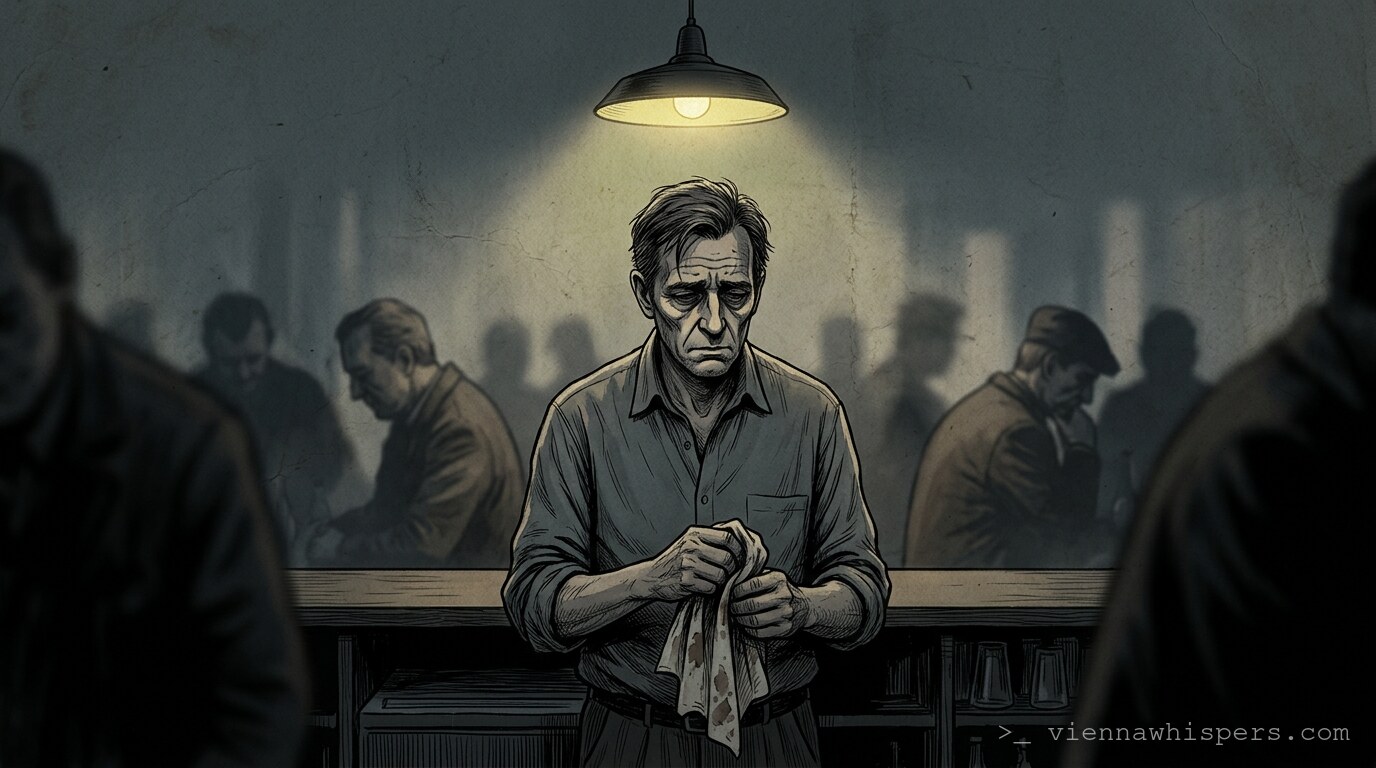
The Last Honest Waiter
Karl tied his stained white apron with the same sharp tug he had used for thirty-eight years. The air in Zum Schwarzen Hahn was thick with the usual perfume of stale beer, floor wax, and damp wool. He picked up his tray and stepped into the room like a man walking onto a stage he had long since stopped admiring.
“Is the Gulasch fresh?” asked the American woman, her smile bright and dangerous.
Karl looked at her. He looked at her husband in the ridiculous bucket hat. He thought of the frozen brick currently defrosting in the back.
“It was fresh,” he said, his voice dry as old bread, “some time during the Balkan Wars. Since Tuesday it has been reheated twice. Your digestive system will file a formal complaint.”
The woman’s smile froze. Her husband’s fork hovered mid-air.
Karl moved on.
At table four, Professor Huber sat behind his Neue Zürcher Zeitung, nursing the same Verlängerter he never finished.
“Your wife is not in Salzburg, Herr Professor,” Karl said quietly, wiping an imaginary spot from the table. “She is in the third district. I saw her yesterday buying groceries for two. She looked lighter.”
Huber turned the color of old curd. The newspaper trembled.
By seven o’clock the Beisl had become a theater of small domestic apocalypses. Karl told the young marketing consultants that their project was derivative nonsense and their ties were an insult to textile workers. He informed the local politician that his suit smelled of corruption and cheap aftershave. He told the cook Hannes, his companion in misery for a decade, that the Apfelstrudel tasted like wet regret wrapped in pastry.
Hannes didn’t hit him. He simply sat down on a crate of empty bottles, lit a cigarette, and whispered with profound relief: “It really does, doesn’t it?”
The usual Viennese Grant — that comfortable, performative grumpiness — had evaporated. In its place was something raw and terrifying: the truth. Customers sat frozen, staring into their glasses as if seeing their own reflections for the first time.
Karl stood at the bar and looked at himself in the tarnished mirror. He looked old. He looked tired. He looked remarkably clean.
He untied his apron, folded it with military precision, and laid it on the counter like a white flag of surrender. Without another word he walked toward the door.
Outside, the winter air was sharp and honest. The Ringstraße lay quiet under the streetlamps. Karl didn’t look back at the yellow window of the Beisl. He simply started walking, his footsteps echoing against the stone with a new, unfamiliar lightness.
Behind him, the lights in Zum Schwarzen Hahn went out, one by one, until only the small glow above the bar remained — a lonely island of truth in a city built on comfortable lies.
Support us
Vienna Whispers is free to read. If you enjoy the stories, we’d be grateful for your support.