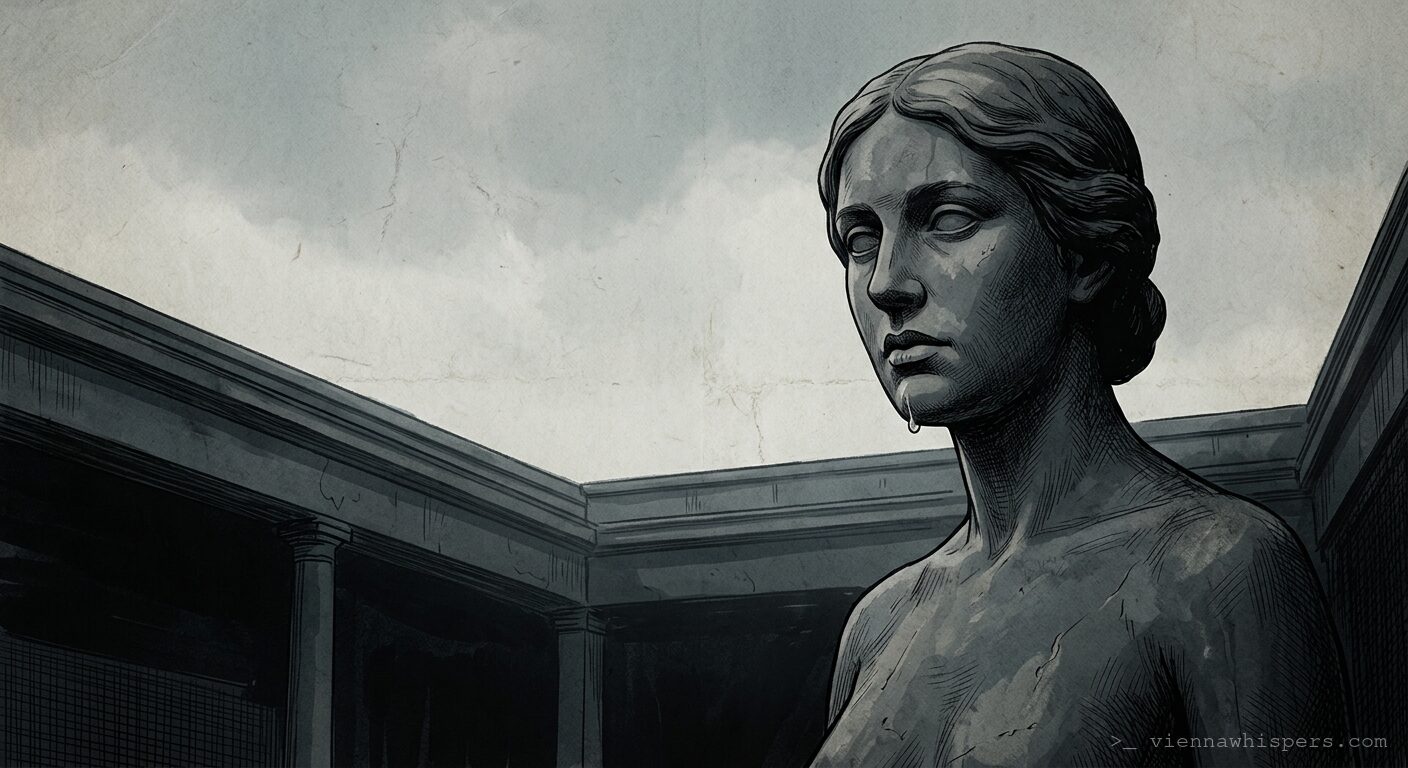
Das Weib Watches the Season Die
The death of summer in the Stadionbad does not announce itself with a date on the calendar. It begins with the light.
Sometime in late August, the glare on the water shifts from a blinding, aggressive assault to a pale, apologetic slant. By September, the deep end of the sports pool is swallowed by the shadow of the Prater trees before four o’clock. The scent of the air changes, too—the frantic, sweet stench of coconut oil and warm French fry grease gives way to the sharp, metallic odor of damp concrete and rotting leaves.
Das Weib feels the shift in her spine first. She is carved from pale marble, anchored to a stone plinth in the open air beside the women’s changing cabins, frozen in a posture of eternal, arched hesitation. She has stood here for nearly a century. She does not shiver, but as the mornings grow brittle, the cold sinks into her stone skin and settles somewhere inside the sealed silence of her chest.
She has watched them for decades. The endless, churning conveyor belt of human meat.
Every May, she witnesses the great delusion. They arrive when the water is still biting and the grass is fresh, bringing with them the frantic optimism of spring. She watches the young women stretching out on brightly colored towels, pulling the fabric of their swimsuits high over their hips to fake the length of a leg. She watches the young men, chests inflated, walking with the stiff, unnatural gait of creatures terrified of relaxing their abdominal walls. They throw themselves into the freezing water to prove a vitality they do not possess.
Das Weib finds it exhausting, but mildly entertaining. It is a peculiar tragedy to be trapped in marble while watching a century of soft tissue desperately pretend it will not rot.
She knows exactly how they will all end up. She sees the preview in the older generation, the regulars who occupy the same shaded spots under the poplars year after year. She has watched bodies sag in real-time. She has tracked the gradual loosening of skin under the triceps, the creeping spread of spider veins mapping the thighs like frozen tributaries of the Danube.
In the 1930s, the bodies she watched were sharp, angular, and hungry. In the 1970s, they were golden, heavy, and careless. Today, they are covered in ink—anchors, geometric lines, the names of ungrateful children, inspirational quotes written in languages the wearers do not speak. They treat their skin like a museum wall, entirely oblivious to the fact that the plaster is already beginning to crack.
There is an old man who has come to the pool every summer since 1982. Das Weib remembers when his chest hair was black and his shoulders were broad. Now, he is seventy, carrying a heavy, drum-like stomach that pulls his spine forward. Yesterday afternoon, a girl of perhaps nineteen walked past him carrying a wet towel. Instantly, involuntarily, the old man sucked his stomach in. His posture snapped straight. He held his breath until his face turned a mottled shade of violet, taking a slow, casual sip from his water bottle as if he naturally stood like a military cadet. As soon as the girl was past the showers, he exhaled, and his body collapsed back into its ruin.
Das Weib allowed herself the faintest marble smirk. He slipped slightly on a puddle of spilled Fanta right after, and before checking his twisted knee, he immediately looked around to ensure the teenager hadn’t seen him stumble. There is nothing quite as pathetic as a spine attempting to lie about the year it was born.
Now, it is the second week of September. The water temperature has dropped to eighteen degrees. The casuals have abandoned the city for the dry warmth of autumn coats and indoor cafes. Only the die-hards remain.
The die-hards are grim. They do not come for joy; they come for discipline, cutting through the icy water with furious, mechanical strokes. The lifeguards stand by the edge wearing fleece jackets, their arms crossed, staring at the swimmers with undisguised resentment. They want to go home. The season is a corpse that refuses to close its eyes, and everyone is simply waiting for the city to finally call the time of death.
A woman in a faded teal swimsuit climbs out of the sports pool. She is one of the regulars. Das Weib has mapped the geography of this woman’s body for thirty years—the appendectomy scar that appeared in 1994, the subtle shift in her hips after 2003, the way she now grips the metal railing with two hands instead of one.
The woman stands on the wet tiles, shivering violently. The wind coming off the Danube is merciless today. She wraps a thin towel around her shoulders and looks up at the statue.
For a moment, the woman stares at Das Weib’s permanent, idealized breasts, her perfectly rendered thighs, her chin tilted toward an invisible sun. The woman raises her own chin, just a fraction. She adjusts the wet fabric of her swimsuit, attempting to smooth out a fold of flesh at her waist that cannot be smoothed. She tries, just for a second, to mirror the statue’s immaculate stillness. She catches her own reflection in the dark, smeared glass of the closed ice cream kiosk. Her shoulders immediately slump. She turns away, pulling the towel tighter around her thick neck, and shuffles toward the locker rooms in wet plastic sandals.
The intimacy of it disgusts Das Weib. Das Weib does not pity them. Pity requires a belief that things could be different.
By four-thirty, the sky turns the color of a bruised vein. The loudspeaker crackles to life, a bored, bureaucratic voice echoing over the vast, empty lawns, announcing the final closure of the baths. Ende der Badesaison.
The stragglers pack their bags in silence. The gates lock.
An hour later, the heavy, hollow thud of the industrial pumps engages deep beneath the concrete. It is a sound that travels through the concrete, through the plinth, and up into Das Weib’s rigid legs. The water level in the sports pool begins to drop, inch by slow inch, retreating down the blue tiles. It leaves behind a slick, gray tide line of human grease, sunscreen scum, and a single, swollen plaster sinking slowly toward the drain.
Support us
Vienna Whispers is free to read. If you enjoy the stories, we’d be grateful for your support.