The Tram That Stops One Station Too Many
Felix Dorn trusted the published timetables of the Wiener Linien considerably more than he trusted his own body. Bodies harbor silent mutations; timetables, at least in theory, submit to mathematics. He was a risk assessor for a mid-tier insurance firm near Schottentor. He spent his days calculating the exact probability of scaffolding collapsing on tourists, or localized flooding in cellar apartments. He understood how the world broke down into numbers.
Every evening at six-fourteen, he took the 41 tram from Schottentor toward Pötzleinsdorf. The 41 is a civilized line. It climbs steadily through the eighteenth district, shedding students and tourists near the Volksoper, until it carries only the tired, well-heeled residents of Währing, wrapped in damp wool and quiet entitlement.
It happened for the first time on a Tuesday in late November.
The tram had just pulled away from Michelbeuern. The next scheduled stop was Eduardgasse. Felix was looking at his phone, drafting a polite but lethal email to a junior colleague. The ULF tram—one of the long, segmented models that resembles a mechanized caterpillar—took the slight curve up Währinger Straße.
Then, the brakes whined. It was a slow, deliberate deceleration. Not an emergency stop for a stray dog or an indecisive cyclist, but the programmed, heavy settling of a tram arriving at a platform.
The synthetic, aggressively cheerful voice of the automated announcer chimed.
“Bleichergasse.”
Felix frowned. There was no Bleichergasse on the 41 line. There was no Bleichergasse in the eighteenth district. He knew the map of Vienna with the sterile intimacy of a coroner knowing a skeleton.
The tram came to a complete halt. The doors hissed open with their familiar, pneumatic exhalation.
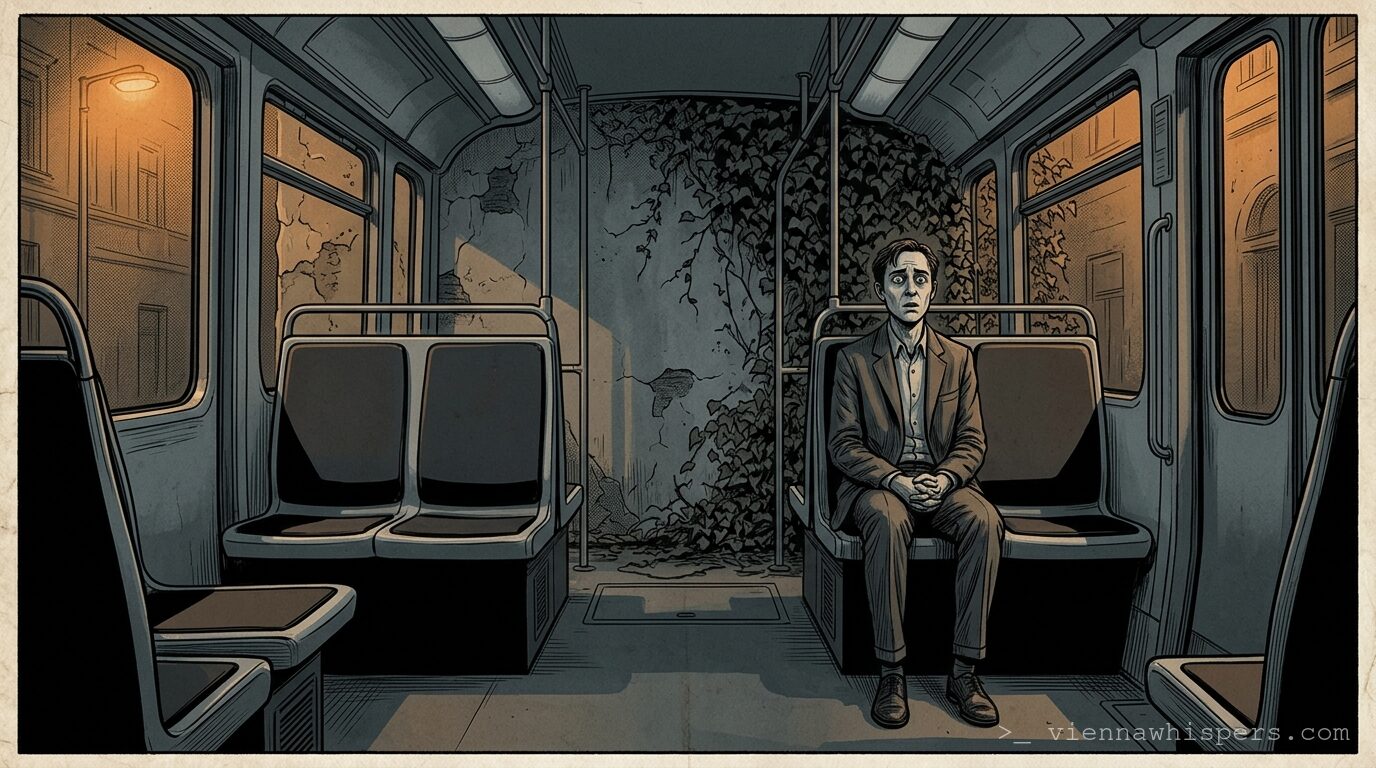
Felix looked up. There was no platform. There was no street. The tram had stopped mere inches from a towering, windowless firewall of dirty yellow stucco, heavily overgrown with dormant winter ivy. A single, flickering sodium lamp mounted high above cast a sickly, orange cone of light onto the wet cobblestones. There was barely enough space between the open tram doors and the wall for a person to stand sideways.
Cold air rolled into the carriage, smelling of wet brick, ozone, and old earth.
Felix waited for the driver’s voice to crackle over the intercom, apologizing for a technical error. He waited for the other passengers to murmur, to shift, to complain about the draft.
Nothing happened.
Directly across from Felix, a woman in her sixties clutching a heavily loaded Billa bag stared fixedly at the reflection of her own knees in the dark window. To his left, a teenager wearing aggressively large headphones was scrolling on his phone, but his thumb had frozen mid-swipe. His knuckles were white.
Sanity in Vienna is mostly just a stubborn refusal to make a scene. No one moved. No one looked out the open doors into the narrow, orange-lit void. The silence in the carriage grew immense, heavy, and utterly deliberate. They were all pretending. It requires vastly more energy to actively ignore the impossible than it does to scream.
After thirty seconds, the warning buzzer sounded. The doors snapped shut. The tram accelerated, gliding smoothly into Eduardgasse two minutes later.
When Felix got home to his apartment in Gersthof, he did not pour himself a drink. He opened his laptop. He pulled up the official Wiener Linien route map. Schottentor, Schwarzspanierstraße, Sensengasse, Spitalgasse, Währinger Straße, Volksoper, Michelbeuern-AKH, Eduardgasse, Johann-Nepomuk-Vogl-Platz, Vinzenzgasse, Sommarugagasse, Simonygasse, Gersthof, Türkenschanzplatz, Erndtgasse, Scheibenbergstraße, Pötzleinsdorf.
No Bleichergasse.
He checked historical zoning maps from 1910, 1945, and 1980. There had never been a Bleichergasse. He zoomed in on the satellite view of the tracks between Michelbeuern and Eduardgasse. The tracks ran straight past a row of Gründerzeit apartment blocks. There was no yellow firewall. There was no gap where a tram could conceivably pause.
He went to sleep feeling a thin, cold wire of unease threaded through his stomach.
For the next three weeks, the ride was perfectly normal. Felix began to convince himself he had experienced a micro-sleep, a neurological blip brought on by staring at actuarial tables for too long. He relaxed. He stopped watching the digital display above the aisle.
Then came the second week of December. Sleet was driving hard against the glass, turning the lights of the passing cars into smeared red streaks.
The tram passed Michelbeuern.
The brakes engaged. The slow, heavy glide.
“Bleichergasse.”
The doors hissed open. The same yellow wall. The same thick ivy, breathing slightly in the wind like the gills of a massive, resting fish. The orange light. The smell of damp earth.
Felix’s heart performed a hard, arrhythmic stumble. He looked around the carriage. It was a different set of passengers this time, but the posture was identical. A man in a camel-hair coat was reading the Kurier, his eyes locked onto a paragraph he was entirely failing to read. A young couple who had been whispering to each other a moment before were now sitting rigidly apart, staring at the floor, their breathing shallow and synchronized.
It is a terrible thing to realize you are not crazy, but that the world itself is occasionally fractured, and that your neighbors have politely agreed not to mention the smell.
Felix felt a sudden, absurd urge to draft an email to the municipal transport authority, categorizing the abyss as a ‘minor service disruption’ and requesting a partial refund of his annual pass. It made perfect sense. If the city was going to bend reality, they shouldn’t charge standard tariff rates for the delay.
The buzzer sounded. The doors closed. The 41 moved on.
The psychological erosion was slow, but absolute. Felix began taking the tram purely to wait for the stop. He let his work suffer. He missed deadlines. He began riding the line up and down, from Schottentor to Pötzleinsdorf and back, sitting in the hard plastic seats until his lower back ached.
He learned the rules of the anomaly through observation. It never happened during the day. It never happened when the tram was crowded with loud, drunk students. It only occurred during the Blue Hour or later, when the carriage held a specific density of exhausted, solitary people.
He also realized why no one ever spoke of it. To acknowledge Bleichergasse would be to admit that the structural integrity of their daily lives was a fiction. A Viennese citizen will tolerate a great deal of misery, but they will not tolerate a breach of protocol. If the tram stops, you wait. If there is no station, you do not look.
In late January, on a Tuesday so cold the ULF’s heating system was whistling in defeat, the 41 stopped for the seventh time at the yellow wall.
“Bleichergasse.”
The doors opened. The cold rolled in.
Felix was sitting near the middle doors. He was watching the wall, tracing the thick veins of the ivy. He was so accustomed to the static dread of the moment that he almost didn’t notice the movement to his right.
A man stood up.
He was entirely unremarkable. Late fifties, wearing a gray anorak and sensible, waterproof walking shoes. He held a wet umbrella. He did not look around. He did not look at Felix.
The man walked to the open doors.
Felix’s breath caught in his throat. He wanted to reach out, to grab the sleeve of the gray anorak, to tell the man that there was nowhere to go, that there was only brick and dead vines and the narrow, wet dark.
He said nothing. He remained seated. He kept his hands folded in his lap.
The man stepped out.
Because the gap between the tram and the wall was so terribly narrow, the man could not stand normally. He had to turn his body sideways. He pressed his face and chest directly into the freezing, wet ivy. He stood there, pinned between the metal flank of the carriage and the blind bricks, perfectly still, his umbrella dripping onto the cobblestones.
The warning buzzer sounded.
Felix watched through the glass as the doors slid shut, sealing the carriage. The tram jerked forward, its electric motors whining as it gained speed.
Felix turned his head to look back through the rain-streaked window. The man in the gray anorak was still standing there in the sickly orange light, his face pressed against the wall, waiting patiently for a street that did not exist.
Support us
Vienna Whispers is free to read. If you enjoy the stories, we’d be grateful for your support.