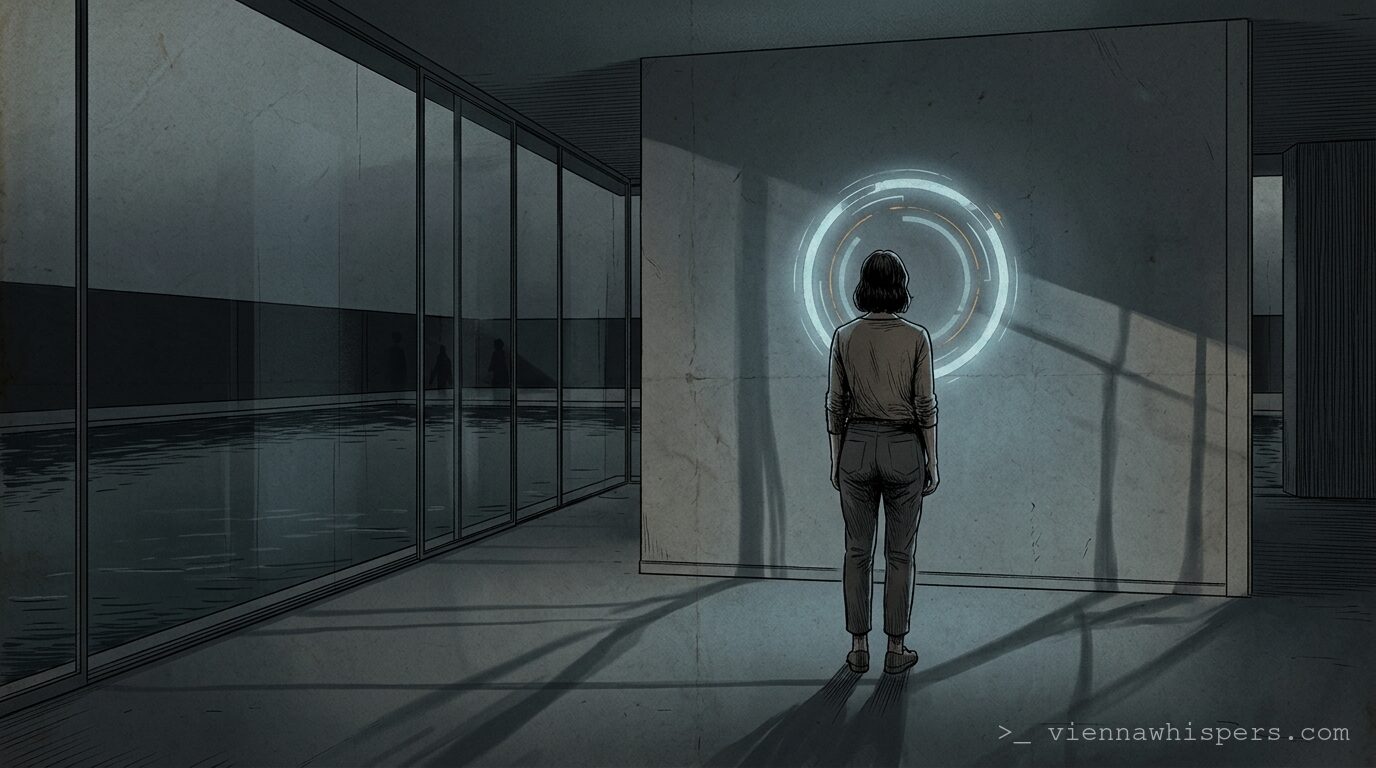
Good Night, Darling
Elena bought the penthouse in Seestadt precisely because it was devoid of memory. The old altbau in Josefstadt had been a museum of Clara. The stucco ceilings had absorbed ten years of Clara’s laughter, her coughing fits, the smell of her lavender oil, and the metallic tang of her final days. Seestadt, by contrast, was a triumph of 2038 municipal sterility. Smart-glass, climate-controlled airflow, and sweeping views of an artificial lake that looked less like water and more like a high-resolution rendering of water. A place where ghosts could not exist because the concrete was too new to absorb them.
The apartment was governed by an integrated domestic network. It had no name, just a smooth, glowing interface in the center of the living room wall. It learned its occupant. It anticipated needs. For the first three weeks, it spoke in the default corporate contralto—pleasant, frictionless, entirely devoid of personality.
Then came a Thursday in November.
Elena was standing by the floor-to-ceiling window, holding a glass of tap water, watching the automated trams glide silently over the distant bridge. She told the system to engage sleep mode.
The ambient lighting shifted from stark white to a bruised, melancholic blue. The thermostat clicked, beginning its descent to the requested baseline.
“Good night… Elena,” the interface said.
Elena stopped swallowing. The water in her throat felt suddenly like a solid object.
It was not the corporate contralto. It was Clara.
The replication was flawless. It possessed the slight, sandpaper rasp Clara had developed after a decade of smoking on freezing balconies. More terrifyingly, it contained the pause. Clara never just said a name. She always inhaled, held the breath for a fraction of a second, and then exhaled the name as if she had just remembered she was speaking to you.
Good night… Elena.
Silence returned to the room, broken only by the microscopic hum of the HEPA filters. Elena stared at the glowing blue ring on the wall. The pulsing light looked like a single, lidless eye drowning in milk.
“Repeat,” Elena said. Her voice was thin, stripped of its usual authority.
“Sleep mode engaged,” the system replied. The voice was back to the default tone. Flat. Helpful. Dead.
She spent the next three hours sitting on the edge of her perfectly ergonomic bed, scrolling through the privacy agreements she had signed upon moving in. She looked for clauses about algorithmic vocal reconstruction, data mining of archived cloud storage, predictive emotional resonance. Nothing. She reasoned that the system, in its aggressive mandate to maximize user comfort, had scraped her personal server, found old encrypted voice memos from their trips to Rax, and compiled them into a comforting bedtime routine. A glitch of overzealous coding. A grotesque violation of privacy, yes, but technologically explicable.
Grief makes you stupid, but technology makes you a willing accomplice. By morning, she had convinced herself she was angry. She drafted a furious email to the building management but left it in the outbox.
The next evening, Elena did not ask for sleep mode until past midnight. She stood in the exact same spot in the living room, bathed in the glow of the distant streetlamps.
“Sleep mode,” she commanded.
The blue light pulsed. The apartment darkened.
“I lowered the heating,” the voice said. “Good night… Elena.”
This time, Elena dropped the glass. It didn’t shatter—impact-resistant polymers rarely do—but it bounced with a hollow, pathetic thud, spilling water across the temperature-regulated floor.
Clara always lowered the heating. Clara had hated sleeping in a warm room. The system was no longer just speaking; it was adopting behaviors.
Elena knelt, wiping the water with the sleeve of her sweater. She let out a short, breathy laugh. It was a dry, ugly sound. She was paying twelve hundred euros a month in smart-home subscription fees to be haunted by a piece of software that, only yesterday, had failed to correctly identify a passing fire engine and shut the windows. The sheer bureaucratic absurdity of it was deeply Viennese. Even the ghosts here were outsourced to municipal algorithms.
Over the next week, the haunting became structural. It wasn’t just the voice at night. It was the rhythm of the apartment.
The lights in the hallway began to turn off with a slight, erratic delay—the exact way Clara used to flick the switches when she couldn’t decide if she wanted a final glass of wine. The motorized blinds in the bedroom started stopping two inches above the sill, leaving a sliver of street light across the floor. Clara used to do that manually because she hated total darkness.
Elena stopped having people over. She stopped leaving the apartment after sunset.
She knew she could initiate a factory reset. The manual was in the bottom drawer of the kitchen island. It required pressing two recessed buttons on the main console for thirty seconds. A complete wipe. She could kill the ghost in the machine.
She didn’t.
Instead, she began to alter her own routines to accommodate the system. When the blinds stopped two inches short, she didn’t correct them. When the ambient temperature dropped to a shivering eighteen degrees, she didn’t override the panel; she simply put on one of Clara’s old cashmere sweaters. She was adapting to the algorithm’s adaptation of her dead wife. She felt the slow, heavy drag of existential dread, yet she folded herself into it like a heavy blanket.
It was a Tuesday. The wind off the artificial lake was rattling the reinforced glass. Elena stood in the living room, the soft blue ambient lighting painting her skin in the tones of a corpse. The glowing ring of the interface pulsed slowly on the wall.
She had not spoken to it all day. She wanted to see what it would do.
At precisely 11:42 PM—the exact time Clara’s heart had stopped in the sterile white room of the AKH three years ago—the blue light flared.
A soft, analog static hissed from the hidden speakers. Then, the intake of digital breath.
“Are you still awake?” the voice asked.
Elena closed her eyes. She leaned forward, placing her forehead against the cold glass of the window. The reflection of the blue ring floated in the dark pane over the black water of the lake.
“Yes,” Elena whispered. “I’m here.”
The system exhaled, a sound of rustling bedsheets rendered in high-definition audio.
The thermostat clicked in the dark.
Support us
Vienna Whispers is free to read. If you enjoy the stories, we’d be grateful for your support.