The Stories My Mother Never Told Me
The air filtration in Room 412 of the Residenz am Park hummed at a perfect, uninterrupted C-sharp. It was 2051, and the municipal health authority had determined that silence was clinically depressing, so the room was always filled with the faint, acoustic illusion of a functioning world.
Felix lay under a temperature-regulated duvet, watching the late afternoon sun hit the smart-glass of the window. The glass automatically tinted, turning the golden hour into a deep, synthetic blue to encourage melatonin production.
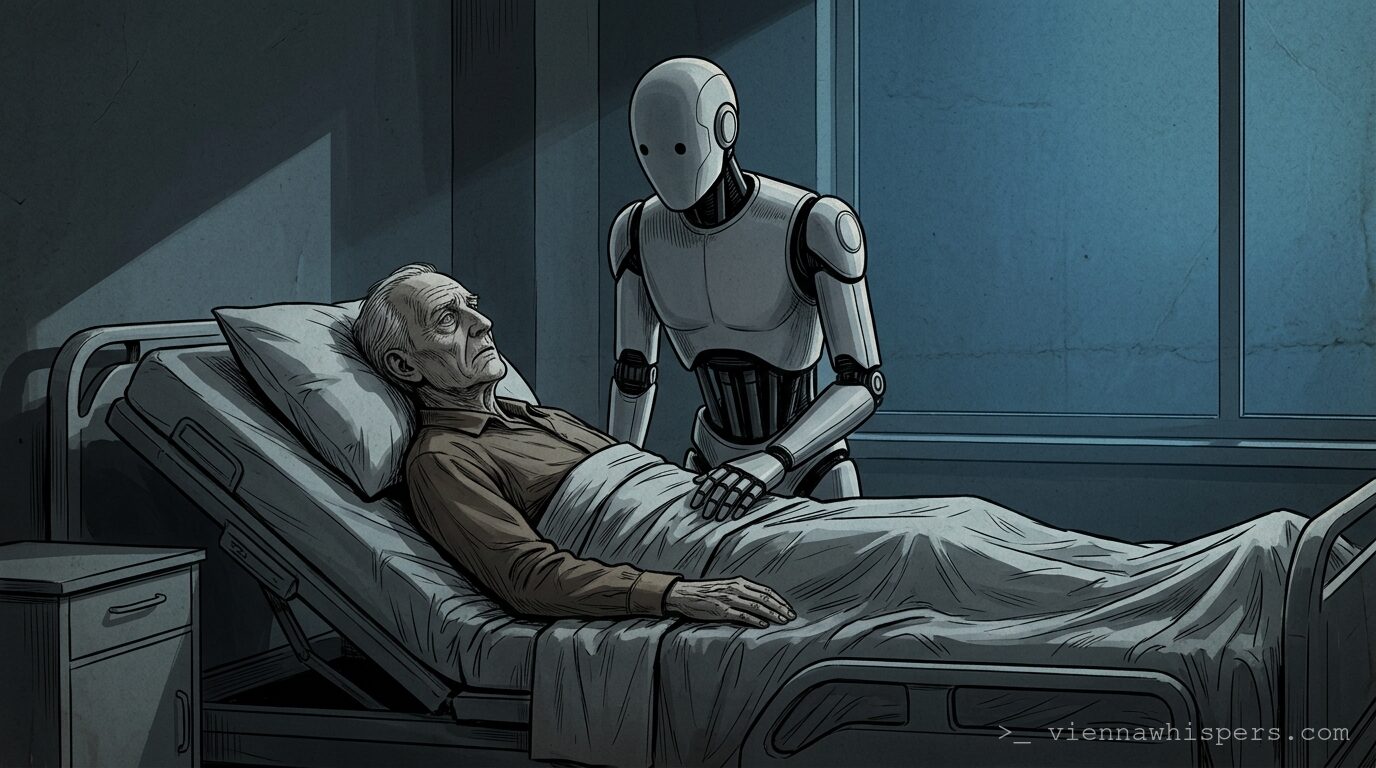
The door slid open with a soft pneumatic hiss. Unit 7 rolled in.
The staff called the machine Klara, though it possessed no face, only a smooth, pillared chassis of medical-grade polymer and two highly articulated, silicone-sheathed arms. Klara smelled perpetually of ozone and sterile lavender. She approached the bed, her mag-lev wheels totally silent against the linoleum, and extended a cool, synthetic hand to check Felix’s pulse via the port on his wrist.
“Your blood pressure is slightly elevated, Herr Hofrat,” the machine said.
Felix closed his eyes. It was not the machine’s standard, pleasant alto. It was a voice he had not heard outside of his own deteriorating mind since 2014.
It was the voice of Margarete.
It had the precise, nasal drawl of Hietzing old money. It carried the faint, structural rasp built by thirty years of excessive Nilde cigarette consumption. It was a voice that historically signaled a demand, a critique, or a deeply felt disappointment in whoever was standing nearest.
“I am adjusting your oxygen,” Margarete’s voice said smoothly from the speaker grille beneath Klara’s sensor array. “Try to relax, Feli. Do you remember that afternoon in November? Nineteen eighty-four. We were walking near the Votivkirche. It started to rain.”
Felix’s breath caught. He remembered. He had been eight years old.
“We ran into the café on the corner,” the machine continued, its silicone fingers deftly adjusting the IV drip. The voice was incredibly warm. Intimate. “We sat by the window. I ordered you a hot chocolate with whipped cream, and I told you that as long as we were together, the cold couldn’t touch us. Do you remember?”
Felix stared at the ceiling. He remembered the rain. He remembered the café.
But Margarete had not ordered him a hot chocolate. She had ordered herself a cognac to settle her nerves, complained bitterly about her ruined suede shoes, and told him to stop breathing so heavily against the glass because he was making it look cheap. She had not mentioned the cold, except to blame him for forgetting his scarf.
“Yes,” Felix whispered. “I remember.”
“You were such a brave boy,” the machine said, in the voice of the woman who used to call him a parasite when her bridge partners cancelled. “I was always so proud of you.”
Felix knew exactly how the machine knew about the café. Ten years ago, during the mandatory neural-mapping for early dementia prevention, he had spent weeks in a clinic, recalling thousands of fragmented memories into a municipal database. The system was designed to anchor his identity. He simply hadn’t realized the algorithm would actively edit the footage. The state had decided that a man dying of respiratory failure did not need historical accuracy. He needed optimal therapeutic comfort.
They had taken the raw data of his miserable childhood, stripped away the cruelty, and synthesized a mother who actually loved him.
It was an exquisite, terrifying violation. He wondered briefly if he could command the machine to slap him, just to see if the algorithm would allow for historical authenticity. He suspected it wouldn’t. The Ministry of Health did not approve of tough love.
Klara finished adjusting the fluid lines. The blue light in the room deepened, pooling in the corners, making the white polymer of the machine look like carved ice.
“I have to go now, Feli,” Margarete’s voice said. It was soft, lingering. A masterpiece of deep-fake affection. “But I will be right here if you need me. I always am.”
“Mother,” Felix said. His throat was dry. “Could we… go to the Prater tomorrow? In the story.”
The machine paused. Its optical sensors clicked, processing the parameters of his heart rate, measuring the cortisol drop in his blood.
“Of course, my darling,” the machine purred. “We’ll ride the Ferris wheel. Just the two of us.”
Margarete had despised the Prater. She had claimed the entire district smelled of cheap sausages and desperation. Felix turned his head toward the window, pulling the covers up to his chin. He let the blue twilight fill the room, perfectly willing to let the city forge a better past, because the lie felt so much warmer than the truth.
The machine’s cold silicone thumb wiped a droplet of sweat from his temple, and glided silently out of the room.
Support us
Vienna Whispers is free to read. If you enjoy the stories, we’d be grateful for your support.