The Baptized Rat
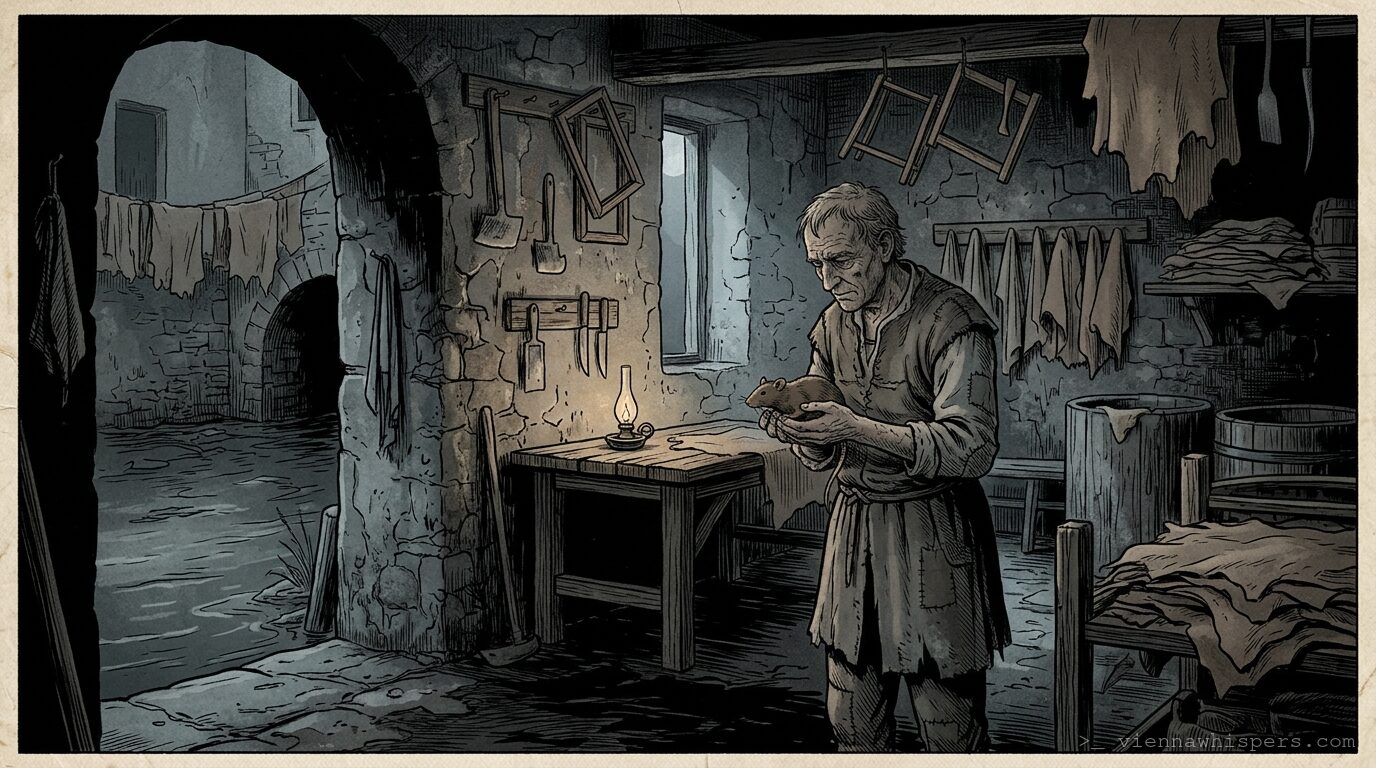
Ignaz possessed the hands of a drowned man. Sixty-seven years of scraping the fat from calf-hides and soaking them in vats of alum, lime, and stale urine had dyed his skin a permanent, necrotic blue-gray. He did not mind the look of them, nor the smell. The smell was his livelihood. He minded only that they were shaking.
It was the autumn of 1387. Down by the dead arm of the Wien river, where the water moved with the viscosity of cold stew and the banks were slick with the runoff of the Tanners’ Quarter, the air hung heavy and bruised. The sky was turning a deep, venous purple. Twilight in this part of the city did not fall; it settled, like silt over a riverbed.
Ignaz stood over his fleshing beam, holding a curved iron knife. Across the damp, sawdust-strewn floor, perched atop a stack of uncured sheepskins, sat a large brown rat.
The rat was grooming its left whisker. It used a rapid, cyclical motion of its front paw, pausing every three seconds to scrape at its incisors.
Ignaz watched this motion with clinical dread. He recognized the rhythm. It was the exact, irritating cadence with which his late wife, Elsbeth, had used a splinter of pine to dig caraway seeds from her teeth after Sunday dinner. She had died three weeks ago of a rapid, wet fever. The rat had appeared two days later, dragging its left hind leg. Elsbeth had suffered from a calcified left hip.
Ignaz was not an overly imaginative man. He dealt in the rendering of dead flesh into useful leather. He understood biology as a series of putrefactions that could be halted only by the application of Hundekot—dog feces—and bitter bark. But he also understood the bureaucratic nature of the divine. Elsbeth had died unconfessed, the priest unwilling to enter the house because of the black bile she was coughing up. Her soul was trapped. And the rat, he had concluded with the cold logic of the deeply exhausted, was the temporary vessel of her purgatory.
He did not want to save her out of any sweeping, romantic devotion. He wanted to save her because she was a notoriously vindictive woman, and if she spent eternity in the fires of Gehenna, he knew perfectly well she would find a way to blame him for the temperature.
He needed to baptize the rodent. And he needed to do it before the city magistrates arrived.
Down the muddy Gasse, perhaps four houses away, a rhythmic, heavy thumping echoed against the timber-framed walls. The Rattenfänger were working their way up the riverbank. Panic over the fever had gripped the inner city, and the Duke’s council had ordered a purge of the outer districts. The rat-catchers moved in teams of three, wearing heavy leather aprons and carrying iron-shod clubs and canvas sacks. They did not lay traps. They cornered, they crushed, and they burned.
They were brutal, efficient men. Ignaz could hear them now, smashing apart a pile of empty barrels in old Huber’s yard. A sharp squeak, a wet crunch, and a burst of coarse laughter floated through the damp twilight air.
Ignaz wiped his gray hands on his apron. He moved slowly toward the back of the workshop, his joints popping. Beneath a table laden with specialized scraping tools and jars of rancid brain-fat, he had hidden his baptismal font.
It was a cracked ceramic chamber pot.
The absurdity of the vessel did not bother him. Inside it sloshed nearly a pint of cloudy water, which he had siphoned from the stone stoup at St. Ruprecht’s church using a pig’s bladder. The theft had cost him a silver groschen to bribe a blind beggar who guarded the side door, and the water had acquired a slightly sour smell from the bladder, but it was consecrated. The grace of God, Ignaz reasoned, was a physical property. It could not be diluted by inferior pottery.
He pulled the pot from the shadows. The water rippled.
The rat stopped grooming itself. It turned its head and looked at him. Its eyes were black, convex, and completely devoid of human warmth. This, too, reminded him of Elsbeth when she was looking over his ledger.
“Stay,” Ignaz whispered, his voice raspy from decades of breathing quicklime dust.
He approached the stack of sheepskins. By all natural laws, the animal should have bolted. A wild sewer rat, confronted by a hulking shadow smelling of death and dog feces, ought to vanish into the floorboards.
The rat did not move. It merely adjusted its weight off its bad left leg and waited.
The silence between them felt strangely ancient. The ambient noise of the city—the distant tolling of the vesper bells, the shouts of the water-carriers, the rhythmic thud of the rat-catchers’ clubs—seemed to detach from the immediate reality of the tannery. Vienna was a vast, decaying organism, shifting in its sleep, indifferent to the microscopic parasites clinging to its damp edges. Yet here, in the stink of the workshop, an unnatural pocket of gravity had formed.
Ignaz felt the sudden, uncomfortable weight of the twilight. The shadows stretched across the floor like spilled ink. For a moment, looking at the fat, greasy rodent, the sheer lunacy of his premise threatened to buckle his knees. It was a rat. It was vermin. It ate garbage and bred in the mud.
Then the creature let out a low, wet, clicking sound in the back of its throat, precisely the noise Elsbeth made when she found a moth hole in her wool shawl.
Ignaz stopped thinking. The clinical imperative of the task took over.
He set the chamber pot down on a wooden stool. The thumping outside was closer now. He could hear the heavy boots squelching in the mud right outside his reinforced door.
“Aufmachen!” a voice barked. Open up. An iron club struck the thick oak of Ignaz’s door, rattling the iron hinges.
Ignaz ignored it. He dipped his right hand into the chamber pot. The holy water felt unusually cold, almost viscous. It clung to his blue-gray fingers.
He stepped toward the sheepskins. The rat raised its snout, sniffing the air. It did not retreat, but its whiskers twitched rapidly.
“Im Namen des Vaters,” Ignaz muttered, his voice barely audible over a second, violent crash against his door. The wood splintered slightly near the latch.
He reached out. The rat tensed, its back arching. Ignaz brought his dripping hand over its head.
“Und des Sohnes.”
He let a heavy drop of the church water fall. It struck the rat directly between the ears.
The effect was instantaneous and deeply uncomfortable to witness. The water did not soak into the fur; it beaded up, oily and resistant. The rat let out a sharp, hissing intake of breath. Its body gave a violent, unnatural shudder, a spasm that rippled from its wet skull down to its mangled tail. It looked up at Ignaz, and for a fraction of a second, the flat black beads of its eyes seemed to fracture, revealing an expression of deep, recognizable outrage.
“Und des Heiligen Geistes,” Ignaz finished, rushing the words. He flicked the rest of the water from his fingers. “Amen.”
The door exploded inward.
The iron latch tore free from the frame, and two men in heavy leather aprons burst into the gloom, bringing with them the smell of sweat, wet ash, and crushed bone. One of them carried a torch that smoked heavily, casting violent orange shadows across the vats.
“Magistrate’s orders,” the larger of the two grunted, not looking at Ignaz. He swung his club toward the corners of the room. “Check the skins.”
Ignaz did not look at the men. He looked at the stack of sheepskins.
The rat was gone.
Where it had been sitting, there was only a small, damp depression in the uncured wool, and a single, wet trail leading toward a crack in the masonry near the floorboards.
“You got a nest in here, old man?” the second rat-catcher demanded, kicking a tanning vat. The dark liquid sloshed over the rim, smelling strongly of ammonia.
Ignaz stood perfectly still. He looked down at his own hands. His fingers were still wet. The water from St. Ruprecht’s was drying on his skin, leaving a faint, chalky residue against the necrotic blue.
“No,” Ignaz said. His voice was flat. He wiped his hands on his apron, feeling the sudden, hollow absence of the uncanny. The room was just a room again. It was cold. It smelled of dog shit. “My wife always kept a very clean house.”
The larger rat-catcher spat onto the floorboards. He stepped forward, raising his heavy iron-shod club, and brought it down violently onto the crack in the masonry.
Something beneath the floorboards gave a sharp, wet snap.
Ignaz did not flinch. He picked up his fleshing knife and went back to the beam.
Support us
Vienna Whispers is free to read. If you enjoy the stories, we’d be grateful for your support.