The Voice from the Boiler
August in Vienna does not negotiate. When the temperature reaches thirty-eight degrees outside Ottakring station, the city simply stops pretending to be civilized. The asphalt softens. The exposed aggregate concrete of the 1970s Gemeindebau stores the sun all day and radiates it back at night, functioning as a slow-release oven for the working class.
But in the third sub-basement of Block F, it was forty-six degrees.
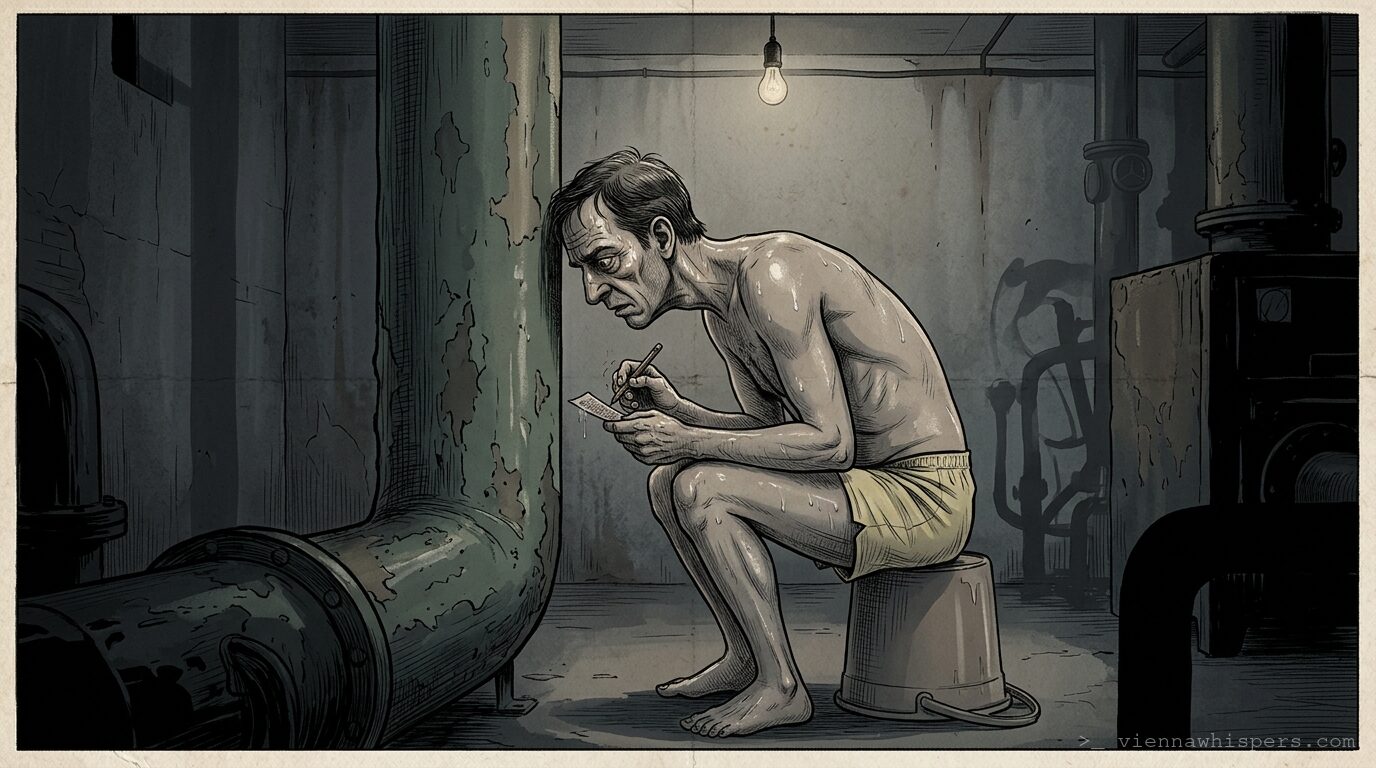
Martin Polasek sat on an overturned plastic bucket, wearing only pale yellow boxer shorts and rubber clogs. He was forty-seven, and currently, he was liquefying. Sweat ran down the deep furrows of his forehead, pooled in the graying hair of his chest, and dripped steadily onto the linoleum floor. He did not wipe it away. Movement cost energy. Movement distracted from the sound.
He held a stubby IKEA pencil and a damp lottery slip.
The primary return pipe of the central heating system was directly in front of him. It was painted a thick, institutional green, the surface peeling in strips that curled backward like dead skin. From deep inside the iron, beneath the rush of heated water, came the whisper.
It did not sound human. It sounded like a wet lung exhaling through crushed glass.
“…twenty-two…”
Polasek marked the box. His hand trembled, smudging the cheap ink with a salty thumb.
He had discovered the anomaly three weeks ago, during a routine flush of the expansion vessel. At first, he assumed the rhythmic scraping was just air trapped in the lines, a common enough defect in a building that had been neglected by the municipal housing authority since 1988. Then the trapped air clearly articulated five numbers and a jackpot supplement. Polasek had written them on a torn envelope, laughed a dry, rattling laugh, and gone upstairs to drink a beer.
Two days later, the Sunday paper confirmed that the trapped air was entirely correct. He had missed four point two million euros.
The shock had not produced regret; it had produced a crystalline, sociopathic clarity. He knew exactly what the money was for. It was for Monika.
Monika had left him four years ago. It was not a tragic departure. She had not gone to find herself, nor had she fled abuse. She had simply become bored by the smell of damp concrete and the sight of him eating Leberkäse from a foil wrapper every Tuesday evening. She now lived in a terraced house in Strasshof with a man who managed three branches of a mid-tier electronics store.
Polasek did not miss her conversation. He did not miss her body. He missed the version of his life where he had not been discarded for a man who sold HDMI cables. People rarely want love to return; they only want the humiliation of its departure to be retroactively canceled. Polasek had calculated the exact sum required to arrive in Strasshof in a tailored suit, purchase the property next door, and systematically destroy her new husband’s life through sheer, vulgar proximity.
Four million would do it.
But there was a logistical problem. The entity in the pipes only spoke when the water temperature exceeded eighty degrees Celsius.
It was the sixteenth of August.
To coax the voice from the metal, Polasek had bypassed the summer environmental controls. He had manually engaged the winter emergency override. For the past six hours, he had been pumping boiling water through the cast-iron radiators of eighty-four apartments above him.
Upstairs, the tenants were suffering a specialized kind of hell. The air outside was thirty-eight degrees; their living rooms were forty-two. Polasek’s phone had been ringing incessantly since noon. The building management app was blinking red with thirty-seven urgent maintenance requests. Radiators glowing. Unbearable heat. Please send someone. We are dying.
Polasek had placed his phone inside a rusted toolbox and closed the heavy steel lid. He did not care if they roasted in their beds. He only cared about the six boxes on the damp paper.
The entity had already given him seven, fourteen, twenty-two, and thirty-one.
He needed two more.
The heat in the boiler room was becoming forensic. The air was so heavy with hot iron and sour body odor that drawing a breath felt like swallowing a warm, wet towel. Polasek’s vision had begun to vignette, the edges of the room turning a soft, fuzzy black. His heart hammered a desperate, arrhythmic beat against his ribs. Severe dehydration was thickening his blood.
He leaned closer to the green pipe.
“Come on,” he rasped, his voice cracking from lack of moisture.
The pipe groaned. The metal expanded, a loud clack echoing off the low ceiling. But the whisper was fading. The entity was losing its voice.
Polasek stared at the analog pressure gauge on the main boiler. The needle hovered at the absolute edge of the yellow warning zone. The safety protocols dictated that the system would automatically vent if it reached the red. But Polasek knew this system. He had spent fifteen years replacing its valves. He knew the manual override for the restrictor.
He stood up. His knees buckled slightly, his calves cramping violently from the loss of salt. He dragged himself to the main distribution manifold and grabbed the heavy iron wheel.
It was a remarkably stupid thing to do. The pipes were fifty years old. The pressure would find the weakest joint, and when it did, the basement would fill with high-pressure steam. He would be boiled alive in seconds. He knew this perfectly well, and yet it seemed entirely reasonable. The math was pure: less heat meant less voice. Less voice meant Monika remained in Strasshof.
He gripped the wheel and turned it clockwise. It resisted, grinding in protest, then gave way.
The boiler roared. The needle on the gauge twitched, then climbed smoothly into the red.
Polasek stumbled back to his plastic bucket and collapsed onto it. The ambient temperature in the room spiked. Above him, the plastic casing of the fluorescent light began to warp, emitting a faint, sweet chemical smell as it melted.
He leaned his face toward the primary return pipe. The heat radiating from the metal was aggressive, a physical wall pressing against his cheek.
“…forty-three…”
The voice was clearer now. Richer. It sounded almost pleased.
Polasek smiled, his cracked lips splitting and welling with a single drop of thick blood. He marked the box. Five numbers. He just needed the final one.
The iron was so hot now that the green paint was blistering into black, popping bubbles. To hear the final number, he would have to get closer. The mechanical scream of the boiler was deafening, shaking pale dust from the ceiling.
Polasek closed his eyes and pressed his right ear firmly against the burning metal.
The flesh hissed. The smell of cooking meat filled the narrow gap between his face and the pipe. He did not pull away. He held his pencil ready, waiting for the whisper.
Support us
Vienna Whispers is free to read. If you enjoy the stories, we’d be grateful for your support.