I Don’t Want the Tablet
She pushes it across the herringbone parquet. It slides smoothly, a flat, heavy tile of black glass, coming to rest against the brass claw foot of the grand piano.
In this Alsergrund apartment, with its four-meter ceilings and stucco rosettes resembling frozen wedding cakes, silence is an expensive commodity. Her parents pay handsomely for it. They buy noise-cancelling headphones for her twelve-year-old brother, Leo. They buy ergonomic silence for themselves. And for five-year-old Lotte, they provide the glowing rectangle. It is the ultimate pacifier of the Viennese bourgeoisie—a window to endless, brightly coloured distraction, engineered to keep small bodies entirely still.
Lotte refuses it.
She does not have the vocabulary to explain that the glass is cold, or that the moving pictures feel like eating too much cotton candy until your teeth ache. She only knows that she wants the heavy double doors of the Altbau to bang shut. She wants the terrifying, electric thrill of footsteps approaching her hiding spot. She wants her father to roar like a tired bear, and her mother to point at the antique map in the hallway and tell her the names of cities that sound like incantations.
“Just watch the cartoon, Mausi,” her father says. He does not look up from his laptop. He is an architect, or perhaps an urban planner; in the golden, dusty light of late afternoon, his exhaustion is generic. “Papa has to finish this.”
Lotte stands in the center of the Persian rug. The light from the tall windows catches millions of dust motes, turning the air into a slow-moving river of gold. She looks at her father. She looks at Leo, who is slumped on the velvet sofa, his face bathed in the sickly, bluish corpse-light of a smartphone, his thumbs twitching in microscopic spasms. He looks like something preserved in formaldehyde.
Lotte kicks the tablet. Just a small tap with her wool-socked foot. It remains dark.
“I’m going to hide,” she announces. Her voice is small but perfectly clear, a silver spoon dropping onto a porcelain plate.
Her mother, passing through from the kitchen with a glass of Veltliner and a glowing screen of her own, offers a vague, automatic smile. “Have fun, darling. Don’t pull the curtains off the rails.”
It is the tragic misunderstanding of the modern parent. They believe a game can be played alone.
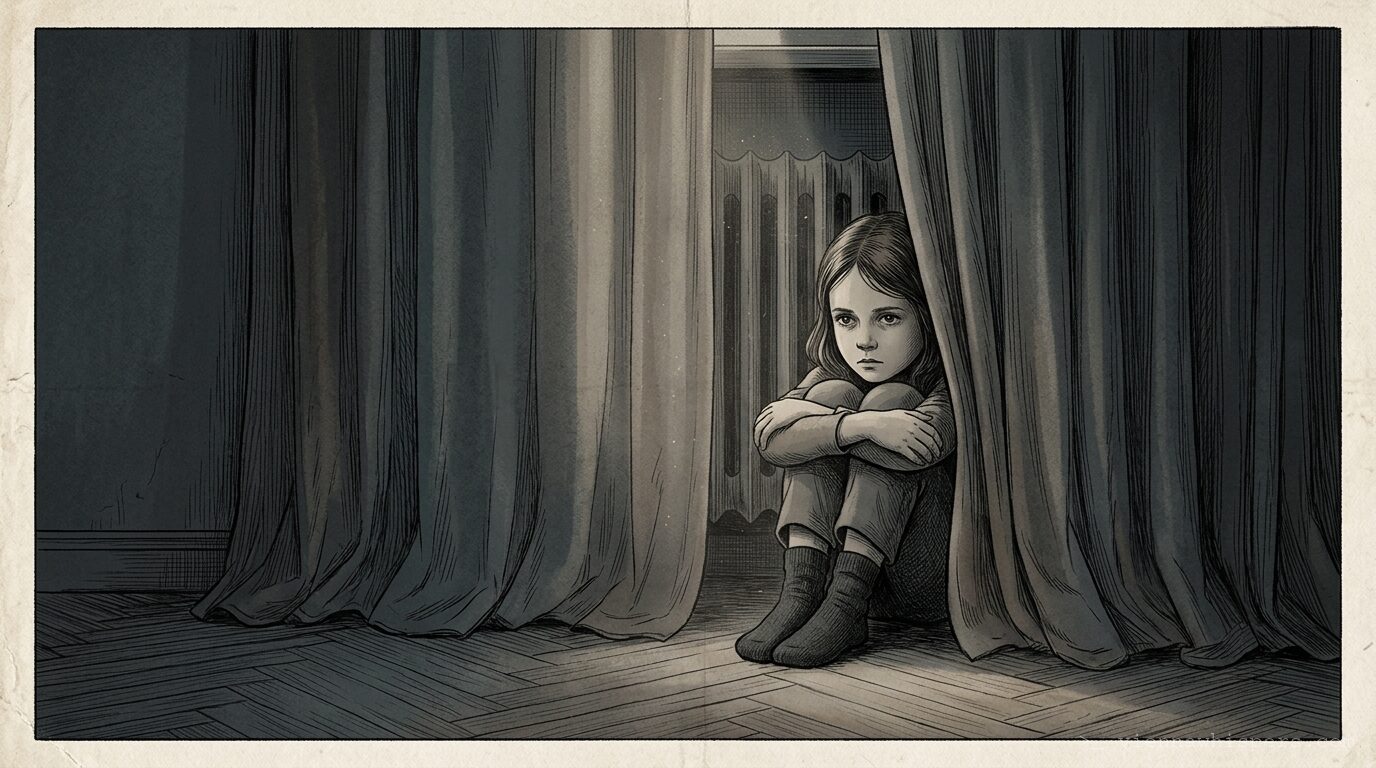
Lotte walks into the dining room. She selects her spot with the practiced eye of a guerrilla fighter. Behind the heavy, floor-length drapes of the bay window, there is a perfect, curved alcove. She slips behind the thick fabric. It smells of warm cast-iron radiators, dry velvet, and the faint, aristocratic decay of nineteenth-century Vienna.
She sits on the cool wood. She draws her knees to her chest. And she waits.
This is the best part. The anticipation. The knowledge that someone is looking for you, that your absence has created a vacuum in the house that must be filled. In proper hide-and-seek, the air grows tight. You hold your breath until your lungs burn. You listen for the creak of the third floorboard in the hallway, the one that always betrays the hunter.
Outside the window, a tram rattles down the Alserbachstraße, sending a faint vibration up through the masonry, right into Lotte’s spine. The real world is wonderfully heavy. It vibrates. It smells. It has shadows.
Ten minutes pass. The golden hour begins to rot into twilight. The amber light on the floorboards recedes, swallowed by the creeping purple shadows of the apartment.
Lotte listens. She hears the low hum of the refrigerator. She hears the soft, rhythmic tapping of Leo’s thumbs on glass. She hears her father sighing.
She waits for the heavy footsteps. She waits for the sudden, dramatic sweep of the velvet curtain, the mock-surprise, the physical confirmation that she exists and is worth hunting.
Another ten minutes. Her left foot falls asleep. The pins and needles are sharp, uncomfortable, and undeniably real. She presses her cheek against the cold plaster wall.
She realizes, with the slow, crushing clarity of a five-year-old, that they are not looking for her. They are enjoying the peace. They likely assume she has found another glowing screen somewhere, retreating into the quiet, compliant paralysis they so deeply crave.
A lesser child would cry. A lesser child would emerge, throw a tantrum, demand the attention she was owed.
But Lotte is a child of Vienna, and she is already learning the structural power of a stubborn delay. She does not leave the alcove. She wraps her arms tighter around her knees, embedding herself deeper into the shadow.
Let them panic, she thinks, though she does not possess the exact word for it. Let them search when the dark finally comes and the screens are no longer enough.
She closes her eyes, perfectly hidden in the center of her own home, breathing in the dust, holding the line.
Support us
Vienna Whispers is free to read. If you enjoy the stories, we’d be grateful for your support.