The Complaint Department of the Afterlife
Theresa died because she was in a hurry to save forty cents on a tin of cat food. She slipped on a patch of leaking milk near the checkout of a Billa in the 7th District. Her skull hit the tiled floor with a sound like a dropping melon.
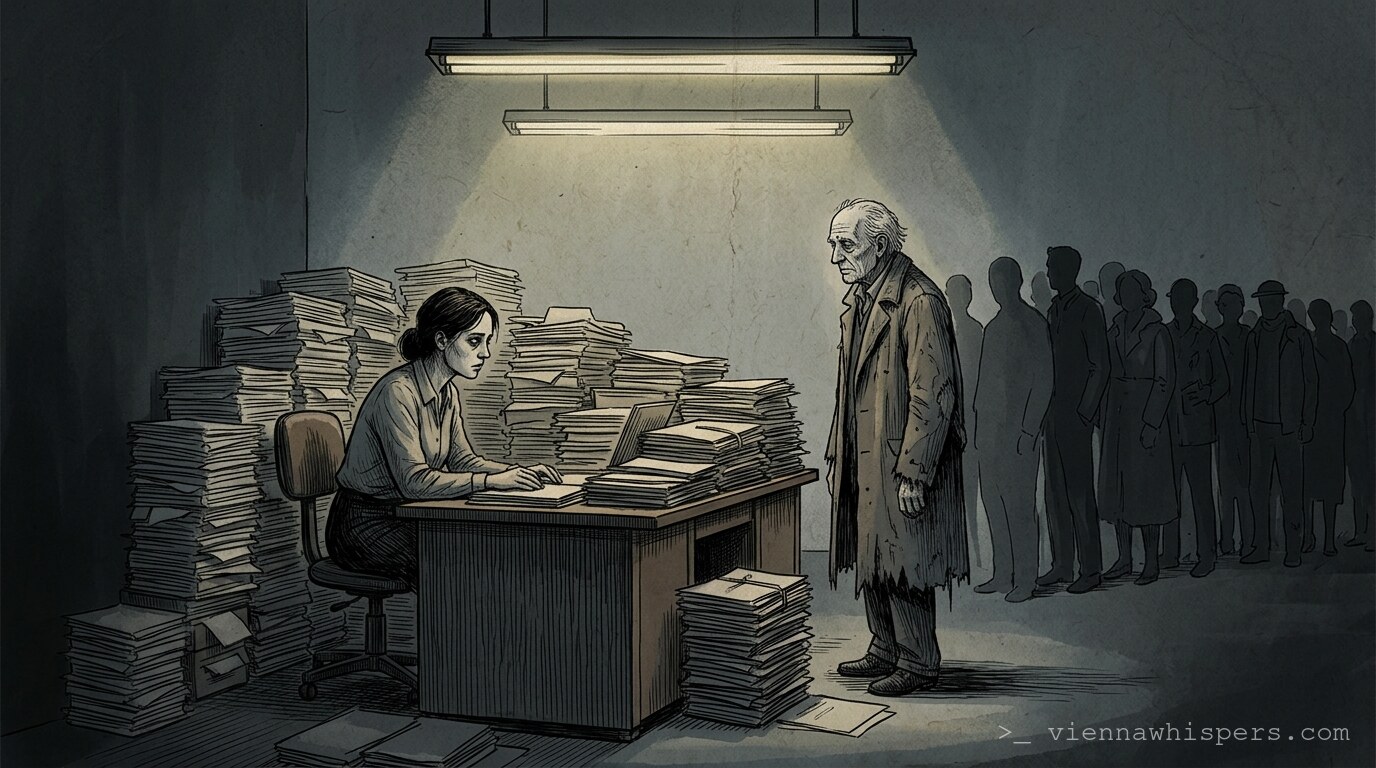
When she opened her eyes again, she was sitting behind a desk in a room that smelled aggressively of floor wax and stale cigarette smoke. It was, unmistakably, a Viennese Amt. The walls were the color of jaundice, the fluorescent tubes flickered with a maddening rhythm, and there was a small, handwritten sign on her desk that read: Complaint Department – Please take a number and wait for eternity.
“Number 4,209,” Theresa called out, her voice already flat with bureaucratic exhaustion.
An elderly man in a moth-eaten Loden coat drifted forward.
“It’s about the temperature,” he began. “They said eternal peace. They didn’t mention it would be a constant nineteen degrees Celsius. I have sensitive joints. I was promised heat. My neighbor, who was a known tax evader, has an actual radiator.”
Theresa pulled out Form 12-B: Grievances Regarding Environmental Allocation.
“Sir, your allocation is determined by karmic balance as processed by the Central Registry. If you find the temperature unsuitable, you may file an appeal. The waiting period is currently three centuries.”
“Three centuries?” The ghost scoffed. “In my day you got a decision in three weeks. This is typical! The whole system is rotten. I’d like to speak to a supervisor.”
“The supervisor is currently occupied with a backlog of complaints regarding the lack of proper Mozart concerts in the Void,” Theresa replied, stamping the form with quiet satisfaction. DENIED.
She watched the man drift away muttering. At least some things never change, she thought. Even death can’t fix Viennese entitlement.
The queue was endless. Next was a woman who had been killed by a falling gargoyle in the First District.
“I demand compensation,” she hissed. “I had a dinner reservation that night. I was supposed to have Schnitzel.”
Theresa didn’t even blink. “Your cause of death is logged as ‘Act of Urban Neglect.’ It is considered a standard risk of living in Vienna. If you want to complain about the masonry, you need to go to the Department of Unfinished Business. This is the Department of Post-Mortem Dissatisfaction.”
“It’s all the same bureaucracy,” the woman snapped.
“Technically yes,” Theresa agreed. “But structurally, we are on different floors. Please take the lift that never arrives. Eventually you’ll realize you’re already there.”
The woman drifted off, still complaining.
Theresa rubbed her eyes. Her coffee was perpetually lukewarm and tasted of wet cardboard. She had been at this desk for what felt like six months, or perhaps six minutes. Time here was broken — it moved only when it felt like it.
A young man who had died taking a selfie on tram tracks stepped up.
“I don’t have a complaint,” he said.
Theresa paused, genuinely surprised. “That’s highly irregular. Everyone has a complaint. It’s part of the induction process.”
The boy shrugged. “I just wanted to know if there’s Wi-Fi.”
“There is,” Theresa lied without hesitation. “But it’s dial-up. And it’s only active between 3:00 and 3:04 a.m. on Tuesdays.”
“Cool,” the boy said, and wandered off into the mist.
Theresa leaned back in her chair and looked at the mountain of files. She realized with a strange, dry clarity that she wasn’t being punished.
This was the afterlife.
Someone had to process the grievances. Someone had to tell the dead that their requests were being ignored with perfect bureaucratic precision. It was the same job she had done in life, only now the paperwork was eternal and the customers never left.
She pulled the next file. It was a complaint about the clouds being too fluffy and lacking sufficient substance.
Theresa grabbed her stamp and brought it down with satisfying force.
DENIED.
Outside the frosted glass, the dead kept queuing, their voices a low, rhythmic murmur of eternal, perfectly justified irritation.
Theresa didn’t look up. She didn’t need to.
The line was always there.
And the coffee was never, ever going to get better.
Support us
Vienna Whispers is free to read. If you enjoy the stories, we’d be grateful for your support.