The Specimen
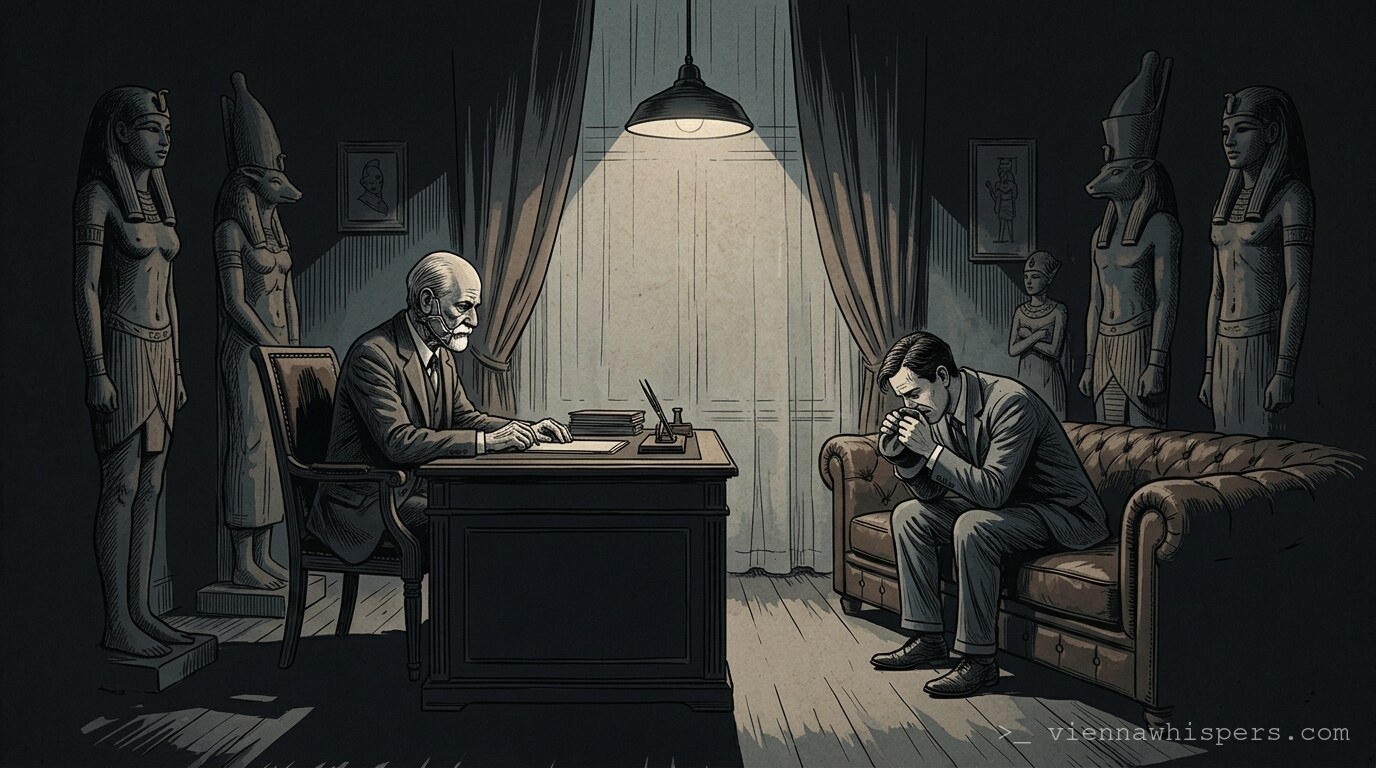
The air in the consulting room at Berggasse 19 had the consistency of curdled milk — thick with the sweet-rot of Virginia tobacco and the metallic, saccharine reek of a jaw slowly devouring itself. Sigmund Freud sat behind the heavy oak desk, anchored by the rigid prosthesis he privately called “the monster.” Every inhalation produced a soft, lubricated click, like a cheap lock trying to close on ruined bone.
The visitor — a minor clerk by the look of his frayed cuffs and the anxious throttling of his hat — perched on the edge of the leather couch. He had come uninvited, slipping into the house like a guilty draft.
“I have done something,” the man began, voice cracking. “It was not madness, Doctor. It was… a necessity.”
Freud did not lean forward. He simply observed. The way the man’s left thumb twitched against his knee. The micro-tremor in the tendons of his neck. The faint sheen of sweat on the upper lip. Textbook.
The visitor continued, desperate to be monstrous. He spoke of embezzlement, of silencing a junior clerk who had noticed the discrepancies. He wanted absolution or condemnation — anything but indifference.
Freud took a slow pull on his cigar. The smoke curled around the terracotta shabti figures on the shelves like incense offered to indifferent gods.
“You believe you have descended into the abyss,” Freud said, his voice thickened and slurred by the prosthesis. “You think you are a predator, a singular darkness. You have come here hoping I will name you exceptional.”
He exhaled. The click of the jaw was louder than the man’s breathing.
“You are not. You are an accounting error. A perfectly ordinary man who acted exactly as his wiring demanded. There is nothing profound in your little crime. Nothing that touches the depths. You are banal, Herr Hauer. Spectacularly, reassuringly normal.”
The visitor froze. The grand confession he had rehearsed for weeks collapsed into ash. He had wanted to be a devil. Instead, he had been diagnosed as a clerk.
Freud watched the man’s face with the detached interest of a pathologist examining a slide. The realization settling in — that there was no grand narrative, no tragic depth, only the grey, tedious machinery of self-preservation — was more devastating than any moral condemnation could have been.
The visitor stood, movements jerky, as though his strings had been cut. He left without another word.
Freud remained seated. The pain in his jaw flared, a bright, familiar fire. He adjusted the prosthesis with two fingers, took another pull on the cigar, and let the smoke drift toward the ceiling where it joined the ghosts of ten thousand previous sessions.
On the shelf, the ancient Egyptian figures stared with blank, eternal eyes.
Another specimen processed. Another soul measured and found unremarkable.
Freud reached for his notebook and began to write, the scratch of the pen the only sound in the heavy, indifferent night.
Support us
Vienna Whispers is free to read. If you enjoy the stories, we’d be grateful for your support.