The Seamstress of Karl-Marx-Hof
The Karl-Marx-Hof stretches for over a kilometer like a red brick wall built to keep the future at bay. In 1931 it had been a promise; by the time Elfriede moved into the forgotten utility closet on the fourth floor, it had become a monument to promises that had quietly died. The building was a Superblock, a socialist fortress of corridors and courtyards designed to house the working class in light, air, and sun. Instead, it had become a geometry of decay — long, identical balconies like firing slits, hollow courtyards that funneled the wind into a constant, low moan, and stairwells that smelled of damp concrete and boiled cabbage.
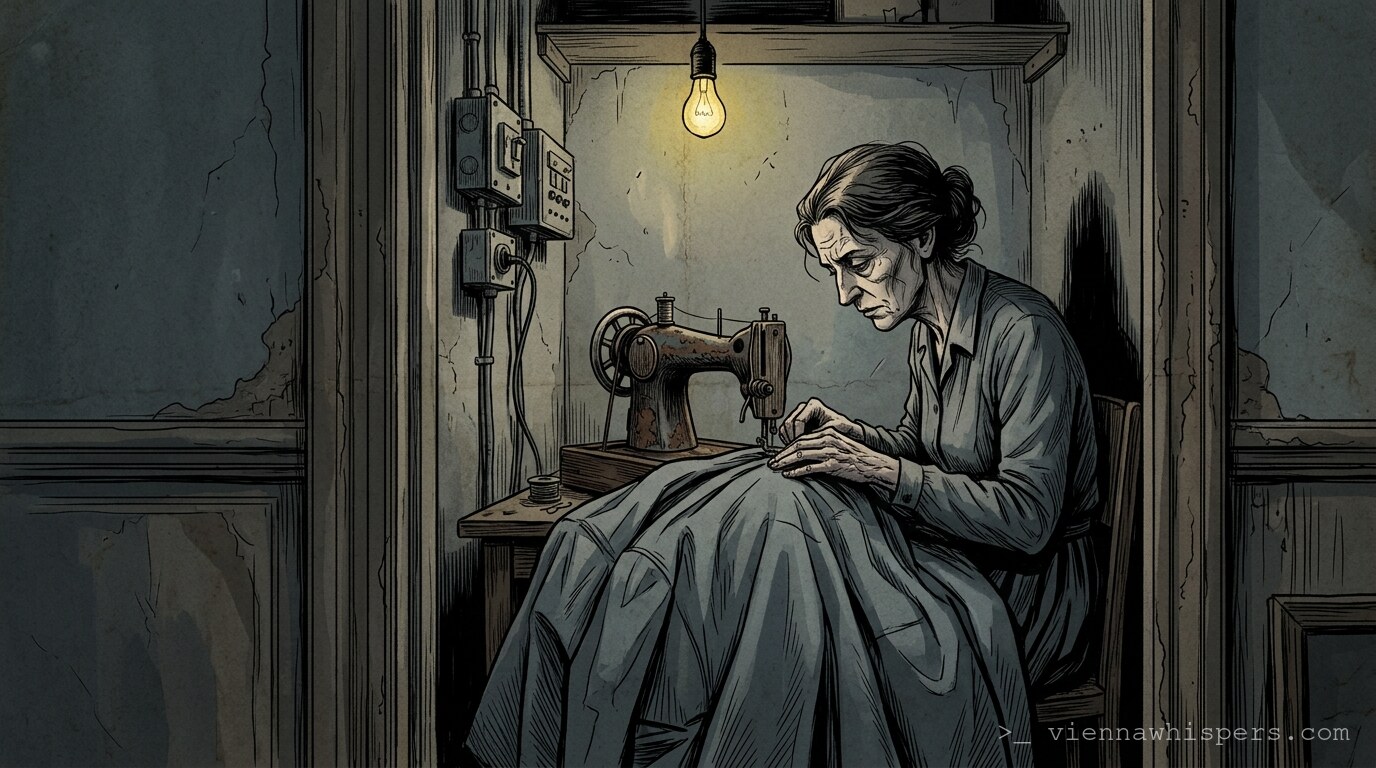
Elfriede was eighty-two. Her hands were maps of tiny scars and calluses, the skin stretched thin over knuckles that had long ago stopped pretending to be elegant. She sat under the single, sharp hum of an incandescent bulb that flickered with the same unreliable rhythm as the city outside. The closet was barely larger than a broom cupboard, but she had claimed it with the quiet efficiency of a parasite that had learned to love its host.
She did not live here illegally. She lived here precisely. The housing authority had listed the space as a utility closet since 1928. Elfriede had simply decided that brooms were overrated.
To power her world, she had opened the wall behind the cot with a rusty Meißel she had found in the basement in 1987. The plaster was brittle, the color of old bone, and it crumbled in dry, chalky flakes that settled in her lungs. She had worked at night for three weeks until she reached the main electrical trunk. The cables inside were from 1928, thick bundles of copper wrapped in brittle black rubber. The smell was immediate: ozone, hot dust, and the faint, sweet rot of old insulation. She had connected her Singer machine with stolen brass terminals. Every time she turned on the light, there was a soft pop and a faint blue spark. The current was stolen from the Gangbeleuchtung — the corridor lights that the Hausmeister turned off at midnight. Elfriede had learned to time her work to the moment the building thought it was asleep. The copper was warm under her fingers, almost alive.
Every evening she emerged in a shapeless gray coat, blending into the sea of pensioners heading to the Hofer for discounted milk. She hated the way they dragged their feet, the way they complained about the rising cost of heating oil, the way they assumed the walls around them were static, inanimate objects. She hated the modern tenants most of all — the young couples with their Ikea furniture. They had no idea that the history was living in them, slowly pressing against the inside of their skulls.
At 4:00 AM she often walked the long corridor toward the abandoned Gemeinschaftswaschküchen. The Waschhauskriege were long over. Now the long rooms were empty, the concrete basins stained with white kalk deposits that looked like bone. The air was thick with the ghost-smell of cheap Waschmittel. In the corridor of section 4B she often passed a man sitting on the floor, head in his hands, crying quietly. Elfriede observed him the way one observes a leaking pipe. He was an obstacle, nothing more.
Back in her closet, she worked by the weak yellow light. Her ledger was open, the pages yellow and brittle. She wrote with a stub of pencil, recording measurements without emotion:
Eintrag 112 – Westflügel, Sektion C: Schulterbreite 82 cm, linke Seite 9 cm breiter als rechte. Torso-Länge 40 cm bei einer Gesamthöhe von 1,12 m. Eintrag 115 – Treppenhaus D, Ebene 3: Drei Armansätze auf Hüfthöhe, rechter Arm 35 cm länger als linke. Ellbogen-Gelenk um 40 Grad nach hinten verdreht. Eintrag 121 – Keller, Sektion Ost: Gesamtlänge 2,14 m, aber nur 0,38 m Breite. Extremitäten-Ansatz 40 cm unterhalb des Sternums.
The Singer machine hummed. The needle rose and fell with the same relentless rhythm as the trams grinding along Heiligenstädter Straße far below. She finished a seam and bit the thread with her remaining teeth. She held the garment up to the light. It swayed gently, a hollow, man-shaped darkness.
She reached for her ledger to begin the next set of dimensions, but paused. Her hand, knotted with arthritis, trembled slightly. She realized, with a dry, detached irony, that she hadn’t measured herself in thirty years.
She picked up the needle again. The Singer machine resumed its steady, mechanical heartbeat.
Support us
Vienna Whispers is free to read. If you enjoy the stories, we’d be grateful for your support.