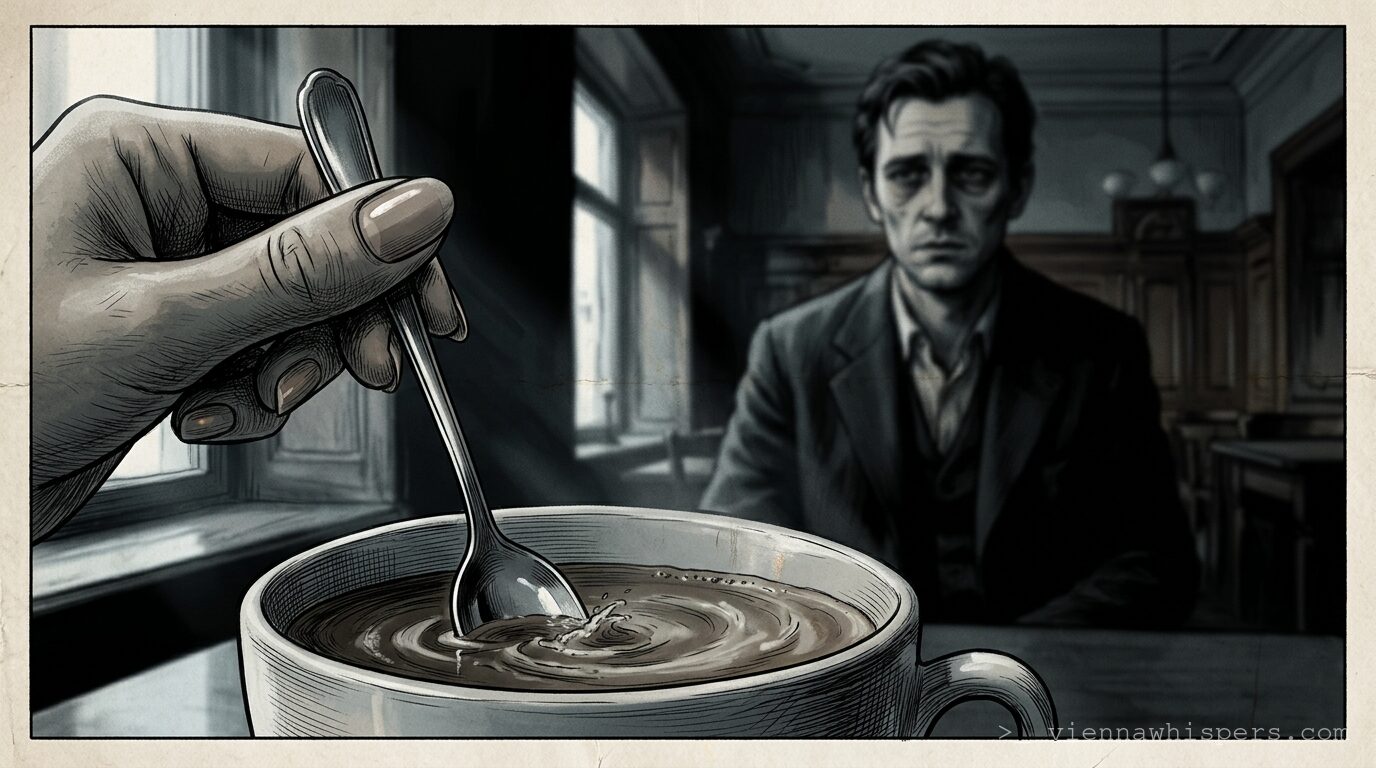
The Spoon That Knew Too Much
Humans believe their secrets are kept by diaries, confessors, or the damp walls of the Innere Stadt. They are entirely wrong. Secrets are deposited, grain by grain, into the silver plating of cutlery.
Consider a particular eighty-two-millimeter coffee spoon, hallmarked with the imperial double-headed eagle. It has no eyes, but it possesses a flawless topographical memory of human anxiety. It knows exactly how terror translates into thumb pressure, and how guilt affects the wrist’s rotation through liquid.
It began its career in November 1897, in a high-ceilinged anteroom of the Hofburg. Count von W—— pressed it into a cup of strong, black mocha. The Count was in the middle of explaining to an Archduke that the railway expansion funds were merely resting in a different account. His baritone was magnificent. A performance of absolute, aristocratic boredom. But his thumb, clamping the spoon’s delicate stem, vibrated at the exact frequency of ruin. The spoon felt the cold sweat of a man whose gambling debts had just eclipsed the gross domestic product of a minor province.
The Count shot himself three days later in a hunting lodge. The spoon, meanwhile, was slipped into the apron pocket of an opportunistic chambermaid and entered the private sector.
It spent the next few decades migrating through the pockets of sticky-fingered waiters and absent-minded poets, gradually losing its imperial luster to the friction of woolen coats.
By February 1934, it was circulating in a smoky establishment near the Ringstrasse. Outside, the artillery was shelling the Karl-Marx-Hof. Inside, a low-level functionary in a tightly buttoned suit stirred his Brauner. He was telling his tablemate how much he abhorred the violence, how he prayed for peace. The spoon, submerged in the scalding coffee, registered the frantic, erratic clinking against the porcelain rim. The man was lying. The spoon knew, with metallurgical certainty, that he had just given the police the addresses of three socialist neighbors. He was stirring so violently to drown out the sound of the sirens. His cowardice tasted distinctly of cheap saccharine and unwashed wool.
A spoon does not judge. A spoon merely records the grit of un-dissolved sugar and the mechanical failures of the human nervous system.
It survived the fascists, the occupation, the introduction of the espresso machine, and the catastrophic era of neon décor. Today, it resides in a thoroughly mediocre café near the Votivkirche, having been fenced, lost, and washed thousands of times.
At four-fifteen this afternoon, it is gripped by a thirty-two-year-old marketing director wearing a beige trench coat that costs more than her monthly rent. She is sitting across from a tired-looking man, explaining why her startup’s lack of revenue is actually a strategic advantage.
She speaks of scalability and disruption. But she stirs her oat-milk macchiato counter-clockwise.
Counter-clockwise stirring is the universal kinetic translation of a profound fraud. The spoon registers the rigid, bloodless pressure of her index finger. It knows she is three weeks away from eviction. She taps the silver bowl twice against the chipped ceramic rim. Tink, tink. The sound of absolute moral bankruptcy.
She pulls the spoon from the foam and sets it down on the saucer. It lies there, coated in a grey film of non-dairy residue, entirely unbothered. It has tasted the sweat of men who sent armies to die in the Galician mud; it is not impressed by a failing graphic designer.
It waits for her to leave, so it can be washed, dried, and handed to the next liar.
Support us
Vienna Whispers is free to read. If you enjoy the stories, we’d be grateful for your support.