The Archivist Who Was Never Born
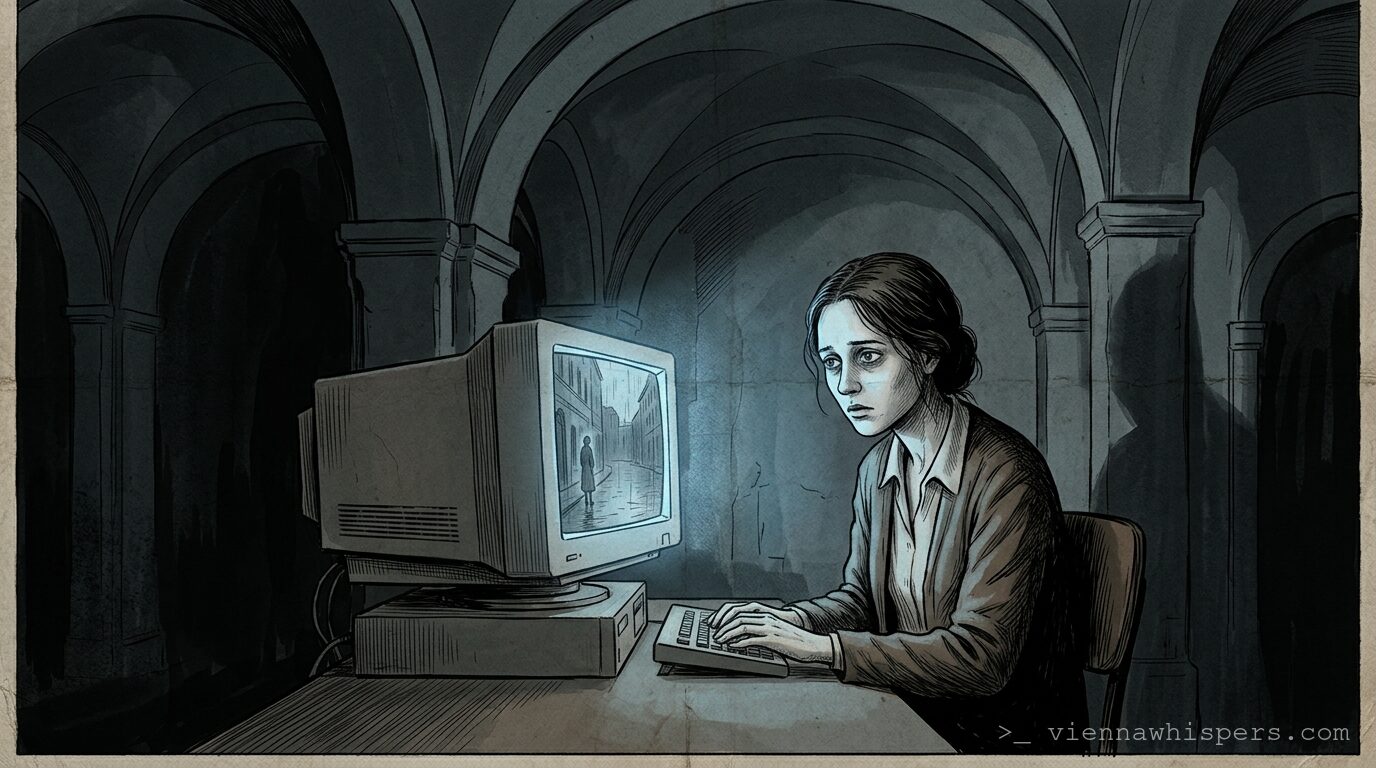
Clara Weiss was a Level Four Verification Officer in the Ministry of Memory, an institution housed in a Baroque palace on the Minoritenplatz that smelled, eternally, of ozone, floor wax, and dead empires. It was November 2047. Her job was to ensure that the city’s automated municipal archives matched the physical infrastructure. She cross-referenced automated surveillance feeds with zoning permits, ensuring that memory and reality remained in perfect, legally binding alignment.
She was very good at her job. She had the kind of pale, unremarkable face that seemed designed to reflect the soft blue glare of a terminal.
The anomaly appeared on a Tuesday, shortly before her lunch break.
Clara was reviewing pedestrian flow metrics from the Schottentor transit hub, specifically footage from the previous morning, during the heavy rain. She remembered the rain. She remembered her umbrella turning inside out near the Votive Church.
She summoned the feed to her screen. The camera angle was high, looking down at the wet asphalt and the black shells of umbrellas moving toward the tram platforms. She found the timestamp: 08:14 AM.
She watched the crowd. She saw the heavy man in the yellow raincoat who had bumped into her shoulder. In the footage, the heavy man shifted his weight, muttered something to the damp air, and altered his trajectory to step around an entirely empty patch of pavement.
The rain fell through the space where Clara should have been.
She frowned, tapping the heavy glass of her desk. An optical glitch. The city’s optimization algorithms often compressed redundant visual data to save server space. She must have been categorized as a redundancy. It was insulting, but structurally common.
She keyed in her personal biometric identification number to pull the raw, uncompressed feed.
The terminal blinked.
Error 404: Search parameters void.
Clara sat back. The ergonomic chair sighed beneath her weight. She opened a secondary window, bypassing the municipal feeds to access the internal Ministry personnel registry. She typed her name.
Weiss, Clara.
Level Four Verification.
Status: Terminated.
Not fired. Terminated. A designation usually reserved for discontinued software protocols or buildings that had been demolished.
She reached for her cup of synthetic melange. It was lukewarm and tasted faintly of copper, the way all automated beverages did lately. Her hand was trembling, just slightly, sending tiny ripples across the pale brown surface.
She spent the next three hours hunting herself.
She checked her residential file in Ottakring. The apartment was listed as vacant, slated for deep-cleaning on Thursday. She checked her bank registry. The account had been dissolved, the funds absorbed into a nameless municipal surplus trust. She checked the facial recognition logs at her local bakery. The baker was recorded handing a seeded Kornspitz to empty air, the copper coins appearing on his counter as if dropped by a ghost.
There was no grand conspiracy. There were no men in black coats coming to drag her away. The system was simply filing her away, executing a quiet, systematic pruning of an existence it deemed mathematically irrelevant.
To be erased from a city like Vienna is not a sudden violence; it is merely an administrative correction of someone who was never quite loud enough to matter.
At 14:00, her colleague Dieter walked into her cubicle. He smelled of cheap peppermint and the deep, abiding class anxiety that drove all mid-level bureaucrats.
“The heating is down in Sector B,” Dieter announced, looking at the wall directly to the left of Clara’s head. “They tied the climate control to the new biometric sensors. If the room doesn’t register enough body heat, it shuts off the radiators. Fucking algorithms.”
“Dieter,” Clara said.
Dieter scratched his chin. “I’m going to file a grievance. If I freeze to death before my pension vests, my wife will kill me.”
“Dieter, look at me.”
He blinked, his eyes sliding over her face like water over a smooth stone. He seemed momentarily confused, a man trying to remember a thought he had just lost. He checked his wrist-terminal. “Anyway. Good talk. See you tomorrow, maybe.”
He turned and walked away. He did not wait for a reply. He had not really been talking to her; he had been talking to the space she occupied.
Clara stood up. Her legs felt light. The existential terror she expected was entirely absent, replaced by a strange, cold clarity. She walked down the long corridor toward the washrooms. The parquet floor creaked under her boots, but the sound felt detached, as if it belonged to someone walking three steps behind her.
She entered the restroom and stood before the sink. The mirrors in the Ministry were smart-glass interfaces, designed to scan the retinas of employees and display targeted internal memos or health advisories.
Clara looked into the glass.
The mirror remained entirely blank. Worse than blank. It displayed the pristine white tiles of the wall directly behind her, perfectly rendered. It was as if light itself had reached a bureaucratic consensus to bypass her face. She raised a hand to her cheek. She felt the warmth of her own skin, the slight rough patch near her jaw. She was real. Flesh, blood, and bone. But the city had revoked its consent to perceive her.
She returned to her desk. She did not pack her things. What was the point? The objects in her drawers—a half-empty tin of lozenges, a spare charging cable—belonged to a Level Four Verification Officer who had never been born.
She logged off her terminal. The screen went dark, reflecting nothing.
Clara walked out of the archiving floor. She did not say goodbye to anyone. No one looked up as she passed. At the main entrance, she faced the heavy, automated security doors. They required a registered heartbeat and a thermal signature to open.
She stood before the glass. The sensors above glowed an indifferent red. The doors remained shut.
She waited. Ten minutes passed. Finally, a junior clerk from the taxation wing hurried toward the exit, buttoning his coat. The sensors flared green. The doors slid apart with a soft pneumatic hiss. Clara stepped smoothly into the gap, slipping out into the damp evening air just ahead of the clerk.
The Minoritenplatz was quiet. The cobblestones gleamed under the twilight. Since the energy reforms of ’42, the streetlights in the First District only illuminated when their motion sensors detected a registered citizen.
Clara took a step forward. Then another.
The lamps above her remained dark. She walked toward the Ringstraße, stepping lightly over the wet stones, moving effortlessly into the perfect, algorithmic night.
Support us
Vienna Whispers is free to read. If you enjoy the stories, we’d be grateful for your support.