Cradle of Humanity
The Natural History Museum was not a museum. It was a stone lung, heavy and ancient, breathing dust and the faint, sweet decay of millennia. In the high Pleistocene hall the light died slowly, sliding down the marble columns in thin, exhausted shafts before expiring somewhere between the floorboards and the bones.
Herbert “Herbi” Schachinger stood before the main display case, a small, greasy monument in a beige polyester suit that smelled permanently of burnt filter coffee and unwashed ambition. His skin had taken on the same yellowish-grey tone as the old exhibition labels. At forty-two he was already a fossil in his own lifetime.
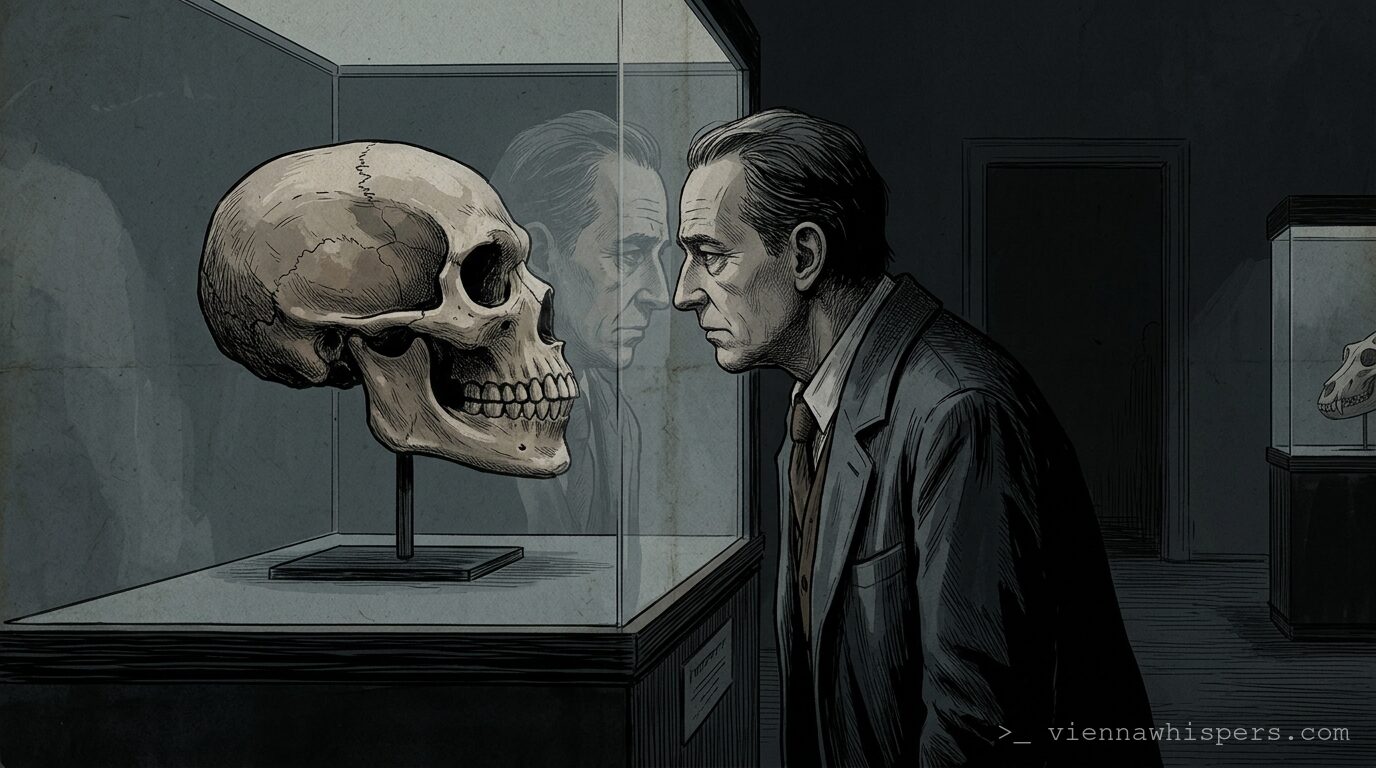
He pressed his right index finger against the glass, hard enough that the tip turned white and left a distinct, oily print directly across the brow ridge of a seventy-thousand-year-old Homo heidelbergensis skull. The print glistened for a moment, then dulled. A territorial marking. A claim.
The hall was almost empty. Only the low, rhythmic clank of the ancient heating system disturbed the silence — a sound like a skeleton trying, with infinite patience, to pick a lock it would never open. The air tasted of floor polish, old paper, and the sour wool of Herbi’s suit, which he had worn every day for the last eleven years.
Around him the exhibits watched.
The massive Irish elk stared down with glassy indifference. The Neanderthal family in the diorama seemed less like reconstructed ancestors and more like exhausted relatives who had long given up explaining anything to Herbi. Even the ammonites in their glass cabinets appeared to have arranged themselves in patterns of mild, geological contempt.
Herbi’s breathing was shallow and slightly moist. A thin film of sweat had formed on his upper lip, carrying the unmistakable note of cheap automat coffee and the metallic aftertaste of disappointment. He shifted his weight. The soles of his shoes made a soft, sticky sound against the polished floor.
A small group of Swedish tourists drifted past. Herbi turned toward them like a predator sensing weakness.
“Look at the sagittal crest,” he said, voice low and fervent. “Pure Third District. Stubborn. Defensive. Already complaining about the postal service before it even had a post office.”
The tourists smiled the polite, nervous smile of people who suddenly regret their choice of museum.
Herbi leaned closer to the glass, his breath fogging it. “Evolution requires bureaucracy. It requires the ability to stand in line for three hours to renew a passport you don’t even need. Only here could that level of refinement develop.”
One of the Swedish women ventured, “Sachertorte…?”
“Sach-er-tor-te,” Herbi corrected instantly, the word slicing through the air like a paper cut. “Not ‘Sasha-torte’. The ‘ch’ is important. It’s the sound of a man clearing his throat before telling you the bill is wrong.”
The young security guard appeared at the far end of the hall, walking with the slow, inevitable gait of institutional reality. His uniform was crisp. His expression was already tired.
Herbi didn’t move. He kept his finger pressed against the glass, the oily print spreading.
The guard stopped two meters away. “Herr Schachinger. Your break ended twenty minutes ago.”
Herbi stared at the skull. For a fraction of a second the empty eye sockets seemed to give him a small, exhausted, thoroughly Viennese nod — the nod of someone who has heard every theory and still has to stand here for another ten thousand years.
Herbi lowered his hand. The print remained, a faint, greasy signature on seventy thousand years of silence.
He turned and walked away without another word, the soles of his shoes sticking slightly to the polished floor.
The heating system clanked once more.
The Pleistocene hall settled back into its proper state: heavy, indifferent, and slightly amused.
Support us
Vienna Whispers is free to read. If you enjoy the stories, we’d be grateful for your support.