The Boy Who Fed the Sparrows
The courtyard of the Gemeindebau in Simmering was not a place for play. It was a functional rectangle of concrete and clipped hedges, designed in the 1970s to contain human life with maximum efficiency and minimum sentiment. At 5:47 PM in late August the heat stood in the air like a wall of warm glass. It pressed down on the grey pavement, on the metal railings, on the perfectly spaced bird feeder that someone from the Hausverwaltung had mounted on a thin pole in the exact center.
Lukas sat on the edge of the concrete balcony of the third floor, legs folded neatly beneath him. He was nine. His white socks were pulled up precisely to the middle of his calves, the left one slightly higher than the right. On his wrist his Casio digital watch blinked 17:47 in small green numbers. He liked numbers. They did not make unnecessary noise.
Below him, the sparrows were committing their daily violation of Ruhezeit.
They fluttered and squabbled around the feeder with frantic, pointless energy — tiny brown bodies full of chaotic motion and shrill, serrated chirps that drilled through the closed windows of the flat where his mother lay in the darkened bedroom with a damp cloth over her eyes. The migraine had come again. It always came when the birds were loud.
Lukas held six small, white, granular pellets in the palm of his left hand. They smelled faintly of the industrial cleaner his mother used when the flat felt wrong. He had mixed them himself in the kitchen while she slept, rolling the damp bread crumbs between thumb and forefinger until they were firm and perfectly spherical. Symmetry mattered.
The courtyard was empty of people. The residents were either at work or, like his mother, surrendered to their bodies’ failures. The only movement came from the sparrows and the slow, heavy shimmer of heat rising from the concrete.
The light in the courtyard was wrong. It was a thick, golden syrup that did not belong to any natural afternoon. It coated the grey walls, the metal railings, the plastic playground equipment that no child had touched in weeks. It gave everything a false, exhausted glow — the color of something that had once been alive and was now merely maintaining appearances.
Lukas watched the birds with the calm, clinical attention of a technician observing a malfunctioning system. He noted the exact rhythm of their arrivals, the unnecessary flapping of wings, the constant, wasteful noise. They were variables. Loud, inefficient variables interfering with the necessary recovery process upstairs.
He did not hate the sparrows. Hate was an emotional surplus. He simply understood that they were the problem, and problems required adjustment.
The heat pressed against his skin. A single drop of sweat ran down the side of his neck and disappeared into the collar of his pale blue T-shirt. He did not wipe it away. Movement was noise.
The Casio on his wrist blinked to 17:48.
The sparrows continued their senseless, chaotic performance.
The courtyard waited — heavy, grey, indifferent — under the thick golden light that promised nothing and forgave nothing.
Lukas sat perfectly still, the six small white pellets resting cool and dry in his open palm.
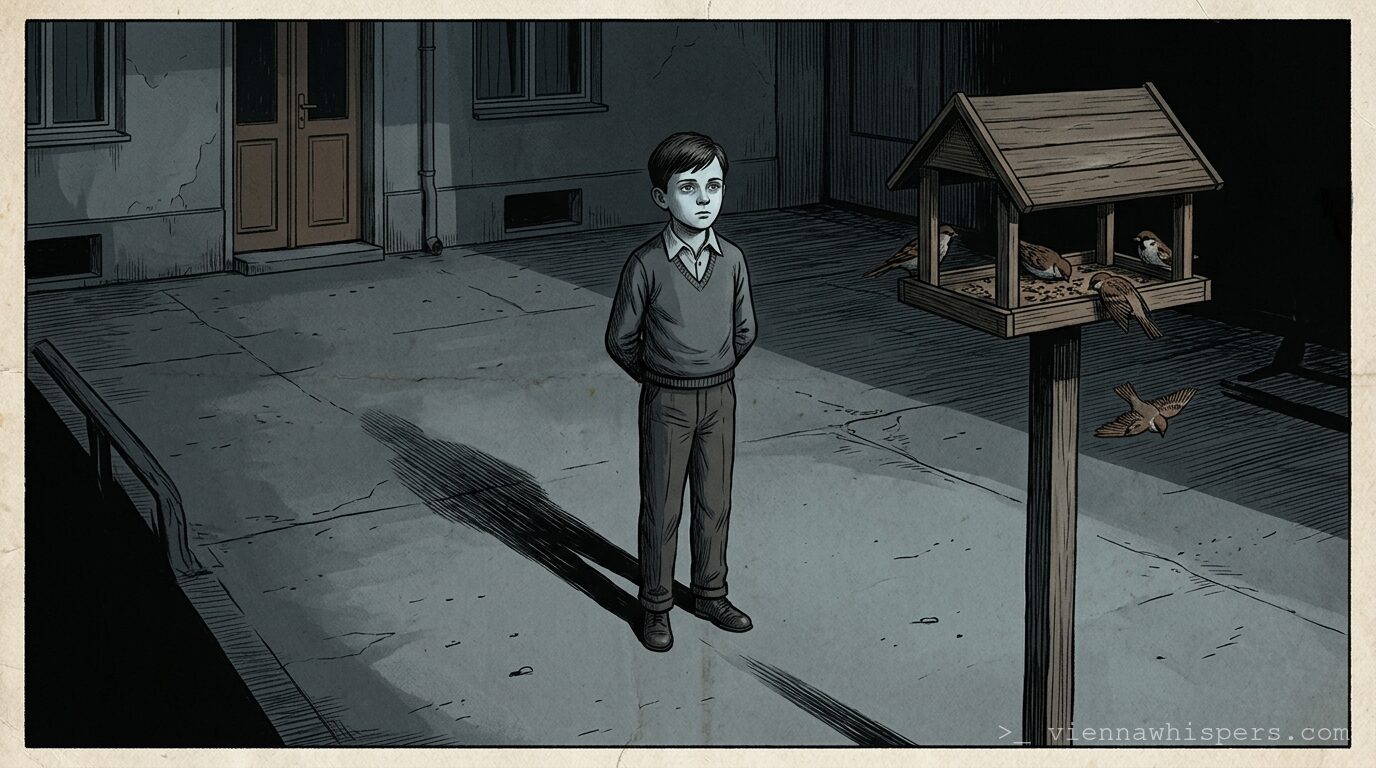
Lukas stood up from the balcony at 17:59. He moved with economical precision, socks pulled high, Casio watch blinking. He slipped the six small white pellets into the left pocket of his shorts and descended the stairs without making a sound.
The courtyard was empty. The heat still pressed down like a lid.
He approached the wooden feeder on its thin metal pole. He did not scatter the bread. Scattering was chaotic. Instead he placed the pellets at exact intervals along the rim — a symmetrical constellation of silence. When he was finished he stepped back three paces, hands clasped behind his back, and observed his work. It was good.
The first sparrow landed at 18:03. It was small and dusty. It pecked once, twice, then shook its head in a quick, surprised jerk. Its throat worked in rapid spasms. After eleven seconds its legs lost their grip. It slid sideways down the metal pole and landed on the concrete with a soft, final thud. Its wings twitched twice, then stopped.
Lukas watched without blinking. The bird’s eye remained open, bright black for a moment, then the light inside it simply went out, like a switch flipped in an empty room.
Two more sparrows came. Then three. They ate quickly. One managed a short, drunken flutter before collapsing against the hedge. Another fell straight down and lay on its back, legs curled like tiny question marks. None of them made noise anymore. The variables had been adjusted.
At 18:14 the courtyard was perfectly still.
Lukas stood motionless in the center of the silence he had created. The heat shimmered above the concrete. The golden light had begun to fade into blue hour. Everything was finally organized.
He looked down at his own hands. Small. Pale. A little dirt under the fingernails. For a brief second he wondered if he too was only a variable — noisy, inefficient, waiting for someone to solve him with a piece of bread.
He shook the thought away. It was unnecessary noise.
Lukas turned and walked back toward the stairwell. The banister felt cold under his palm. Upstairs his mother was resting. The flat was quiet. The courtyard was quiet.
The world was finally organized.
Support us
Vienna Whispers is free to read. If you enjoy the stories, we’d be grateful for your support.