The Frequency of Silence
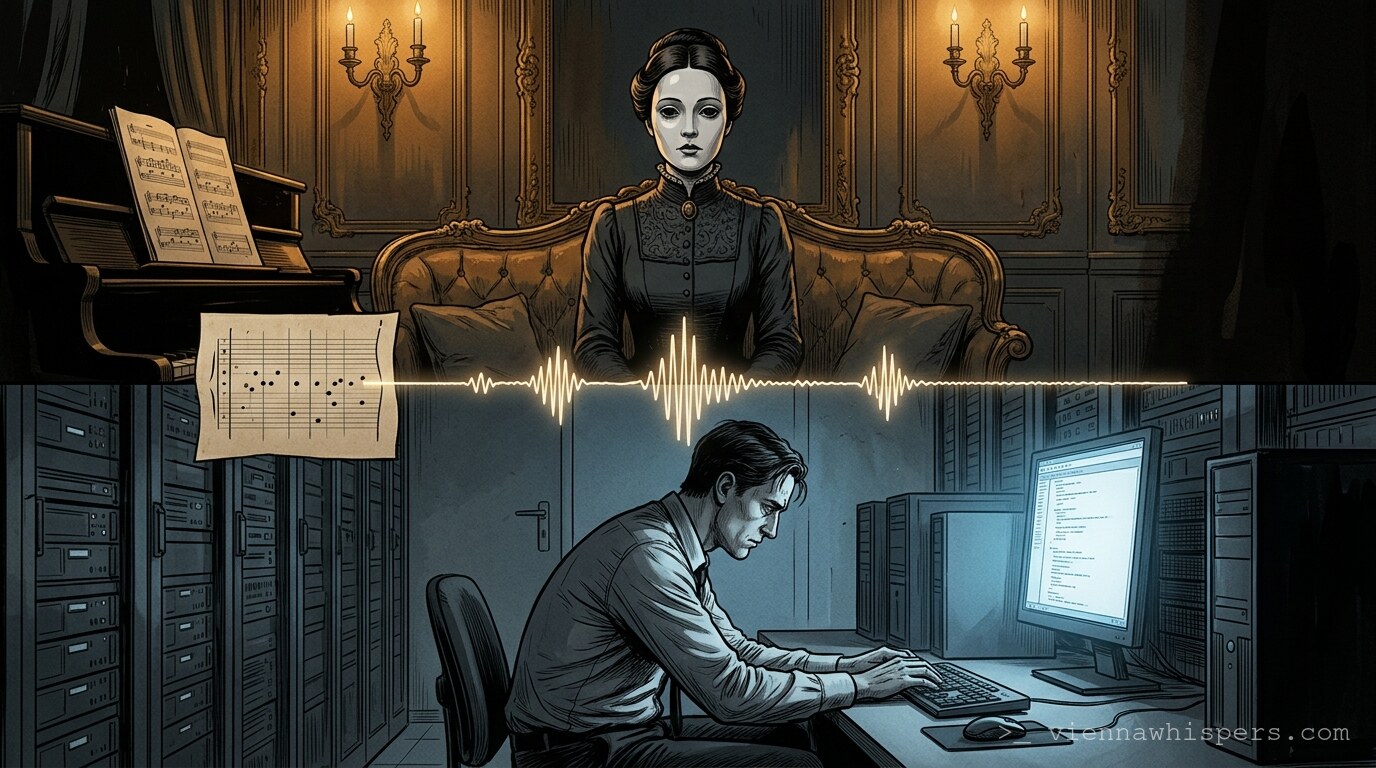
The piano roll in the salon did not play music. It played a sequence of mechanical interruptions.
Hedwig sat on the velvet ottoman, knees pressed together, conscious of how the silk of her dress pulled across her thighs. The industrialist to her left was speaking about steel output, his breath smelling of expensive tobacco and impending war. He leaned closer, eyes sliding over her face like a thumb over polished stone.
“You are quiet tonight, Hedwig,” he whispered. “Is the music not to your taste?”
“The music is perfect,” she replied, her voice flat and calibrated. “It is the repetition that strikes me. It is so easy to predict where the note will fall next.”
In the Döbling server room seventy years later, Stefan stared at a monitor bleeding blue light into the grey. He was eating a dry Mohnzelten, poppy seeds catching in his molars. He was looking for signal leakage, for the ghost in the machine causing packet loss.
The waveform on the screen oscillated — a rapid, rhythmic hopping between frequencies that defied the logic of the local network. It was, by all technical standards, an error. Noise masquerading as information.
“Damn thing,” he muttered, scratching the eczema on his forearm.
Back in the salon, the air grew thick with jasmine and stale sweat. Hedwig watched a man stumble against the piano, his elbow grazing the keys. A discordant clatter filled the room. No one blinked. They were too busy discussing the inevitability of expansion, the geography of power.
Hedwig felt a sudden, sharp clarity: she was not a participant. She was an ornamental fixture, like the clock on the mantel or the heavy drapes that kept the night air from violating the interior.
She excused herself. In the hallway, she caught her reflection in a pier glass. She looked at herself — really looked — and saw nothing but a surface, flawless and offering no purchase for the mind. She hated the reflection.
Stefan, in the server room, finally reached a conclusion. He decided the frequency-hopping error was likely caused by a faulty grounding wire. It was a mundane explanation for a profound phenomenon. He made a note in the ledger — Interference detected; hardware check required — and closed the file.
He didn’t know he was looking at the digitized skeleton of an idea born in a Viennese salon, conceived as a way to hide torpedo signals from German submarines. He didn’t know that the technology powering the global network had been invented by a woman the world remembered only as beautiful.
Hedwig returned to the salon. The industrialist found her near the doorway and placed a possessive hand on the small of her back.
“Come,” he said. “The car is waiting.”
She followed him into the biting Viennese winter. High above the city, signals began to move — jumping from one invisible node to the next, weaving a web that connected every corner of the world.
The technology was everywhere, humming in pockets, traveling through the air like a ghost.
Hedwig looked up at the stars, obscured by the haze, and felt nothing at all. She climbed into the back of the car, pulled the blanket over her knees, and allowed herself to be driven into the dark, her mind already calculating the next sequence of silence.
The server room went dark. The hum remained.
The city continued its slow, mechanical respiration, indifferent to the brilliance that had been lost — or the infrastructure that now ran on its forgotten bones.
It was just another night in Vienna, where everything of importance was buried in the space between the notes.
Support us
Vienna Whispers is free to read. If you enjoy the stories, we’d be grateful for your support.