The Clerk Who Optimized the Coffee Break
Before Frau Fachoberinspektorin Claudia Wagner intervened, the morning coffee break on the third floor of the Ministry of Commerce lasted approximately forty-seven minutes. It required the boiling of hard Viennese tap water in three distinct electric kettles, the sequential fetching of milk from a refrigerator that smelled faintly of liverwurst, and a minimum of twenty minutes spent complaining about the draft from the double-casement windows.
Claudia considered this a failure of the state. It was October 1974, and the modern world demanded flow.
She began her campaign with a stopwatch disguised as a pendant watch, hung sensibly over her grey wool cardigan. She recorded Hofrat Wessely, noting that he took fourteen sluggish steps to the sink, halted twice to scratch his neck, and spent four minutes waiting for the water to boil while staring blankly at the courtyard wall. Multiply this by twenty-two clerks, Claudia calculated, and the Republic was bleeding hours.
Efficiency in Vienna is not a metric; it is an insult to the passage of time. But Claudia had the terrible, blind energy of a woman who genuinely believed the folders in her outbox mattered.
Her first reform was the communal thermos. She arrived at six-thirty, boiled the water centrally, and placed the insulated jugs at equidistant points along the linoleum hallway. The clerks, unnerved by the sudden absence of the kettle’s roar, simply poured in silence and returned to their desks. Twelve minutes saved.
Next, she tackled the pastries. Instead of allowing the junior secretaries to dawdle at the bakery on the corner, exchanging gossip through the cigarette smoke, Claudia arranged for a standing delivery. Punschkrapfen and Topfengolatschen were distributed directly to the desks by nine in the morning, sealed tightly in cellophane. There was no longer any need to discuss who owed whom three Schillings.
The used spoons rested on their grey desk blotters by ten-fifteen like tiny, exhausted silver fish.
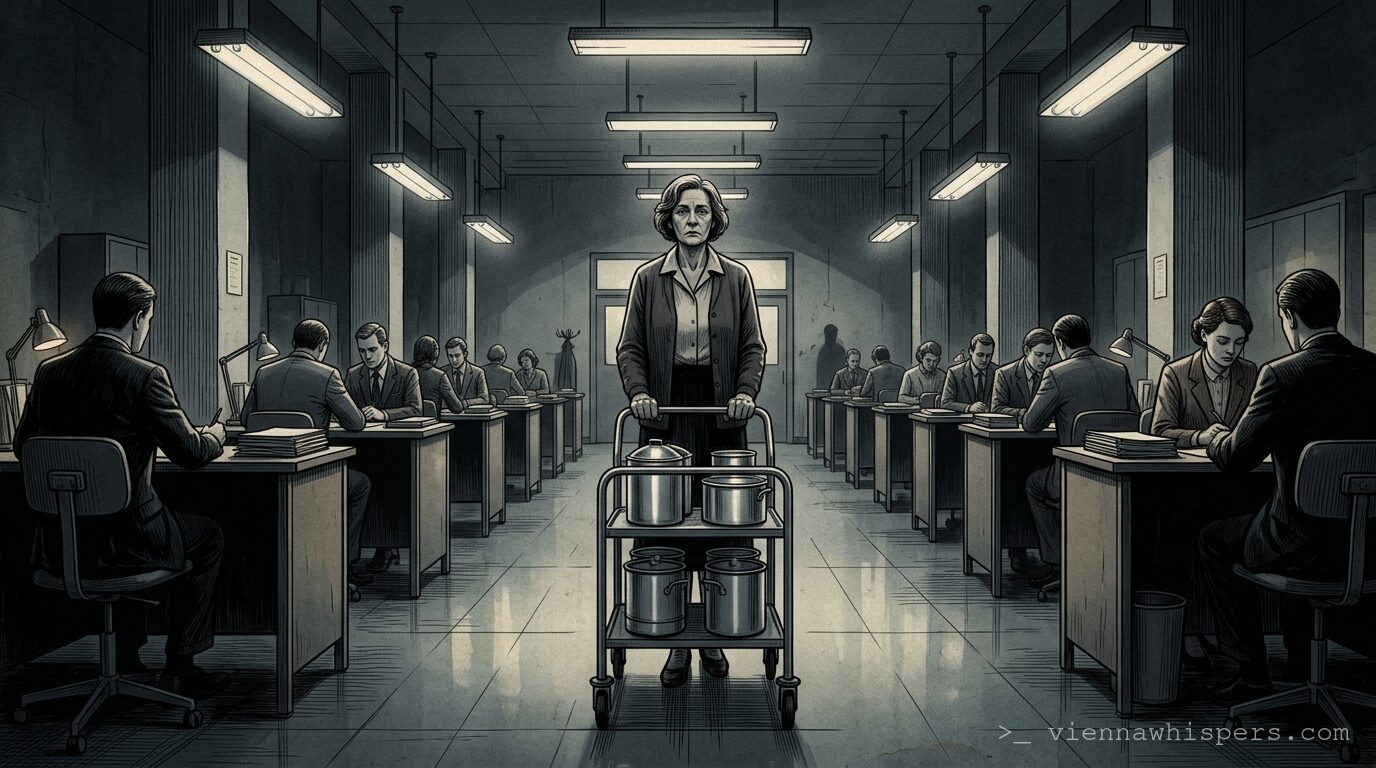
By November, she eliminated the hallway entirely. She requisitioned a metal postal cart, greased the wheels, and converted it into a mobile dispensary. She rolled it through the corridors herself, doling out precisely one cup of lukewarm Meinl coffee to each desk. No sugar packets were permitted—too much tearing and stirring time. She pre-dissolved the sugar into the main aluminum vat.
If a clerk attempted to speak to her about the weather, she simply tapped the crystal face of her pendant watch and moved to the next door.
It was a masterpiece of logistics. Claudia acted utterly against her own biological needs—she had not actually swallowed a drop of coffee herself in six weeks, convinced that the sight of the perfectly synchronized consumption was far more nourishing to her nervous system.
By mid-December, the coffee break on the third floor had been optimized down to exactly three and a half minutes.
The clerks did not leave their chairs. They did not speak to one another. At ten sharp, the cart squeaked past. They received their porcelain cups, swallowed the tepid, pre-sweetened brown liquid in three efficient gulps, and returned to their typewriters. Nobody took a break anymore. The concept had been successfully streamlined out of existence.
At ten-o-six, Hofrat Wessely sat at his desk, staring at his empty cup. He had ninety-four uninterrupted minutes until lunch. He opened a file on municipal gravel allocation, closed it, and began to softly, methodically, tear his blotting paper into perfectly even strips.
Support us
Vienna Whispers is free to read. If you enjoy the stories, we’d be grateful for your support.