The Ashtray Full of Other People’s Regrets
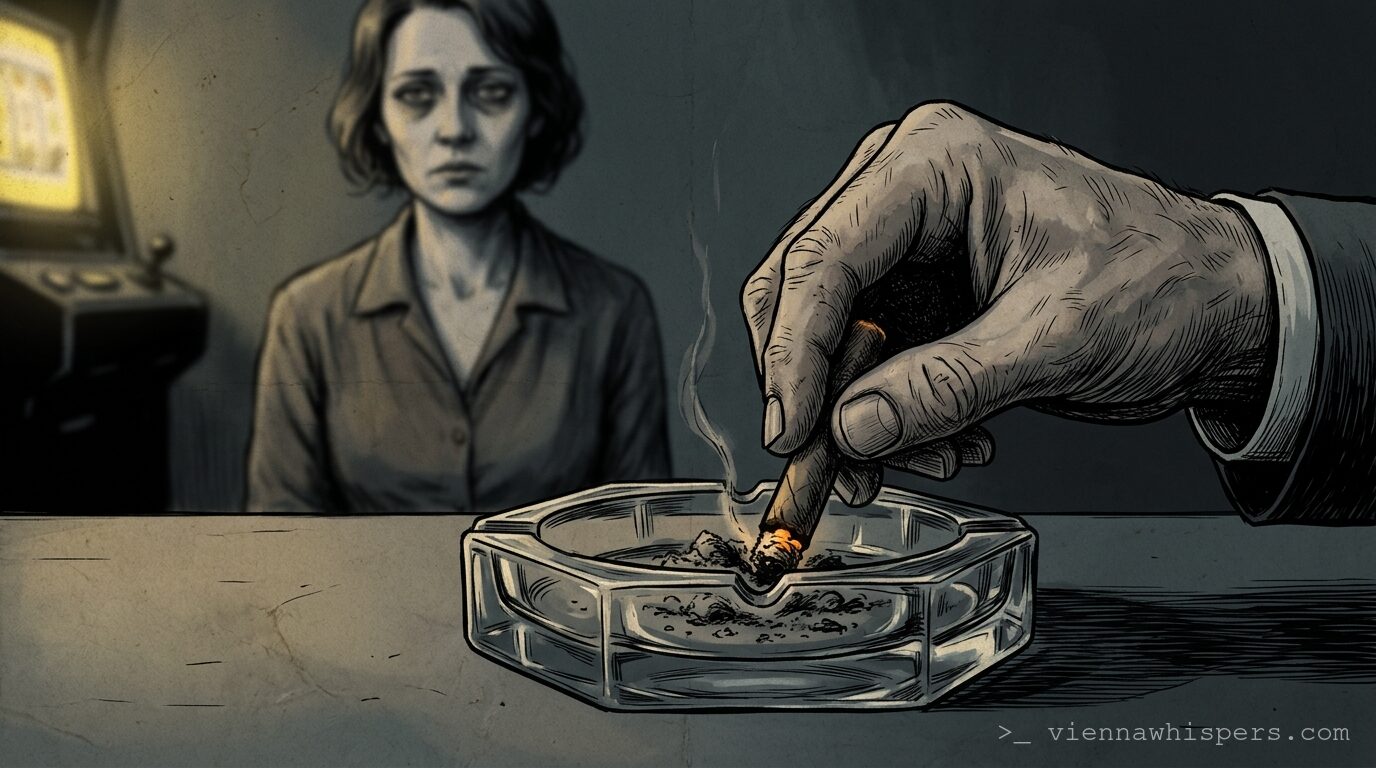
It weighed almost a kilo, a thick, hexagonal block of pressed industrial glass stolen from a brewery promotion in 1984. It lived on Table 4 in the back corner of a Beisl in Ottakring, directly beneath a ventilation fan that had been vibrating with a low, asthmatic hum since the first Schüssel administration.
Over forty years, the ashtray had acquired a subtle but distinct sentience. It was not a magical awakening. It was simply a matter of physics. If you pound enough human failure into a piece of silica, eventually the glass begins to push back.
It knew things. It had listened to the intricate, mathematically impossible tax evasion schemes of men who currently owed the city four hundred euros in parking fines. It had absorbed the acoustic shockwaves of broken marriages, negotiated over lukewarm Gulasch with butter knives. It had suffered the greasy, stabbing index fingers of men whose worldview was constructed entirely from headlines they had misunderstood in the Kronen Zeitung.
Most of all, it had endured the physical indignities of the Viennese afternoon. People only confess their worst sins when their hands are busy destroying something small.
It was 4:15 PM on a Tuesday. The air in the tavern was solid, a heavy, unbreathable emulsion of deep-fryer fat, spilled Ottakringer, and the sour yeast of damp winter coats. In the corner, a Novomatic slot machine played its manic, trilling jingle to an audience of one hollow-eyed pensioner.
At Table 4, Manfred and Uschi were engaged in what they both tragically believed was a flirtation.
Manfred was fifty-eight, a man who sweated aggressively from the scalp and wore a polyester shirt unbuttoned to reveal a tuft of graying chest hair that resembled steel wool. He was smoking a cheap vanilla cigarillo.
Uschi sat across from him, encased in a fake leather jacket that squeaked every time she shifted her weight. She smelled fiercely of synthetic coconut, laughing at Manfred’s jokes with a high, rattling sound.
The ashtray sat between them on a soggy cardboard coaster, simmering with a deep, geological hatred.
“And then I told the judge,” Manfred said, leaning forward, invading the table’s neutral airspace. “I told him, ‘Your honor, my ex-wife couldn’t find a vacuum cleaner if it was bolted to her face.’ And you know what? The whole courtroom laughed.”
This was a lie. The ashtray knew it was a lie. It had heard Manfred tell this story fourteen times in the past three months. The courtroom had not laughed. The judge had fined him for contempt.
Manfred brought the cigarillo to his wet lips, took a dragging pull, and then drove the glowing cherry into the center of the glass hexagon. He didn’t just tap it. He ground it down with a vicious, twisting motion, using the glass to enact the violence he wished he could inflict upon his alimony payments.
The ashtray took the heat. It felt the scorch of the cheap tobacco, the smear of Manfred’s saliva on the paper tip. It held the dead butt alongside a terrifying graveyard of other refuse: a chewed toothpick, the cellophane wrapper from a pack of Memphis Blue, and a small, graying piece of gristle that the previous occupant had casually spat out during a plate of roasted pork.
No one actually wants to be understood; they merely want an audience while they justify their own cruelty.
“You’re terrible,” Uschi squeaked, leaning in closer, her knee bumping the wooden table leg. “A real rebel.”
Manfred smiled, a wet, self-satisfied stretching of the lips. He lit another cigarillo, shaking the match out and tossing it into the ashtray. He missed the center basin. The charred wooden stick rested on the thick glass rim.
The ashtray had reached its limit. Decades of absorbing the petty, racist rants of men who hadn’t seen their own toes since 1998, the pathetic lies of minor functionaries, the sheer, staggering volume of human mediocrity. It was full.
Manfred gestured expansively with his right hand, the cigarillo clamped between his yellowed index and middle fingers. “The thing about women like her, Uschi, is they don’t understand loyalty. They don’t understand that a man has needs. A man needs respect.”
He brought the hand down to ash the cigarillo. His muscle memory calculated the distance to the center of the glass hexagon exactly. He had done it ten thousand times.
The ashtray shifted.
It was a movement so microscopic it defied physics. It simply glided one-eighth of an inch to the left across the damp surface of the Ottakringer coaster. Not enough to be seen. Just enough to alter the geometry of the table.
Manfred’s hand descended blindly. Instead of the hollow basin, the burning tip of his cigarillo struck the solid, angled rim of the glass. The impact was abrupt. The glowing cherry snapped off the paper tube entirely.
It bounced once on the glass edge, fell directly into the gap between Manfred’s spread thighs, and landed squarely on the stretched fabric of his polyester trousers.
Manfred did not notice immediately. He was busy holding eye contact with Uschi, trying to look profound.
The ashtray watched the ember burn. It glowed with a beautiful, furious orange intensity against the cheap synthetic weave. Two seconds passed. Three. A thin ribbon of gray smoke, smelling distinctively of melting plastic, began to rise from Manfred’s crotch.
“Because at the end of the day,” Manfred whispered, lowering his voice for intimacy, “you just want someone who makes you feel—”
Manfred shrieked like a little child.
It was a high, thin, entirely unmasculine sound. He vaulted backward, his knee slamming into the underside of the table. The table tipped. Uschi’s Spritzer spilled a tidal wave of lukewarm soda water across the wood. Manfred slapped violently at his own groin, his face purple, knocking his chair over as he scrambled backward into the blinking lights of the Novomatic machine.
Uschi sat frozen, a drop of cheap white wine hanging from her chin, her squeaking jacket silenced by shock.
The waitress, a woman named Gabi who had not smiled since the winter of 2011, materialized from the gloom behind the bar. She held a damp, gray rag. She did not look at Manfred, who was currently bent double, inspecting a molten black hole near his zipper.
Gabi walked to Table 4. She wiped the spilled Spritzer into a dirty puddle onto the linoleum floor. She picked up the heavy glass ashtray, dumped its gray, powdery autopsy into a tin bucket, and slammed it back down onto the soggy coaster.
The glass caught the dull light of the neon beer sign in the window. It sat heavy, empty, and cold, waiting patiently for the evening shift.
Support us
Vienna Whispers is free to read. If you enjoy the stories, we’d be grateful for your support.