The Signalman of the Dead Tracks
The kerosene cost him three Chesterfield cigarettes, traded behind the ruined opera house to a man missing half his jaw. Ignaz Lehner did not smoke, nor did he eat much beyond boiled cabbage and sawdust bread, but kerosene was not a luxury. It was infrastructure.
He carried the tin canister through the second district in the late afternoon. Spring in 1946 did not arrive with blossoms; it arrived as a slow, wet thaw that made the city smell of wet ash, raw sewage, and pulverized brick. Vienna was not rebuilding. It was merely rearranging its rubble into slightly more convenient piles.
Lehner walked until the streets bled out into the vast, jagged wasteland of the Nordbahnhof.
Once, this had been the grand terminus of the Empire. The Northern Railway. The iron artery pumping people and coal from Moravia, Silesia, and Galicia straight into the capital’s heart. Now, it was a graveyard of twisted steel and shattered glass. The great roof had collapsed during the bombardments, leaving the rusted ribs of the station canopy exposed against the sky like the carcass of a rotting whale.
Lehner arrived at dusk. The blue hour. The sky over the Praterstern bruised into a deep, cold violet.
He wore his uniform jacket. The brass buttons, stamped with the winged wheel of the Federal Railways, were tarnished, but he had polished them with spit and a rag. The fabric was threadbare, smelling of damp wool and old sweat, yet it held him together. Without the uniform, he was a starving pensioner wandering through a bomb site. With it, he was the law of the tracks. The objects remembered their purpose even if the world had lost its mind.
He set his leather satchel down at Switch Point 14.
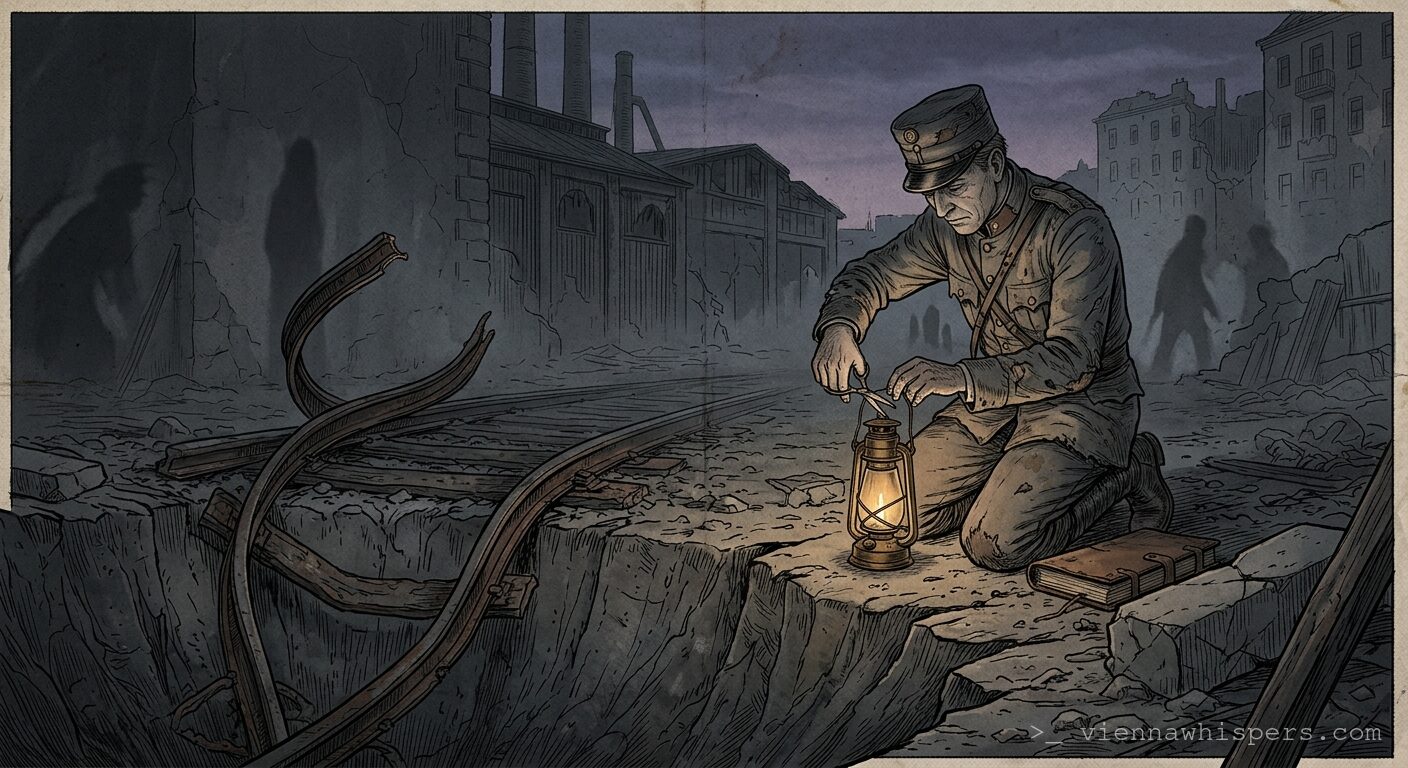
Switch Point 14 controlled the approach to the former Platform 2. The tracks here did not go anywhere. Twenty meters to the north, the steel rails curled violently upward like dead spiders’ legs, snapping off over a massive bomb crater filled with black groundwater and sunken masonry.
Lehner knelt in the wet ballast and uncapped his lantern. It was a heavy brass piece, issued in 1928, solid and unbothered by the collapse of two successive governments. He filled the reservoir, trimmed the wick with small iron scissors, and struck a match. The yellow flame spat, then settled into a steady, oily glow.
He consulted his ledger. It was a thick, leather-bound book from 1938, the pages crowded with his small, neurotic handwriting.
Grief in Vienna is rarely an affair of the heart; it is, more often, a profound irritation at poor administration. The war had disrupted the schedule. Cities were flattened, empires evaporated, millions turned to ash—but to Lehner, the primary offense of the twentieth century was the delay.
There was a train from the East. Troop transport 404-B. It had been routed from the Don bend, scheduled to arrive at Platform 2 in February 1943. It had never arrived. Therefore, it was late.
A Soviet patrol crunches past on the gravel bed fifty yards away. Three boys in ill-fitting greatcoats, carrying submachine guns and smoking harsh tobacco. They stopped, looking at the old man standing by a lit lantern in front of a flooded crater. One of them pointed and muttered something in Russian. Another laughed, a short, barking sound, before they kept walking. They left him alone. The occupiers had learned that the city was full of broken clockwork people, repeating the same useless motions in the ruins.
The light drained entirely from the sky. Blue became black. The wind picked up, blowing unobstructed across the flattened plains of the marshlands, whistling through the rusted ironwork above. It sounded like a choir of tuneless flutes.
Lehner cleaned the red and green glass panels of the lantern with a dirty rag. His hands were blue with cold, the knuckles swollen with arthritis.
He checked his pocket watch. A silver cylinder escapement, awarded for twenty-five years of flawless service. The crystal was cracked, but the ticking was loud, a frantic mechanical heartbeat against the silence of the dead yard. It was 10:40 pm.
There were thousands of others in Vienna waiting for the missing. Women standing in the freezing rain outside the Red Cross, men scanning typewritten lists pinned to church doors. Amateurs. They waited with hope, which is exhausting, sloppy, and fundamentally irrational. Lehner waited with administrative certainty. An empty block section on the timetable must eventually be occupied. A train that has departed must arrive. To believe otherwise was to invite chaos.
At 11:00 pm, the wind dropped. The air grew utterly still, heavy with the smell of frost and burnt iron.
Lehner knelt by the tracks. He pushed his grey hair back, lowering his head until his right ear pressed against the rusted steel of the rail. The iron was freezing, biting instantly into the thin skin of his cheek.
He closed his eyes. He expected nothing but the cold. He had done this every night for four months.
But tonight, there was a texture to the steel.
He held his breath.
Thud… thud… thud.
A vibration. It was impossibly faint, rising from deep within the earth, from somewhere far beyond the water-filled crater, beyond the ruined city, pulling forward from the dark, frozen plains of the East. The undeniable, rhythmic tremor of a heavy steam locomotive dragging dead weight over welded joints.
Lehner opened his eyes. The iron hummed against his jawbone.
He stood up. His knees popped in the damp air. A quiet, profound vindication settled over him. The 404-B was approaching. The boys from the snow, the vanished, the unburied—they were finally making their arrival. The schedule was intact.
He picked up his lantern and twisted the heavy brass handle, sliding the green glass over the flame.
He raised his arm, holding the green light high against the black sky, giving the all-clear to the twisted iron, the flooded crater, and the empty night.
The vibration in his boots grew stronger. He took a measured step back from the edge of the sleepers, straightening his collar, to let them pass.
Support us
Vienna Whispers is free to read. If you enjoy the stories, we’d be grateful for your support.