The Architect of Silence
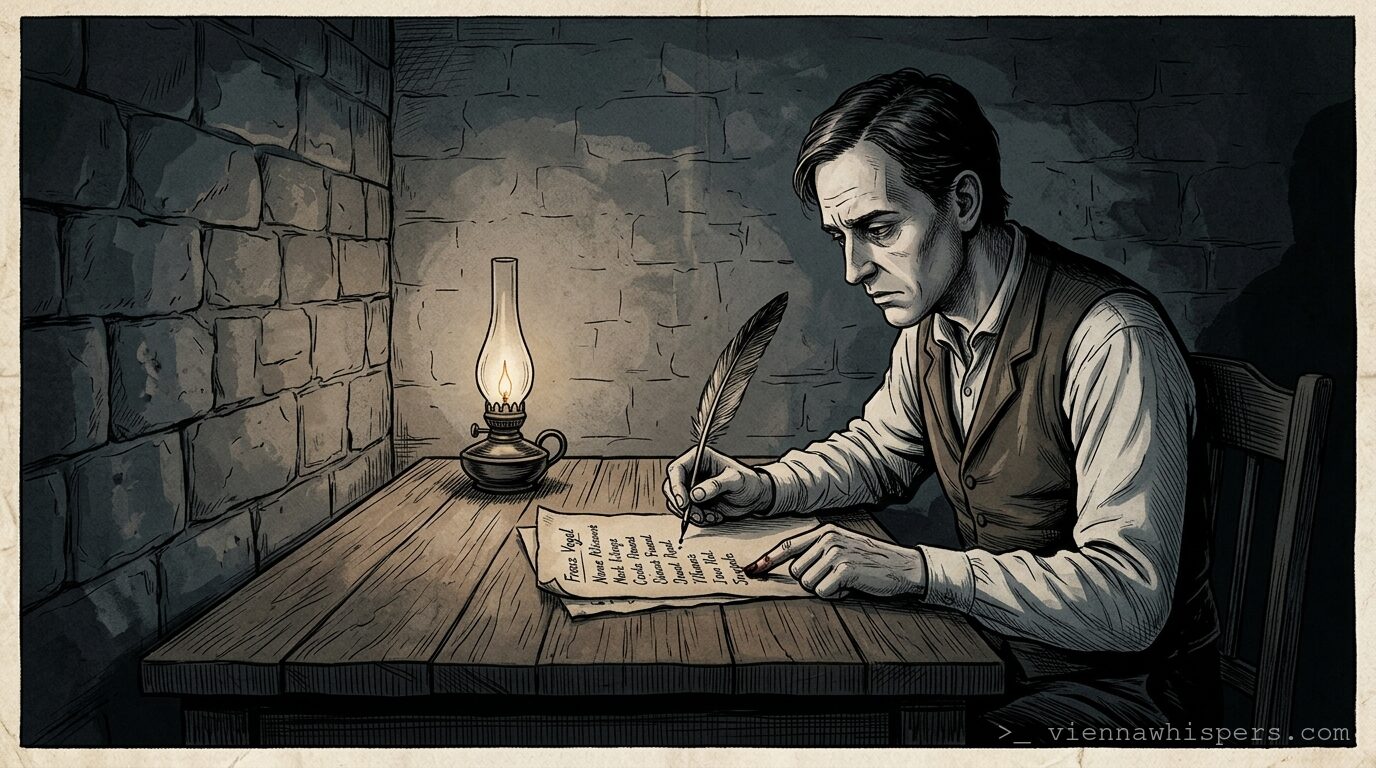
Franz Xaver Vogel sat motionless in the windowless basement chamber beneath the Hofburg, the only light coming from a single tallow lamp that guttered and spat. The air was thick with the smell of old ink, damp stone, unwashed wool, and the faint, sweetish rot of documents that had been stored too long. At twenty-eight, his skin had taken on the colour and texture of aged parchment — yellowish, almost translucent under the weak flame. The ink had long since worked its way into the cracks of his hands and under his nails. No amount of pumice could remove it anymore. He had tried until the skin bled.
He was a cipher clerk. A man whose entire purpose was to make things disappear without noise.
The room was low-ceilinged and oppressively still. Stacks of dossiers rose like miniature city walls around his desk. Some were tied with frayed red ribbon, others lay open, their margins already black with crossings-out. Every crossed name was a village, a dialect, a memory quietly erased from the new map of Europe. Napoleon was on Elba, but here in the basement the real work continued: the slow, meticulous redrawing of the continent with nothing louder than the scratch of a goose-quill.
Vogel dipped his pen. The nib scraped across the paper like a tiny claw. He wrote with the mechanical precision of a man who had long stopped thinking about what the words actually meant. Kovács. Hrabal. Steiner. One after another received their neat diagonal line. Then the heavy “X” that sealed the page. The sound of the pen was the only noise besides the occasional wet cough of his superior, Hauer, who sat three desks away, his gout-swollen leg propped on a stool.
Hauer smelled of sour wine, old sweat trapped in silk, and the cheap powder he used to mask both. His breathing was loud and laborious, like a bellows with holes in it. Every few minutes he would shift his weight and the stool would creak in protest. He never looked at Vogel. He didn’t need to. They both understood the nature of the work.
Vogel’s shoulders ached from the permanent hunch. The cold of the stone floor had long since climbed into his legs and settled there. He could feel the weight of the entire Hofburg pressing down on him — not just stone and timber, but centuries of careful, polite erasure. Upstairs they danced. Down here they made the dancing possible.
Hauer dropped a new dossier onto his desk with a dull thud.
Vogel opened it. His eyes moved over the list of names. Then he stopped.
Among them was one he knew. Not personally — he had never been to that region — but the name of the village was familiar from childhood stories his grandmother had told. A small place in the shadow of the Carpathians where the streams still carried the old dialect. For a fraction of a second his quill hovered.
He could shift the line four miles east. Just a small adjustment. No one upstairs would notice. A tiny, invisible act of mercy.
The impulse passed.
He drew the diagonal line through the village name with steady, practiced strokes. Then the heavy “X”. The ink bloomed slightly on the cheap paper. He blotted it carefully.
Hauer wheezed from his corner without looking up. “Next one’s already waiting.”
Vogel nodded once. He took the new dossier. His fingers, stained dark walnut, left faint prints on the outer cover. He opened it and began again.
The lamp flickered. The shadows on the wall remained perfectly still.
Upstairs the waltz continued.
Support us
Vienna Whispers is free to read. If you enjoy the stories, we’d be grateful for your support.