The Single Left Glove in the Burgtheater Cloakroom
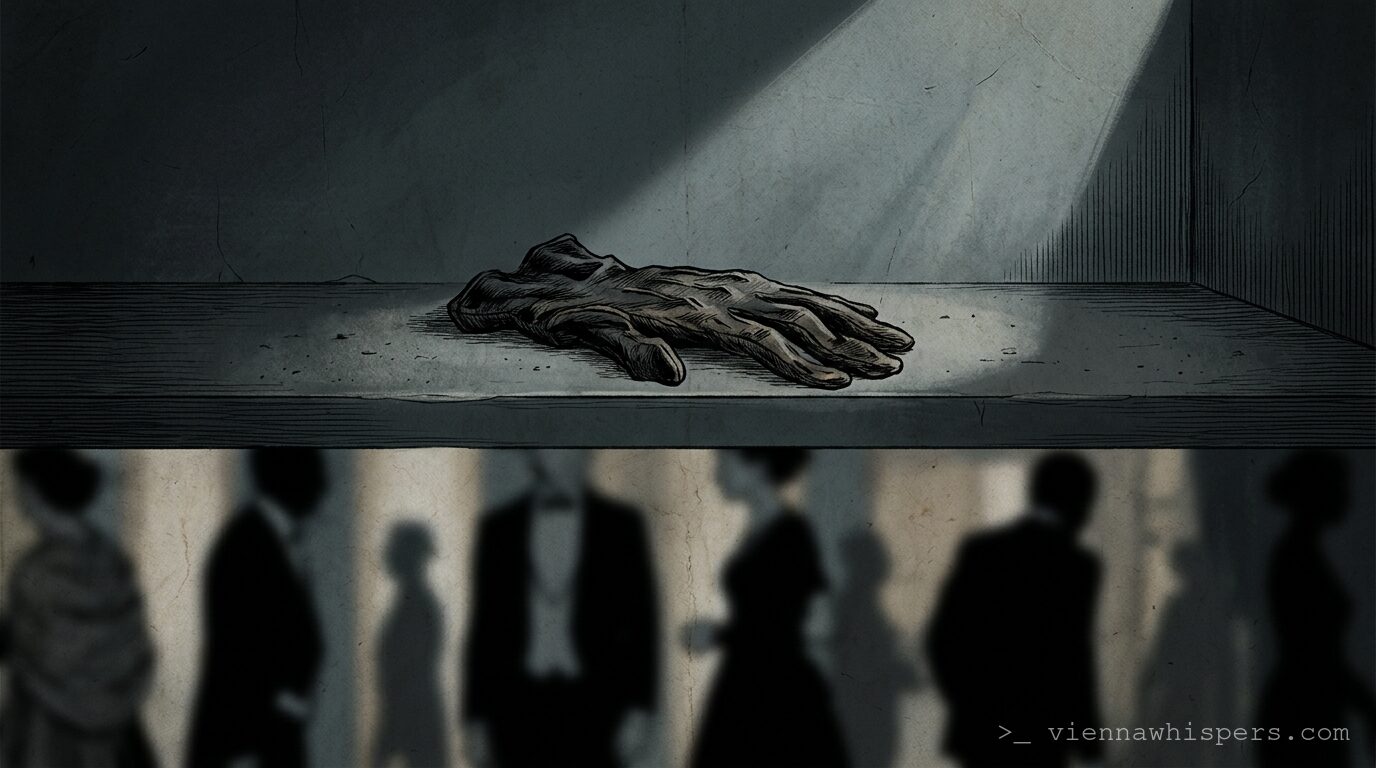
It sits on the highest shelf of Section C, pushed to the far left corner behind a spare roll of ticketing paper and a chipped porcelain saucer that formerly held Frau Hildegard’s afternoon mints.
It is a left glove. Black peccary leather, three meticulous ridges of hand-stitching down the back, lined with what used to be Scottish cashmere. Now, the lining is little more than a fine, grey powder, digested over forty-five years by a lineage of highly cultured, state-subsidized moths.
It was abandoned on a Tuesday in November 1978. A performance of King Lear, notable only for the fact that the lead actor forgot his lines in the third act and blamed a draft from the wings.
Whoever left it—presumably a man of some means, given the quality of the leather—never returned for it. Perhaps he slipped it off to hold the elbow of a woman who was not his wife as they hurried down the grand staircase. Perhaps he laid it on the polished wooden counter of the Garderobe, became enraged by the slow service of the attendant, and snatched his coat, leaving the leather hand behind in a fit of pure, cardiovascular Viennese irritation.
It does not matter. The glove was recorded in the red ledger by Frau Elfriede, who noted its existence with a blunt pencil. Because it was recorded, it became matter. Because it was matter inside a federal building, it required a signed form in triplicate to be destroyed. No one ever found the form. Frau Elfriede retired, then died. Frau Helga took over, then retired. Now there is a bored art history student named Sophie who occasionally uses the glove to wipe a smudge off her phone screen.
The glove remains. It is the longest-serving fixture of the Burgtheater cloakroom. A quiet, rotting witness to the endless, looping tragicomedy of the Viennese arriving and departing.
The cloakroom is not merely a place to leave coats. It is a social purgatory. It is where masks are adjusted before facing the foyer, and where they slip immediately upon retrieval of the damp wool. Over the decades, the glove has absorbed the specific atmospheric pressure of this room: the smell of Shalimar and melting snow, the sharp scent of mothballs that expensive coats exhale in deep winter, the stale peppermint breath of anxious men, and the sound of fifty people simultaneously refusing to look at each other.
From its high shelf, the glove has watched the evolution of vanity.
In the late seventies, it watched heavy furs slung across the counter like freshly killed game, smelling of expensive cigars and marital dread. It watched the wide shoulders of the nineteen-eighties, where men in oversized camel-hair coats stood aggressively close to their companions, arguing in harsh, theatrical whispers about Thomas Bernhard, entirely to ensure the people in line behind them knew they understood Thomas Bernhard.
It watched the minimalist nineties, where the coats became darker, sharper, and the affairs became more clinically negotiated. And it watches the present, where people arrive in technical outdoor fabrics that rustle like depressed sleeping bags, paying sixty euros for a stall seat while dressed for an emergency evacuation in the Alps.
The fabrics change. The specific, hollow arrogance of the patrons does not. People do not go to the theater to be transformed; they go to ensure they are seen surviving the boredom of their own curated lives.
The glove knows their secrets. It is entirely fluent in the choreography of deceit.
It knows the exact physical hesitation of a cheating husband. The way a man will hand over his wife’s coat with fluid grace, but when he brings his mistress, his movements become jerky, his eyes darting toward the brass rails, terrified of encountering a colleague from the Ministry. The glove watched a prominent bank director in 1994 hastily transfer a velvet jewelry box from his inner pocket to his companion’s trench coat, only to drop it, in a moment of panic, into the pocket of a complete stranger’s identical Burberry. The glove watched the banker realize his mistake precisely as the stranger’s coat was hoisted up onto the mechanical rack and spirited away into the dark upper tiers. The banker stood frozen, his mouth slightly open, while the glove looked down upon him with the dry, leathery apathy of a Roman emperor watching a gladiator bleed out.
It has seen wives cry so carefully into their programs before the bell rings that their mascara forms two perfect, unsmudged black beetles on the thick paper. It has seen critics draft their scathing reviews in their heads while waiting in line, their faces contorted into masks of preemptive disgust before the curtain has even risen.
And then there is Herr Doktor Pollinger.
Pollinger is the human thread that strings the decades together. He was there in 1978. A thirty-two-year-old lawyer with a thick mustache and an aura of aggressive ambition. He is, in fact, the man who left the glove.
The glove remembers the precise shape of his left hand. The slight stiffness in the index finger, the sweat of his palm on that wet November night. Pollinger had been distracted, arguing fiercely with a young cellist about the political implications of the stage design, eager to prove his intellectual dominance so he could later sleep with her. He slammed his hand on the counter, leaving the black leather shell behind as he snatched his brass token.
For forty-five years, the glove has watched Pollinger return.
It watched him age from a young predator into a broad-waisted patriarch. It watched him arrive with the cellist (who lasted two seasons), then a wealthy industrialist’s daughter (who lasted a decade), then a very quiet woman who always smelled of gin and looked past his shoulder while he spoke.
Pollinger never remembered the glove. He simply bought a new pair. Over the years, he has lost at least six umbrellas, two scarves, and a felt hat to the Burgtheater cloakroom, but he never asked for them back. To ask would be to admit a flaw in his administration of his own life.
In 2005, Pollinger’s voice lost its booming resonance. He began asking the cloakroom attendants to assist him with his sleeves. In 2015, his hands developed a tremor, rattling the brass token against the wooden counter like a nervous percussionist.
Tonight, it is a Tuesday in late January. The blue hour has long since bled into a freezing, starless black. A performance of Der zerbrochne Krug. The foyer is thick with the smell of damp cashmere and wet leather boots.
Pollinger approaches the counter. He is alone. He is seventy-seven years old. His posture has finally surrendered to the gravity of his own insignificance. He wears a heavy charcoal overcoat that seems to be wearing him.
Sophie, the bored art history student with a septum piercing, stands behind the counter. She does not look at Pollinger’s face. She only looks at his coat.
“Number,” she says, her voice flat, devoid of the deference Pollinger commanded in 1985.
He fumbles in his pockets. His hands shake. The right hand, bare and spotted with age. The left hand, covered in a pristine, newly bought brown leather glove. He cannot find the token.
“A moment,” Pollinger wheezes. The line behind him shifts impatiently. A woman in a green silk shawl sighs audibly, a sound as sharp as glass breaking in a quiet room.
Pollinger’s panic rises. He digs into the deep pockets of the charcoal coat. His breathing is shallow. He is no longer the man who dissects Thomas Bernhard; he is just an old man blocking the exit. He looks up, his eyes watery, scanning the high shelves behind Sophie as if hoping the brass token has magically flown up there.
His gaze passes directly over Section C, upper left corner. He looks straight at the black peccary leather glove.
He does not recognize it. It is just a lump of shadow in a room built to hold the empty skins of the wealthy.
The glove looks back. The cashmere powder inside its belly shifts slightly as a draft rolls in from the main doors. It feels no pity. It feels a quiet, dusty triumph. It knows that Pollinger’s bones are turning to chalk, that his relevance evaporated long before his wife left him, and that soon, he will stop coming entirely. Another name crossed out of the subscriber list.
But the glove will stay. Because without the correct triplicate form, it cannot be removed. It is an immovable part of the state apparatus.
Pollinger finally finds the token in his breast pocket. He drops it on the counter. It lands with a heavy, final clack. Sophie wordlessly hands him his coat. He struggles into it, his left arm missing the sleeve twice. He does not turn back as he shuffles out toward the ringing trams of the Ringstraße, stepping into the freezing night.
The three-minute warning bell for the end of the evening rings through the foyer. The last stragglers grab their coats. The brass rails empty out, resembling the ribcages of slaughtered beasts.
Sophie pulls the heavy metal grille down over the counter. The lights snap off, section by section. The darkness rushes in, smelling of floor wax and phantom perfume. Up on the top shelf, the glove settles into the cold, waiting for tomorrow.
Support us
Vienna Whispers is free to read. If you enjoy the stories, we’d be grateful for your support.