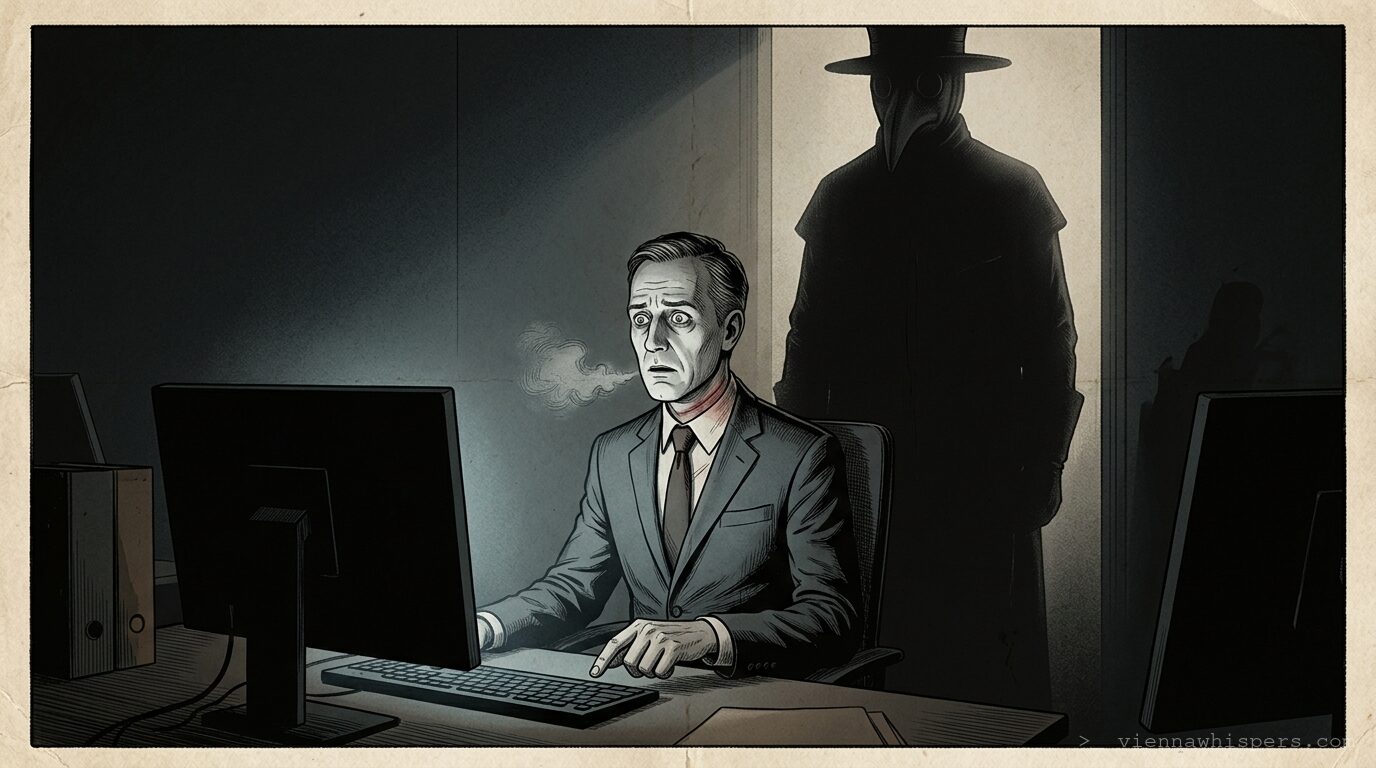
The Plague Doctor’s Visit
Herr Maurer did not believe in ghosts. He believed in the cold, immutable mechanics of debt — in interest rates, penalty fees, and the soothing rhythm of automated reminder emails sent at precisely 8:17 a.m. every third Tuesday of the month.
He sat in his small office in the 3rd District, surrounded by the sterile hum of servers and the faint, chemical smell of industrial floor cleaner. His necktie was, as always, too tight. By three in the afternoon it had left a faint, livid red line against his throat, a private mark of discipline he wore like a medal.
The air in the room changed first.
It thickened, grew heavy and damp, as though someone had opened a door to a cellar that had not been aired since the seventeenth century. The central heating system clicked off with a startled mechanical whine. The temperature dropped so sharply that Maurer’s breath briefly fogged in front of him.
Then the visitor simply occupied the space between the desk and the filing cabinet.
He wore heavy, damp black wool and cracked leather. The long, curved beak of his mask was stuffed with dried lavender and cloves. The smell — sweet, medicinal, and rotting — instantly overpowered the lemon-scented disinfectant. Behind the thick glass goggles were not eyes, but two dark, unblinking pools of viscous oil.
Maurer’s finger hovered motionless over the Enter key.
For a long moment neither of them moved. The only sound was the low, defeated hum of the dying heating system.
“Interest,” the figure said at last. The voice was a dry rasp, like parchment being slowly torn in a room that had not known fresh air for three hundred years.
Maurer tried to summon his professional sneer, the one he reserved for particularly stubborn debtors. “I don’t know which collection agency you represent, but this is harassment. I will call security.”
The Plague Doctor tilted his head with slow, deliberate courtesy. From the heavy, stained satchel at his side he drew a ledger. It was not made of paper. The surface was thin, cured human skin, marked with faint, vein-like calligraphy. When he placed it on the desk, the laminate surface gave an audible crack.
“The debt of 1679 remains open,” the Doctor whispered. “The compounding interest has been paid in blood, silence, and forgotten names for three hundred and fifty-four years. Today we collect the final installment.”
Maurer stared at the ledger. His own name was written there in cramped, archaic script, squeezed between a plague-stricken baker from Leopoldstadt and a disgraced cleric who had died screaming in the Stefansdom. Next to his name, a single line remained: One life. Unsettled.
He reached for his phone. His fingertips had already begun to change color — a bruised, mottled gray. Fine dust, like ash, fell onto the keyboard as the skin sloughed away in delicate flakes. There was no pain. Only a strange, clinical detachment, as if he were watching someone else’s body fail.
The Doctor leaned closer. The curved beak brushed gently against Maurer’s cheek. The smell of rot and ancient rosemary filled his nostrils.
“Efficiency is considered a modern virtue,” the Doctor murmured, almost kindly. “But you seem to have forgotten the oldest rule of proper bookkeeping, Herr Maurer. Every ledger must eventually be closed.”
Outside the window, the normal evening traffic of the 3rd District continued — cars, trams, people hurrying home with plastic bags from Billa. Inside the office the temperature continued to fall. The lightbulb in the desk lamp flickered once, then shattered with a soft pop, even though the switch remained in the ‘on’ position.
When the cleaning crew arrived at six o’clock, they found the office empty and impeccably tidy. The only things they remarked upon later were the strange, lingering scent of cloves and lavender, and the fact that the chair behind the desk was slightly askew — as though someone had risen from it in a great hurry, or perhaps had simply ceased to occupy it.
Support us
Vienna Whispers is free to read. If you enjoy the stories, we’d be grateful for your support.