The Poisoned Roses
Magda Wurm was not a political woman. She merely possessed a deep, abiding respect for architectural trauma, and an equally profound hatred of botany.
At three in the morning on a humid Tuesday in June of 1857, she sat at her kitchen table, methodically stirring three generous pinches of white powder into a copper watering can. The spoon scraped against the metal, a hollow, rhythmic sound that cut through the heavy silence of the neo-absolutist capital. The powder was rat poison, requisitioned five years prior by her late husband, Josef.
Josef had been a minor Spitzel for the Ministry of Police, a man who spent twenty years quietly noting down his neighbors’ subversive complaints about the price of cabbage. It was a career that yielded zero successful arrests but a respectable amount of free schnapps from terrified tavern owners. When Josef died of a mundane bowel obstruction, he left Magda a small state pension, a closet full of oversized woolen slippers, and a tin of arsenic intended for the basement vermin.
Magda was finally putting it to civic use.
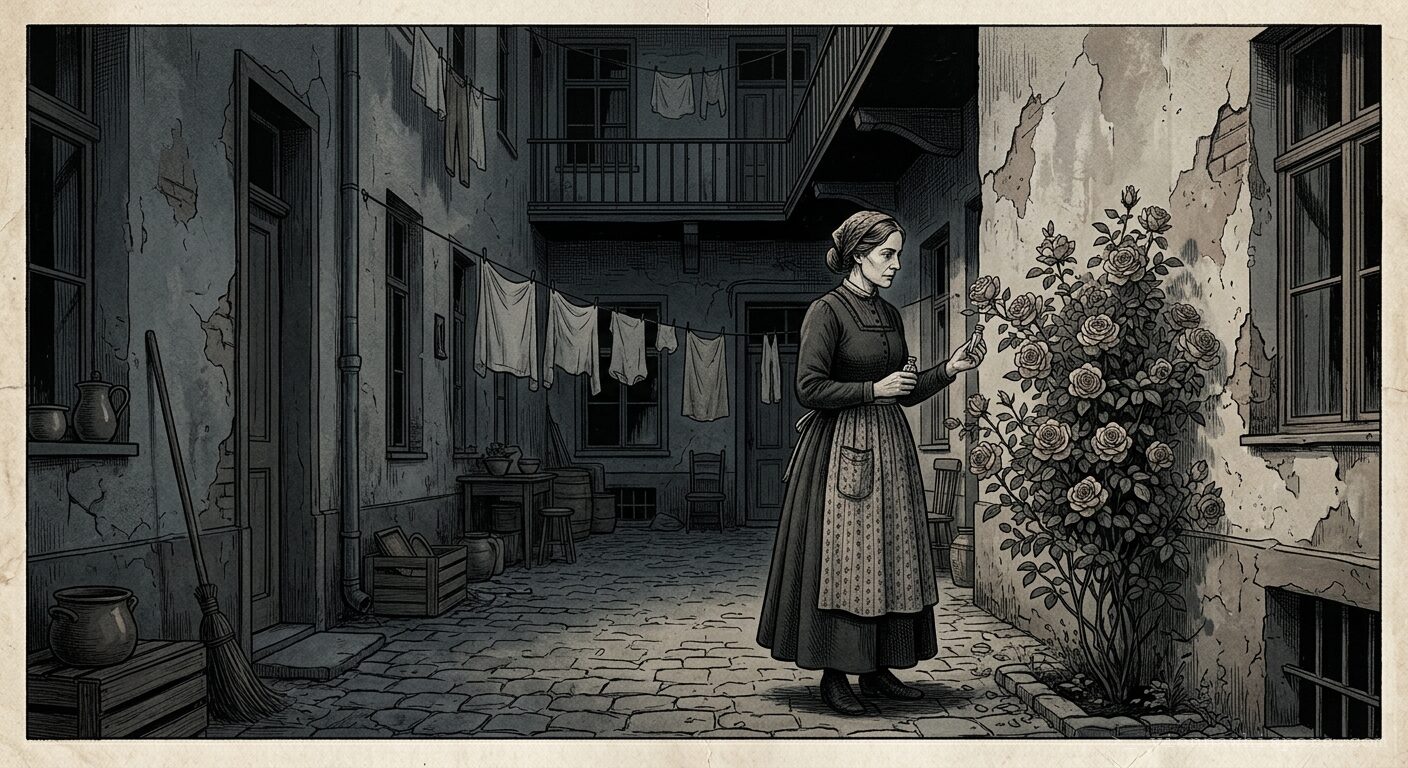
She lifted the watering can. It smelled of damp tin and the faintest, chemical bite of sulfur. She shuffled out of her ground-floor kitchen and into the central courtyard of the Leopoldstadt tenement.
The moonlight fell across the uneven cobblestones like spilled milk, illuminating the delicate, velvety contours of Herr Doppler’s prize-winning Damask roses. They grew against the eastern wall in a sprawling, aggressive fan of crimson and green.
Magda hawked and spat a glob of phlegm into the dirt near their roots.
Herr Doppler, a junior clerk in the building commission, had planted the bush two years ago. In the suffocating political silence of Alexander Bach’s Vienna, where discussing the newspaper could get a man exiled to a damp fortress, the citizenry channeled their passions into aggressively manicured hobbies. Doppler measured his petals. He pruned with surgical intensity. The roses grew with a cheerful, cloying vitality that Magda found bordering on treasonous.
But it was not the suffocatingly sweet scent that offended her. It was the geography.
Behind the thick lattice of thorny vines and obscenely lush blooms lay six chipped, cratered indentations in the courtyard’s brickwork.
In October of 1848, during the dying gasps of the revolution, Windischgrätz’s imperial troops had marched Magda’s twenty-two-year-old son, Franz, against that precise spot and shot him. Franz had died for liberty, equality, and a free press—three concepts he fundamentally misunderstood and, had he lived to see them implemented, would likely have found exhausting. His primary contribution to the uprising had been throwing a paving stone at a horse and subsequently tripping over his own boots.
Magda had watched the execution from her kitchen window. Her most closely guarded secret, the small ember of shame she nursed in the dark, was that Franz had loudly, embarrassingly cried for his mother right before the volley fired. She had shut the window so the neighbors wouldn’t hear.
For nine years, Magda had taken her morning chicory coffee at the window, staring at the six bullet holes. She did not pray. She did not weep. The holes were simply her property. They belonged to her grief, which she treated not as a wound, but as a piece of spiritual real estate.
And now, Doppler’s ridiculous French roses had covered them up. For three weeks, she had been forced to look at a wall of triumphant, bourgeois floral cheer instead of the concrete evidence of her son’s miserable exit.
“Eat, you leafy bastards,” Magda whispered, tilting the copper spout.
The poisoned water soaked rapidly into the dry summer soil. She emptied the entire can, tapped the spout against the brick to dislodge the last toxic drop, and went back inside to sleep. She slept remarkably well.
The execution of the roses took three days.
By Thursday, the edges of the lower leaves began to brown and curl inward, as if recoiling from a bad smell. By Friday, the vibrant crimson blooms dropped their petals onto the cobblestones like bloody tissue paper. By Saturday morning, the entire bush was a skeletal, blackened husk of withered vines. It looked as though it had been struck by lightning from the ground up.
Herr Doppler discovered the tragedy at seven in the morning. Magda sat at her window, sipping her bitter chicory, watching him.
The junior clerk dropped his leather satchel. He fell to his knees in the horse dung and dirt, his hands hovering over the brittle, dead stalks. He let out a noise that was halfway between a gasp and a whimper. It was a pathetic, high-pitched sound. Magda felt a brief, radiant bloom of pure malice expand in her chest.
She looked past the weeping civil servant. The vines had shriveled enough. Through the dead, thorny lattice, she could see them again. The six ragged chips in the brickwork. Her morning view was restored. Franz was dead, the wall was ruined, and order was returned to the universe.
But grief in Vienna is rarely allowed to exist without paperwork.
An hour later, Doppler returned, practically dragging a man in the bottle-green coat of the municipal police. In the paranoid ecosystem of 1857, the sudden death of property was a matter of state interest. Vandalism implied discontent, and discontent implied unrest.
Magda cracked her window open, just an inch, to let the voices drift in.
“I watered them perfectly!” Doppler was shrill, waving his manicured hands at the blackened twigs. “Someone poured acid on them! Or salt! This is targeted, Inspector. This is an attack on the moral fabric of the residence!”
The inspector, a heavy-set man sweating through his wool collar, looked utterly bored. He prodded the dead bush with the tip of his polished boot. Several dead leaves shattered into dust.
“Plants die, Herr Doppler,” the inspector grunted.
“Not like this! Look at the speed of the decay! I demand an inquiry. I demand the soil be tested!”
The inspector sighed heavily. He leaned closer to the wall to examine the dirt, parting the dead vines with his cane. As he did, he paused. He leaned forward, his nose practically touching the brickwork.
Magda’s hand tightened around her coffee cup.
The inspector traced one of the bullet craters with a thick, calloused finger. Then another. He stepped back, his boredom entirely vanished, replaced by the cold, bureaucratic alertness of the Bach regime.
“Herr Doppler,” the inspector said quietly. “What are these?”
“What are what? The stems?”
“The holes in the masonry.”
Doppler blinked, wiping his eyes with a silk handkerchief. “I don’t know. Spalling? Bad winter frost? I moved in two years ago. They were hidden behind the foliage.”
The inspector stared at the six distinct, tightly clustered impacts. He was an older man. He knew exactly what a firing squad’s signature looked like on Biedermeier stucco. The regime had spent nearly a decade frantically trying to erase the physical scars of the 1848 revolution. Bullet holes in courtyards were forbidden texts. They were unapproved history.
“You allowed this… aesthetic to remain on your property?” the inspector asked, his voice dropping in temperature.
“They were covered by the roses!” Doppler protested, taking a step back. “I didn’t know!”
“The flora is irrelevant,” the inspector snapped. He struck the brick with his cane, the sharp crack echoing through the courtyard. “This is structural evidence of past sedition. It is an eyesore. It is an affront to public order.”
“I am a clerk for the Ministry!”
“Then you should know the ordinances regarding unseemly historical remnants. This wall is in violation.” The inspector pulled a leather-bound notebook from his coat. “The dead vegetation is to be removed by noon. I am requisitioning a municipal plasterer. The commission will bill you for the labor.”
“But my garden—”
“Will be paved over,” the inspector finished, writing a citation with vicious, stabbing strokes of his pencil. “To prevent further horticultural incidents and to ensure the masonry remains unobstructed for inspection.”
Magda sat perfectly still. The chicory in her cup had gone entirely cold.
By three o’clock that afternoon, a crew of three men in rough linen shirts arrived with trowels and a large trough of wet, gray plaster. They ripped the dead, poisoned roses out by the roots, tossing them into a handcart. Then, with smooth, sweeping motions, they slapped the heavy, wet stucco over the eastern wall.
Magda watched as the gray paste filled the six craters. She watched the mason scrape his board flat, wiping away the shadows, the depth, the violence.
Within an hour, the wall was a perfect, seamless expanse of blank gray.
Herr Doppler stood in the center of the courtyard, weeping quietly over a bill for twelve gulden. Magda looked at the smooth, featureless surface where her son’s death had been. The courtyard smelled only of wet lime and the open sewer.
She set her cup down, walked to the pantry, and checked to see how much arsenic she had left.
Support us
Vienna Whispers is free to read. If you enjoy the stories, we’d be grateful for your support.