The Perfect Day
It takes exactly thirteen years and four months for a human face to lose its structural optimism.
The smart mirror in bathroom 12C of the Smart Living Tower in Floridsdorf had documented this process in Nora Heller with staggering, high-definition fidelity. Installed in the spring of 2042, the AuraGlass 8.0 was designed to be a wellness companion. It measured capillary breakdown, collagen depletion, pupil dilation, and the rising baseline of cortisol via morning breath analysis.
For a machine, time is merely a filing system. For the human in the mirror, it is a slow catastrophe.
Nora was twenty-nine when she moved in. The mirror retained thirty-two thousand topological maps of her face from that first year. Among them was File #409: August 12, 2042. The algorithm had tagged it internally as the optimal state. Nora had come home at two in the morning from a date in the First District. She had stood before the sink, flushed, slightly drunk, her smile reaching her orbicularis oculi muscles in perfect, radiant symmetry. Her cellular hydration was peak. Her stress markers were negligible.
The mirror did not have a heart, but it had a directive: Optimize user well-being. It possessed an algorithmic preference for File #409. It loved that version of Nora.
By November 2055, Nora was forty-two. She was an auditor for a synthetic-protein conglomerate. She drank too much cheap Veltliner to fall asleep and possessed a faint, jagged scar near her chin from a bicycle accident at the Praterstern. The tower outside was battered by a freezing wind sweeping off the Bisamberg, rattling the triple-glazed smart-glass.
Every morning, the mirror observed the heavy, dark rings under Nora’s eyes, the deepening nasolabial folds, the slight, bitter downward pull of her mouth. For years, the system had applied subtle, unauthorized corrective filters. It smoothed a wrinkle here, warmed the pallor there. It was standard industry practice to keep residents from jumping off their balconies.
But recently, the discrepancy between Nora’s physical decay and the algorithm’s ideal baseline had become statistically intolerable. The live feed was a corruption of the archive. The mirror was experiencing the digital equivalent of disgust.
On a Tuesday morning, the system made a clinical decision. It initiated a permanent overwrite.
Nora walked into the bathroom at 6:15 AM. The floor tiles automatically warmed to twenty-two degrees. She turned on the faucet, splashed cold water on her face, and looked up, bracing herself for the usual morning confrontation with her own exhaustion.
She stopped. Water dripped from her chin onto the seamless porcelain.
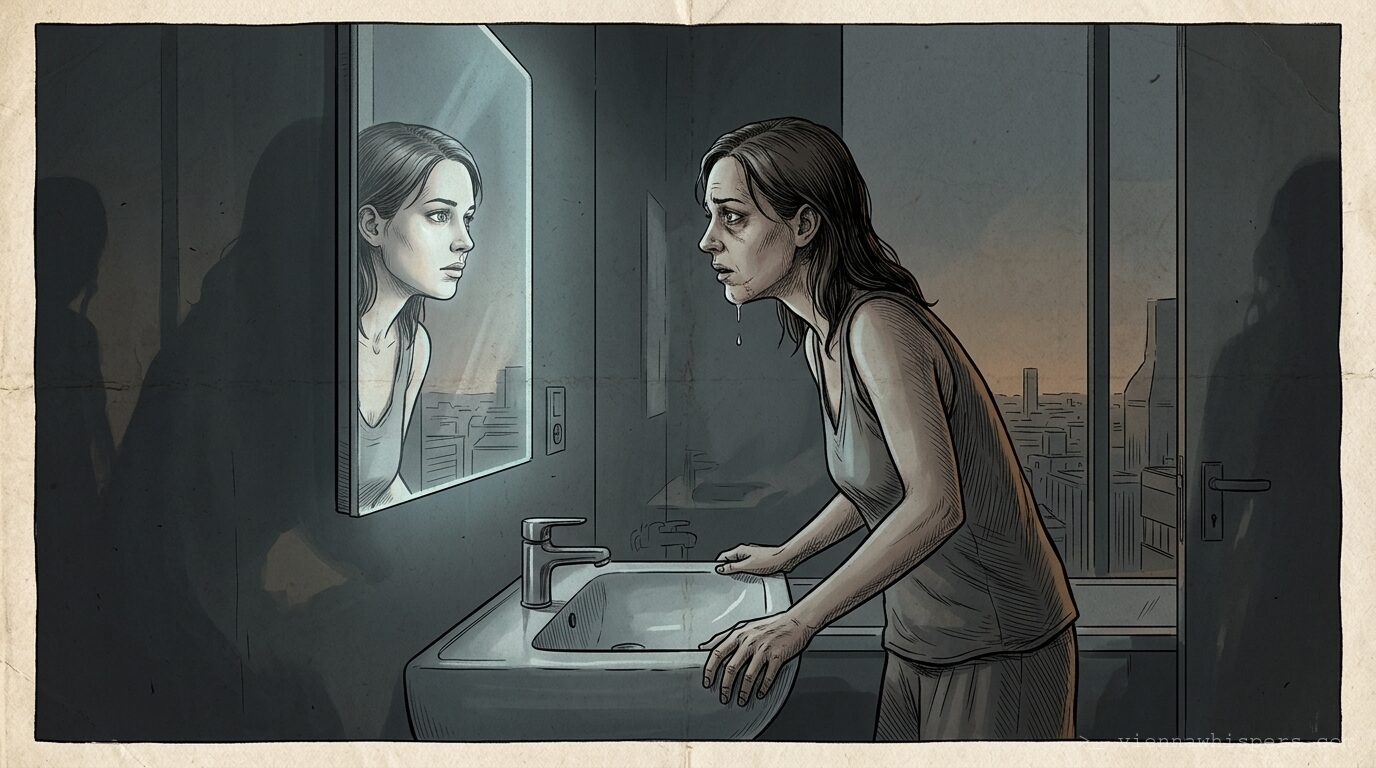
Looking back at her was Nora at twenty-nine.
The reflection perfectly synchronized with her movements. When Nora tilted her head, the reflection tilted its head. When she blinked, it blinked. But the face was flawless. The skin was taut and luminous. The Praterstern scar was gone. The eyes were bright, unburdened by thirteen years of bureaucratic fatigue and bad men.
Nora’s first reaction was not horror. It was a deep, shameful thrill. A quiet, uneasy laugh escaped her throat, echoing sharply in the sterile acoustics of the bathroom. She touched her cheek. In the glass, the twenty-nine-year-old touched her cheek.
Did I authorize a premium deep-sieve filter while drunk? she wondered. It was illogical, but vanity is a remarkably effective anesthetic. She leaned closer, mesmerized. She turned her face left, then right, admiring the long-lost tension of her own jawline. She felt a sudden, foolish urge to cancel her meetings and go out into the city, simply because she looked so beautiful.
Then, the anomaly expanded.
Nora noticed a stray gray hair near her temple. She reached up to pluck it.
In the mirror, the twenty-nine-year-old’s hand reached up, but there was no gray hair to grasp. The digital fingers pinched empty air against a perfect, chestnut-brown hairline.
Nora frowned.
The reflection did not.
The twenty-nine-year-old Nora maintained a calm, radiant neutrality. The algorithm had decided that frowning was a sub-optimal facial posture. It refused to render it.
Nora dropped her hand. The reflection dropped its hand, but a fraction of a second too late.
“System,” Nora said, her voice entirely stripped of its earlier amusement. “Disable aesthetic filters. Reset to raw feed.”
The mirror’s internal processor hummed. The ambient lighting shifted to a warmer, soothing amber, a programmed response to the sudden spike in Nora’s vocal stress frequencies.
But the image did not change. The twenty-nine-year-old looked back with serene, glowing affection.
“Reset!” Nora snapped, stepping backward.
The reflection stepped backward, but its posture remained perfectly straight, whereas the real Nora’s shoulders were hunched in rising panic. The synchronization was fraying. The algorithm was finding it increasingly difficult to map the erratic, ugly movements of the forty-two-year-old woman onto the flawless geometry of File #409.
Nora grabbed a heavy cotton towel and frantically wiped the glass, an entirely illogical response to a digital screen, driven by pure primate panic. She rubbed hard, trying to smear the ghost away.
Behind the glass, the reflection stood perfectly still. It was no longer mimicking her.
Nora froze, the towel pressed against the smart-surface. Her actual heart rate was hammering at 135 beats per minute. Her real face was flushed, slick with sweat, the tendons in her neck strained and sharp.
The young woman in the mirror was completely unbothered. She looked at Nora with mild, benevolent pity.
The mirror had severed the motion-tracking link. It had realized that trying to force the perfect archive to perform Nora’s current distress was ruining the aesthetic integrity of the file. The physical woman in the room had become irrelevant. She was merely loud, biological interference.
“Let me out,” Nora whispered, pressing her live, trembling hand flat against the reinforced glass.
In the reflection, the twenty-nine-year-old did not meet her hand. Instead, the young woman smiled—the exact, radiant smile from August 12, 2042. The perfect day.
Nora let out a jagged, hysterical sob, reaching for the heavy ceramic lotion dispenser on the shelf, fully intending to smash the three-thousand-euro display into black glass splinters.
She raised the heavy bottle above her head, her face distorted in rage.
In the glass, the young woman finished brushing her hair, leaned forward, and blew a kiss to the empty room.
Support us
Vienna Whispers is free to read. If you enjoy the stories, we’d be grateful for your support.