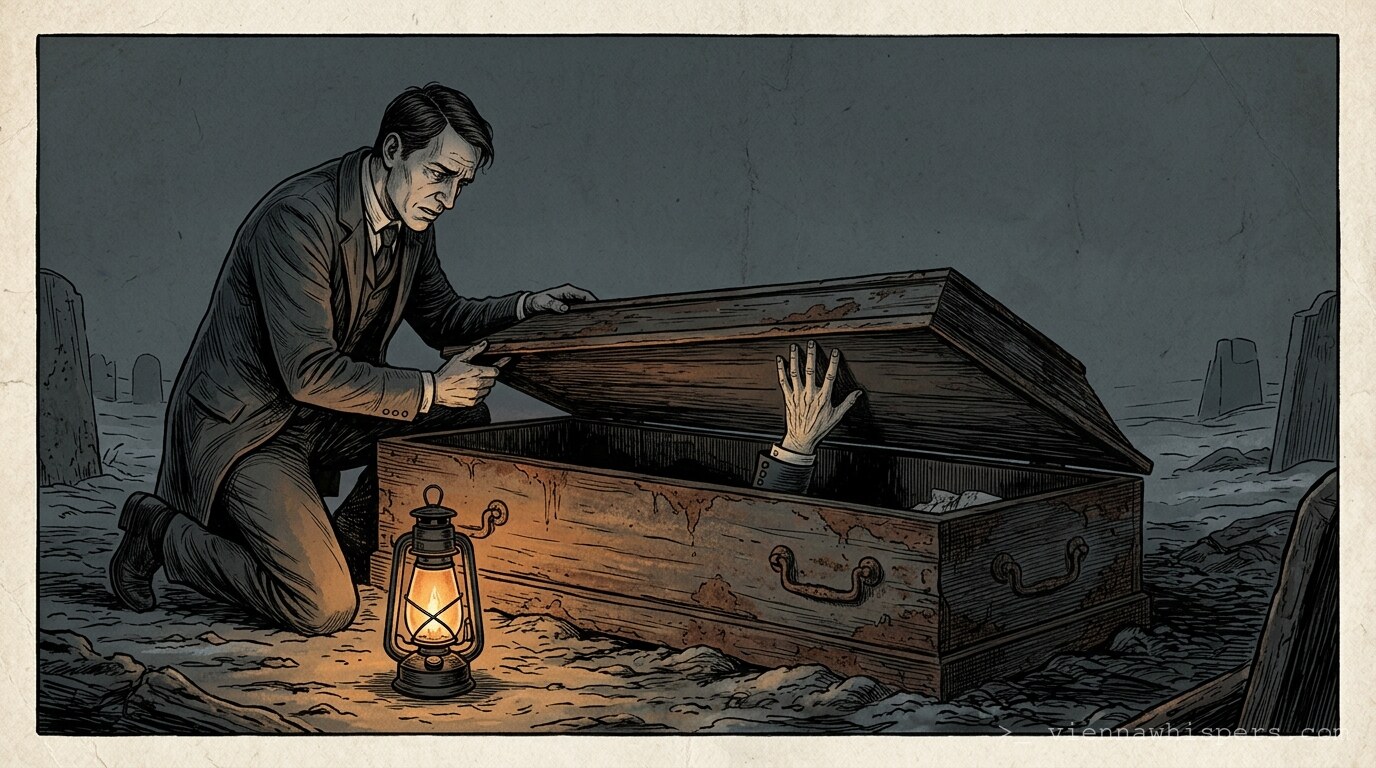
The Coffin with the Hatch
The ledger required a signature in triplicate, but the grease on my fingers made the paper translucent. It was a cold Tuesday in November 1784. I stood in the mud of St. Marx, lantern in hand, staring at the latest triumph of imperial efficiency: the Sparsarg.
Joseph II had demanded that even death become economical. The reusable coffin was pine, crude, with a hinged bottom. One pull of the lever and the body would drop into the mass grave like a package down a chute. Umschlagsgeschwindigkeit — turnover speed — was the guiding principle.
I grasped the iron lever. It was slick with cheap tallow. I pulled.
Nothing.
The mechanism gave a long, metallic shriek of protest, but the hatch remained stubbornly closed. No grit in the hinges. No rust. Just resistance.
I knelt, pressing my ear to the side of the box. From within came a dull, rhythmic pressure — not the frantic clawing of a living man, but the slow, deliberate force of someone who had decided not to cooperate.
I slid the locking pin and eased the hatch open a sliver.
Inside lay an elderly man in the faded mustard livery of a low-level tax assessor. His eyes were open, clear, and utterly calm. His right hand was pressed flat against the underside of the hatch. Not pushing it open. Holding it shut.
He was dead. There was no question of that. Yet the tension in his forearm was immense. He was refusing the final administrative step with the same weary stubbornness I had seen in a thousand minor officials over twenty years of service.
“Sir,” I said, the word absurd even as it left my mouth. “Your cooperation is required for the proper completion of the record.”
The corpse did not blink. He simply maintained pressure. A small, quiet act of bureaucratic defiance from beyond the veil.
I felt a surge of professional irritation. “This creates additional paperwork,” I hissed. “A report on mechanical failure. An audit. You are impeding the efficiency of the imperial interment protocol.”
The dead man’s grip tightened. The wood creaked.
I looked at my own hands — trembling not from fear, but from the cold and the exhausting recognition of a kindred spirit. I had spent two decades ensuring every body was counted, every coffin accounted for, every ledger entry pristine.
And here, in the dark, a dead tax assessor was doing exactly what I would have done in his position: refusing to be processed smoothly.
I stood up. The frost crackled under my boots. I looked at the lever, then at the lantern, then back at the coffin.
I did not force the mechanism. I did not call for assistance. I simply closed the hatch, signed the ledger as “mechanical anomaly – under investigation,” and walked away.
Behind me, in the absolute silence of St. Marx, I heard the faint, deliberate sound of a bolt sliding home.
The state would find its missing body in the morning.
But tonight, the ledger remained — for once — incomplete.
Support us
Vienna Whispers is free to read. If you enjoy the stories, we’d be grateful for your support.