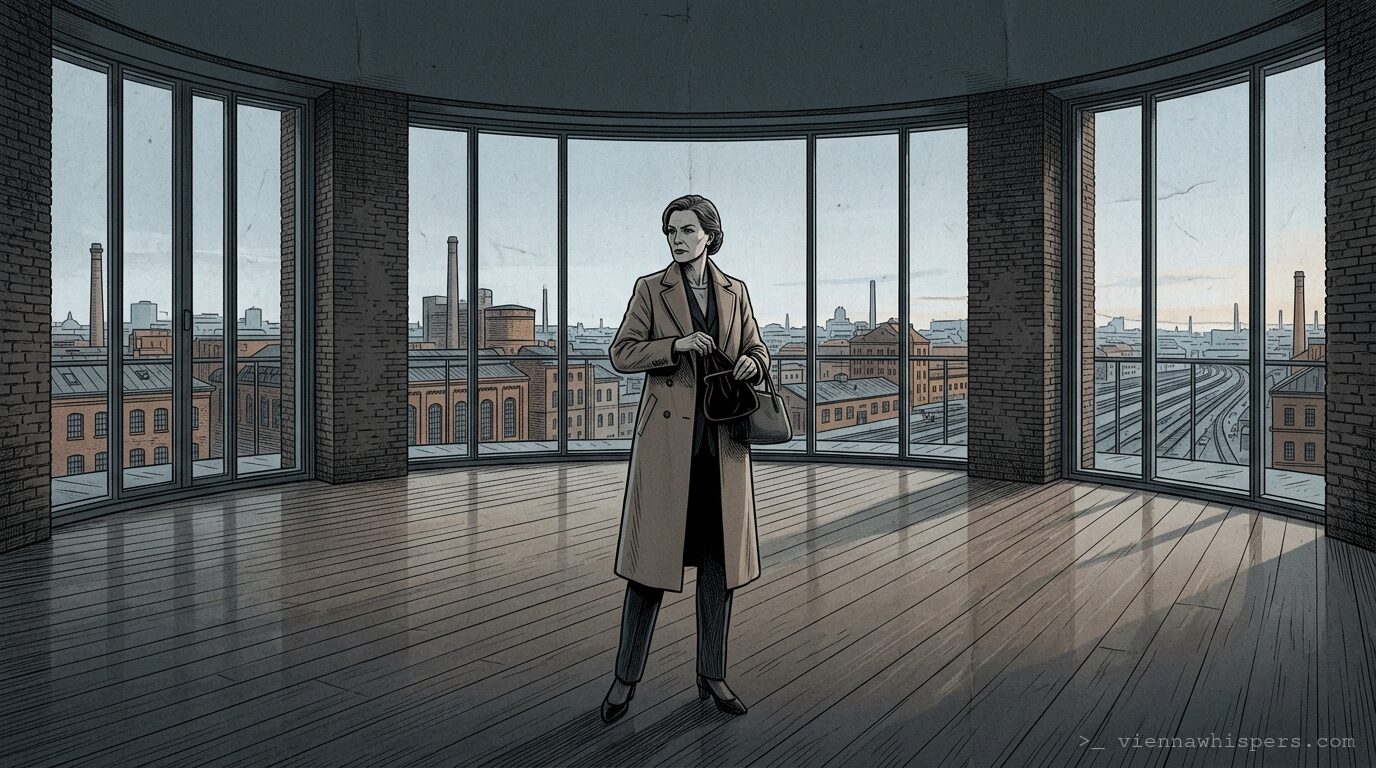
The Woman Who Bought the Gasometer
Irene Kalt considered mourning to be an administrative error, a lapse in upper-class discipline usually cured by a month at a clinic in Montreux or a sudden, spiteful adjustment of one’s will. She did not weep for her late husband, Johannes. Weeping caused facial swelling, and Irene, at sixty-eight, had invested far too much capital in her cheekbones to ruin them over a man who had the atrocious timing to die of a cardiac arrest during the first act of Parsifal.
Instead of weeping, she liquidated a considerable portion of his portfolio and bought the entire fifteenth floor of Gasometer A.
It was a cash transaction. The real estate agent, a slick young man with a suspiciously tight suit and a U-Bahn tan, had assumed she was purchasing the four-hundred-square-metre circular penthouse for a tech-startup grandson, or perhaps to open a tragically avant-garde gallery. When Irene informed him that she intended to leave it entirely empty, he had smiled with the pained, elastic terror of a man realizing his commission might bounce.
It did not bounce. Irene now owned a 360-degree panopticon suspended above the industrial decay of Simmering.
Every Tuesday and Thursday, her driver, Marek, brought her from the manicured, oxygen-rich silence of the 19th District down into the concrete gut of the 11th District. He would park the Mercedes in the underground garage of the Gasometer shopping mall, wedged between rusted Skoda Fabias and the smell of stale cinema popcorn, and wait. Irene would take the private elevator up, rising past the lower floors of students, subsidized renters, and municipal dreamers, until the doors opened directly into her vast, hollow kingdom.
The apartment smelled of ozone, fresh plaster, and aggressive nothingness. It was immaculate. Herringbone oak floors stretched outward in a massive ring, bounded by exposed nineteenth-century brick and floor-to-ceiling glass.
Irene unbuttoned her cashmere coat—the color of old money and unroasted coffee—and withdrew a small velvet pouch from her handbag.
She had not bought the floor to live in it. The very idea of residing in Simmering, hovering over a U-Bahn station and a cemetery, was geographically offensive. She had bought it to enact an embargo.
Five years ago, she and Johannes had attended a ghastly corporate reception here, back when the space was leased by a venture capital firm that subsequently went spectacularly bankrupt. Fleeing a conversation about blockchain, Johannes had pulled her toward the northern curve of the glass. He had stood right there, his heavy, manicured hand resting on the mullion, looking out over the glowing, thrombotic vein of the A23 highway.
“Look at it, Irene,” he had said, swirling a glass of aggressively mediocre Veltliner. “From up here, you can’t see the dirt. You can’t hear the socialists. It’s the only place in Vienna where the city looks like it actually works.”
He had looked happier in that single, cynical moment than he had on their thirtieth anniversary.
Irene refused to let anyone else inherit that exact angle of his satisfaction. The market was ruthless; eventually, she would die, and some newly rich idiot with a podcast and a golden retriever would buy the floor and look out her husband’s window.
She could not stop the future, but she could successfully sabotage it.
She walked to the custom kitchen island, an expanse of black Italian marble that looked like a tombstone waiting for an inscription. From her velvet pouch, she produced a heavy steel flathead screwdriver. Bending slightly, she reached underneath the overhang of the marble—a place no one would ever look, but where someone, eventually, might rest their fingertips—and dragged the screwdriver hard across the polished underside.
A sharp, violent scraping sound echoed through the empty cylinder of the building. She gouged a deep, jagged trench into the hidden stone.
“Perfect,” she whispered.
She moved to the guest bathroom. Last week, she had used a pair of pliers to slightly strip the threading on the hot water valve, ensuring it would forever emit a high, thin whistle when turned past halfway. Today, she had brought a tiny glass vial of her own expired, discontinued perfume—a heavy, cloying scent of ambergris and rotting jasmine. She carefully emptied three drops into the unsealed gap between the floorboards and the bathtub. Over the next decade, whenever the room grew warm, it would smell faintly of an old woman’s funeral.
The joy of it warmed her blood. It was architectural petty treason. She was salting the earth of her own real estate.
Finally, she arrived at the northern curve of the glass. The Johannes Window.
Below her, Vienna was darkening into the Blue Hour. The headlights on the highway were a slow-moving river of cholesterol clogging the city’s arteries. Far off, the U3 rumbled, sending a barely perceptible vibration up through the massive brick spine of the tower.
Irene looked at the glass. It was flawless. Thermally insulated, soundproof, terrifyingly expensive.
She removed her leather glove, exposing her left hand. On her ring finger sat a five-carat emerald-cut diamond, an apology gift from Johannes after a particularly tedious affair he’d had in the late nineties with a cellist. It was a vicious, unfeeling stone.
She pressed the flat edge of the diamond against the glass at eye level.
With a slow, deliberate pressure, she began to drag her hand in an arc. The diamond shrieked against the tempered pane—a high, agonizing frequency that sounded like a mouse being crushed in a vice. Irene did not flinch. She kept her wrist locked, turning her whole body to maintain the geometry, completing the motion until the two ends of the scratch met.
She stepped back to inspect her work.
A perfect, frosted circle, deeply etched into the center of the panoramic view. The city lights flickered through it, distorted and fractured by the ruined glass.
Support us
Vienna Whispers is free to read. If you enjoy the stories, we’d be grateful for your support.