Coffee with the Basilisk
The year is 1684, though the light in the corner of the small, low-ceilinged Beisl near the Wollzeile flickers with a quality that suggests it has been flickering for centuries.
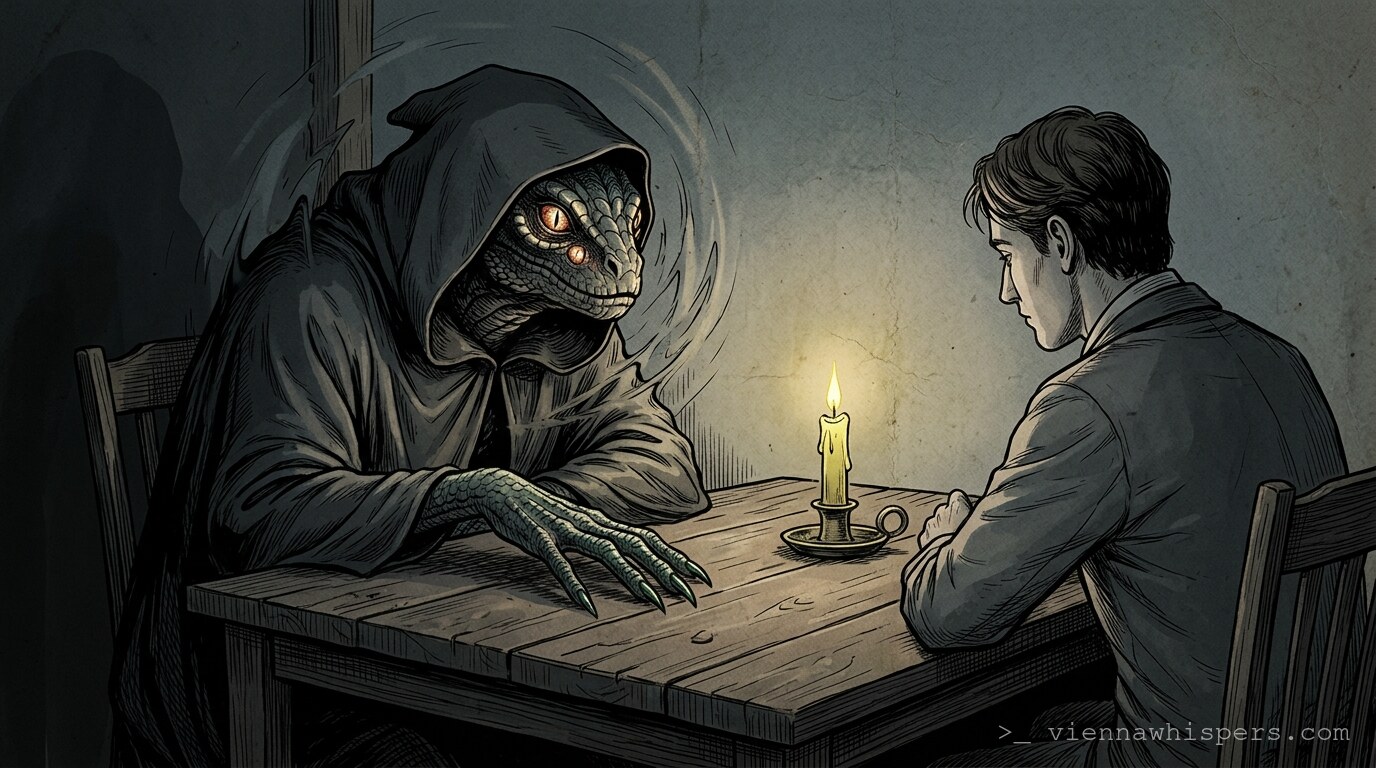
The creature occupies the shadow-drenched booth at the back. To a casual, drunken observer it might pass for a hunchbacked regular in a heavy charcoal-grey wool cloak, hood pulled low. To the innkeeper, who has long since traded his capacity for astonishment for the steady intake of coin, it is merely the customer who never touches his food and tips in pre-inflation silver florins.
It is, of course, the Basilisk. The terror of Schönlaterngasse.
It lifts a porcelain cup with a clawed, scaled hand, talons clicking softly against the rim. The coffee is tepid and the creature sighs — a sound like dry leaves skittering over cobblestones.
“The apprentices,” it rasps, voice a grating friction of stone on stone, “walk with such leaden feet these days. They lack the grace of the properly terrified. In the old days a man would hold his breath, his heart stuttering like a trapped bird. Now? They stumble past my alley smelling of cheap ale and unearned confidence. They do not even look toward the shadows.”
It leans forward. The candlelight catches a patch of emerald-dusted scales. Its eyes are not eyes in any sense understood by the Viennese medical faculty; they are burning, multifaceted apertures capable of turning living flesh into jagged basalt. Fortunately tonight it is merely bored. It has seen enough stone statues of tax collectors and failed poets to last three lifetimes.
“Manners are a lost geometry,” it continues, addressing the untouched goulash. “I turned a perfectly respectable baker into stone in 1590 — sturdy, honest proportions. Now? If I were to glance at the modern pedestrian they would probably just drop their device and complain about the service. They lack the requisite awe.”
A young student enters, soaking wet from the autumn rain, boots tracking mud across the worn floorboards. He is loud, laughing about a lecture on theology, gesturing broadly. His sleeve nearly brushes the Basilisk’s cloak.
The air in the room turns sharp for half a heartbeat, smelling of ozone and ancient subterranean dust. The student pauses, rubs the back of his neck as if struck by a sudden chill, shivers, and continues on — oblivious that he had been one careless movement away from becoming a decorative garden figure for the next four hundred years.
“See?” the Basilisk mutters, tapping a sharp talon against the table. “No appreciation whatsoever. The world grows thick, dull, impenetrable. It is a tedious epoch.”
It rises, the heavy cloak hanging like an architectural weight. It drops a few coins minted in a century that has not yet fully arrived and moves toward the door with a stiff, reptilian gait. Its tail scrapes briefly against the doorframe — a dull, rhythmic sound like someone cleaning their fingernails with a chisel.
Outside, the Schönlaterngasse waits, glistening after the rain. The creature pauses at the threshold and looks up at the smog-grey sky with profound, weary disappointment.
“If I still had the energy,” it says softly, to no one in particular, “I would turn the entire district into a quarry. At least stone doesn’t talk back.”
It steps into the darkness. A moment later the alley is empty.
The silence that follows is not the absence of sound, but the heavy, expectant weight of something ancient that continues to watch, still waiting for someone to finally be polite enough — or foolish enough — to look it directly in the eye.
Support us
Vienna Whispers is free to read. If you enjoy the stories, we’d be grateful for your support.