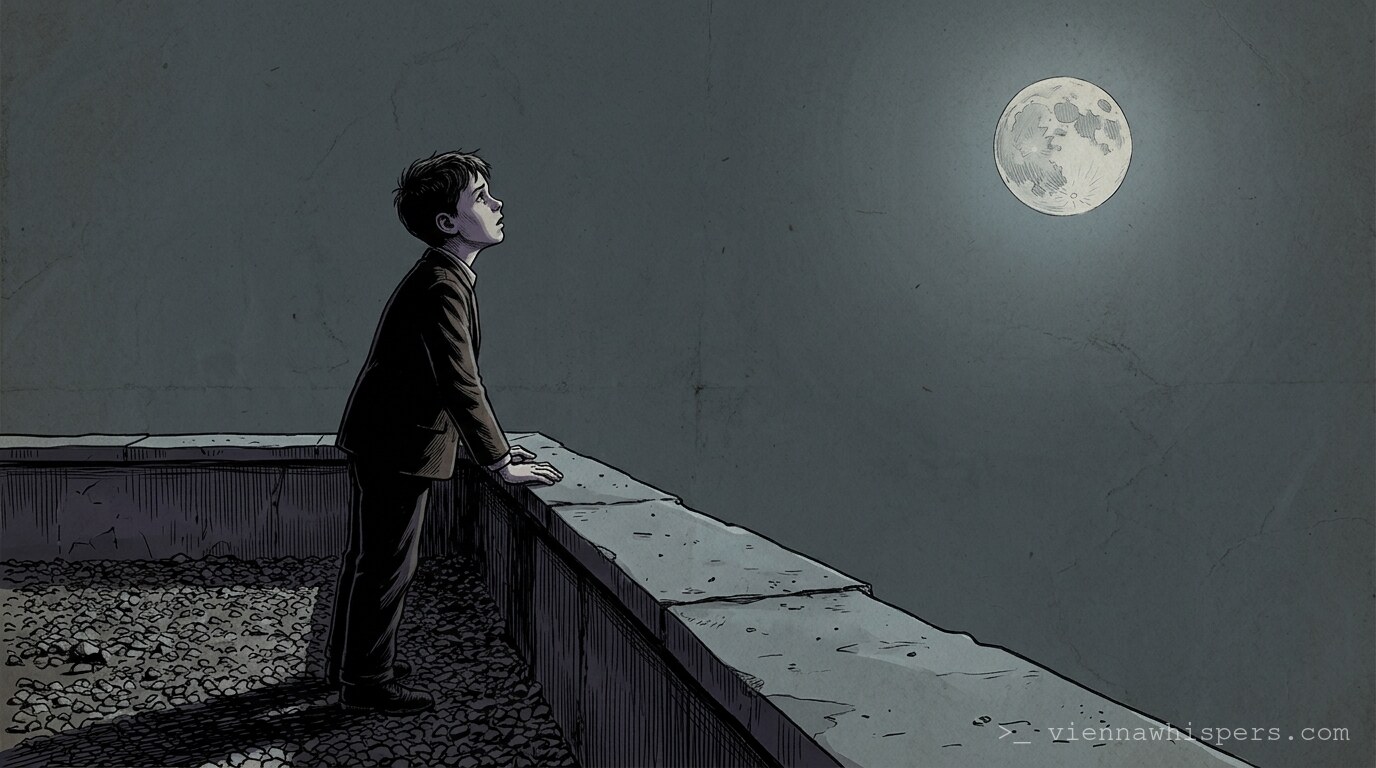
The Boy Who Watched the Moon Walk Away
The heat in our apartment on the fourth floor of the Karl-Marx-Hof was not merely a matter of degrees; it was a physical weight, a thick, stagnant broth of unwashed linen, cheap tobacco, and the sour, metallic tang of the radiator that didn’t work but somehow still managed to radiate a stifling, dry exhaustion. It was July 21, 1969. The world was shrinking, pulled tight by the glowing glass eye of the television set in the living room.
My father sat in his undershirt, his skin the color of damp parchment, a bead of sweat tracing a slow, agonizing path through the dark hair on his chest. My mother clutched a glass of warm mineral water as if it were a holy relic. They were waiting for the step. The giant leap. They didn’t notice me, but they never really did; I was a piece of furniture that occasionally required feeding, something that took up space in the hallway without contributing to the communal obsession.
On the screen, grainy figures danced in a sea of static. The adults were weeping. My father, a man who generally reserved his emotions for complaining about the price of goulash at the butcher, had his mouth slightly open, a thin string of saliva caught in the corner of his lip. He looked ridiculous. He looked small.
“They’re doing it, Leo,” my mother whispered, her eyes fixed on the gray ghosts of men playing in the dust three hundred thousand kilometers away. “They’re actually doing it.”
I didn’t care about the men. I cared about the Moon. I had been watching it for months from the cramped balcony that faced the inner courtyard, a concrete throat that swallowed the noise of the city and spat it back as a dull, repetitive hum. I knew the Moon’s craters, the way it shifted in the sky, the way it seemed to lean toward Vienna on cold, clear nights, as if it were trying to hear the tram bells clanging on Heiligenstädter Straße.
I slipped out of the room during the commercial break, past the mountain of folded laundry that smelled of starch and disappointment, and climbed the service stairs to the roof.
The heat followed me up, but here, the air was thinner. The sky was an bruised, electric purple, the color of a fresh hematoma. I scrambled over the gravel, my knees scraping against the jagged stones, and stood at the edge of the parapet. I looked up.
It was there. Or, it was where it should have been.
But it wasn’t standing still. The Moon was shivering. It looked like a coin held between two fingers, wobbling as it turned. And then, I saw it—a movement so subtle it felt like a trick of the optic nerve. It wasn’t drifting; it was recoiling. It was a rhythmic, violent shudder, a cosmic flinch. As the radio in the apartment below crackled with the voices of astronauts—men who sounded like buzzing insects, arrogant and loud—the Moon began to peel itself away from the horizon.
It wasn’t orbiting. It was abandoning us.
I gripped the cold stone of the parapet. I was nine, and I knew that things were supposed to stay where they were put. My toys stayed in the box. The dust stayed under the sofa. The church bells stayed in the tower. But the Moon was moving backward, sliding into the velvet black like a shy guest backing out of a room where a terrible argument has broken out.
It didn’t look grand. It didn’t look like a triumph. It looked like a frightened animal.
Down in the city, the lights of Vienna flickered. The streetlamps along the Danube canal cast a jaundiced yellow glare, but they couldn’t reach up here. I watched the Moon dim. It wasn’t being eclipsed; it was simply retreating, pulling its white light inward, shrinking into a pale, translucent ghost. I felt a sharp, hollow ache in my chest, the kind of grief that doesn’t belong to a child. I felt complicit.
“They’re touching you,” I whispered to the dark. “I’m sorry. They’re touching you.”
The city hummed below, oblivious. Thousands of people, huddled in their boxes, were watching the television screens, their hearts full of a borrowed, hollow pride. They were celebrating a theft. They were cheering for the moment we breached the final frontier, ignorant of the fact that the frontier had simply decided to leave.
I looked down at the courtyard. A cat was stalking a moth near the trash bins. An old man in a bathrobe was leaning out of a window two floors down, smoking a cigarette, looking at the same sky and seeing only the night. He didn’t see the hole where the anchor should have been.
The Moon was nearly gone now, just a faint, shivering smudge of luminescence, a frantic pulse of silver against the vast, indifferent void. It was receding with a terrifying, silent speed. I imagined it huddling in the deep dark, curling into a ball, trying to heal the puncture wounds the men were making on its skin.
I turned back to the roof door. My hands were shaking. I touched my face; it was cold, despite the July heat.
When I walked back into the living room, the scene had changed, but not in the way they expected. The television was showing a flicker of a flag, a stiff, synthetic thing that couldn’t possibly know what wind felt like. My father was standing up, clapping his hands together with a soft, meat-slapping sound.
“The future,” he said, his voice thick with a strange, performative reverence. “Look at the future, Leo.”
He looked at me, but he didn’t see me. He saw an audience. He saw a legacy. He saw a world that had been conquered and divided and pinned to the wall like a dead butterfly.
“Yes,” I said. My voice sounded thin, alien to my own ears.
“You’ll remember this night forever,” my mother said, wiping her eyes. She looked at the TV, then at the wall, then at the ceiling. She didn’t look at the window. Nobody ever looks at the window when they think they own the world.
I sat on the edge of the sofa. The heat in the room was unbearable, a pressurized vacuum that seemed to be squeezing the oxygen out of the space. I looked at the screen—the grainy, jumping, gray dust—and then I looked at my father’s feet, tucked into worn-out leather slippers.
I thought about the rooftop. I thought about the emptiness waiting up there. I realized, with a sudden, clinical clarity, that nothing would ever be the same, and that no one would ever know why. The Moon was gone, and the darkness that replaced it was heavy, solid, and absolute.
I knew, even then, that the sun would come up, but the light would be wrong. It would be the light of an afterlife.
Support us
Vienna Whispers is free to read. If you enjoy the stories, we’d be grateful for your support.