The Last Man Who Could Still Lie
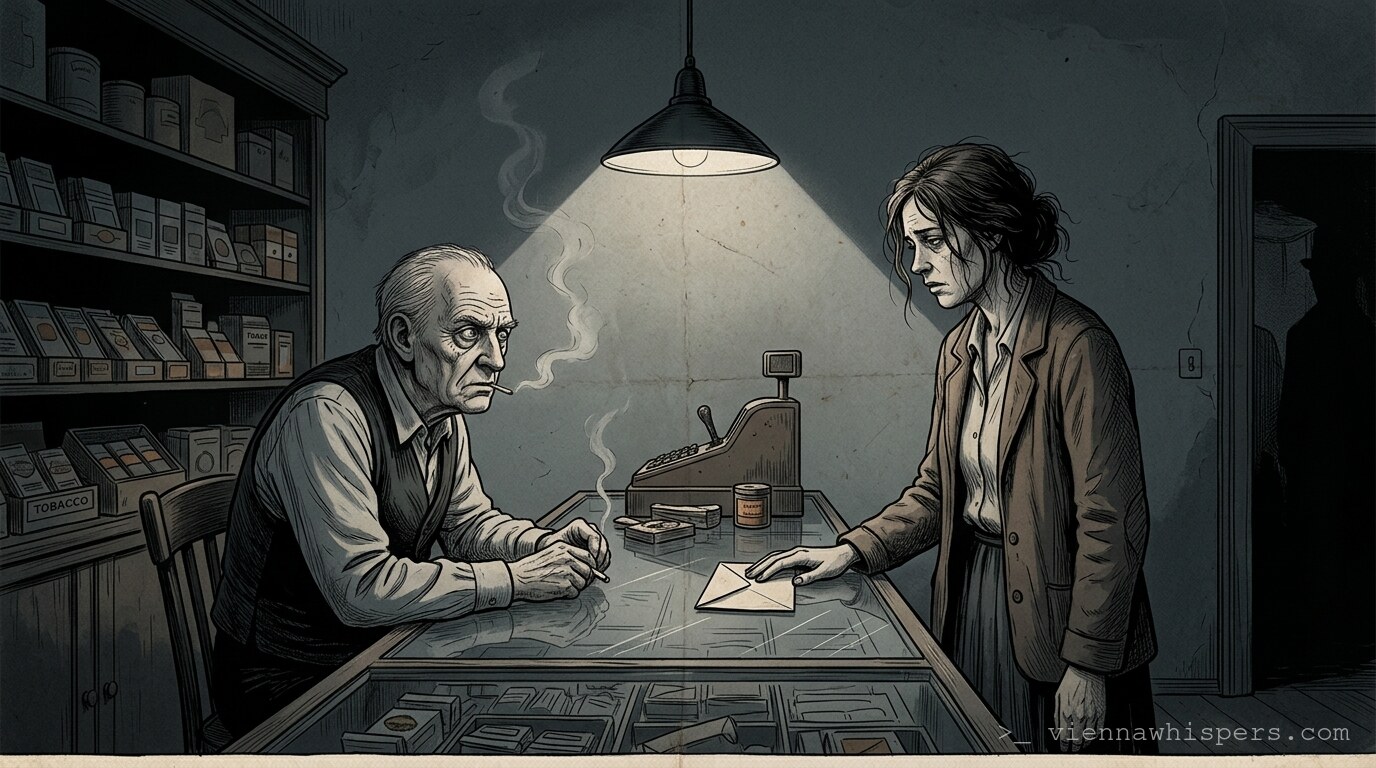
Ferdinand “Ferdl” Zawichowski sat behind the scratched glass counter of his Trafik like a king on a throne of stale tobacco smoke and lottery tickets that smelled faintly of damp wool and bureaucratic disappointment. It was 2026, and Vienna had become an insufferable place. Since the Great Honesty had swept the city in January, people were physically incapable of lying. Politicians stood at podiums and described their embezzlement schemes with the monotonous cadence of a weather report. Marriages dissolved over breakfast when husbands admitted their wives’ cooking was “pedestrian at best.”
Ferdl alone remained untouched. Seventy-eight years of practiced misdirection had apparently rendered him immune. While the rest of the city choked on its own sincerity, Ferdl continued to sell lies — clean, tailored, and expensive.
The bell above the door rattled. A woman entered. She wore a coat that cost more than Ferdl’s entire inventory and looked as if she had spent the afternoon being scrubbed by a wire brush. Her face was tight, the skin around her eyes bruised with the particular exhaustion of someone who had heard nothing but brutal, unfiltered truth for months.
“I need a lie,” she said.
Ferdl wiped his hands on a rag that had seen the fall of the Wall.
“Standard marital betrayal is fifty. Full affair with convincing details is eighty. If you need me to fake a terminal illness for your mother-in-law, we negotiate.”
“I don’t want a story,” the woman replied. “I want you to tell me I’m a good person.”
Ferdl’s glass eye drifted lazily toward the door. He took a slow sip of cherry schnapps from the bottle under the counter.
“That’s not a lie, Gnädige Frau. That’s a fucking miracle. I deal in fiction, not theology.”
She placed a heavy envelope on the counter.
“Everyone else tries and their body rejects it. Stomach cramps. Hives. One man pissed himself on the U6 trying to tell his wife he still loved her. I need to hear it from someone who can actually say it.”
Ferdl leaned back. The chair creaked like an old man’s knees.
“You want a masterpiece of deception about your own soul. That’s premium service.”
“I’m begging you.”
Ferdl looked at her properly for the first time. He saw the manicure, the trembling jaw, the older, heavier shadow that seemed to stretch back further than this woman’s lifetime.
“You’re a good person,” he said, his voice smooth and practiced. “You’ve always done your best. The little betrayals, the moments you looked away, the quiet selfishness — none of that defines you. You are fundamentally decent. The world is simply too cruel to see it.”
For a second, relief washed over her face like cool water. Her shoulders dropped. She closed her eyes and breathed out, shaky and grateful.
“Thank you.”
Ferdl pushed the envelope back toward her.
“Don’t thank me. I lied. That’s what I do. And because I’m the only one left who still can, nothing I say has any value. If I tell you you’re good, it’s automatically false. If I told you the truth — that you’re probably just as selfish and mediocre as everyone else — you wouldn’t believe me anyway. You don’t know how to trust anymore.”
The woman stared at him. The fragile peace on her face cracked and fell away.
“So what is the truth?” she whispered.
Ferdl didn’t answer. He simply reached for the small bowl of coins on the counter and began counting them, one by one. The metallic clink-clink-clink filled the smoky silence like a tired, indifferent heartbeat.
The woman stood there a moment longer, then turned and left. The bell rattled behind her. Cold Viennese air swept in, honest and sharp.
Ferdl kept counting.
Support us
Vienna Whispers is free to read. If you enjoy the stories, we’d be grateful for your support.