The Heurigen That Never Closes
The Buschen above the entrance is not a welcoming wreath. It is a cadaver. A bundle of straw grey with two centuries of fine dust, mummified and twisted, hanging like a small executed animal that was never granted the dignity of removal. It has signaled “ausg’steckt” since 1784 without ever being replaced. The wind from the Kahlenberg moves through it with a dry, papery rasp, as if the thing were still trying to breathe.
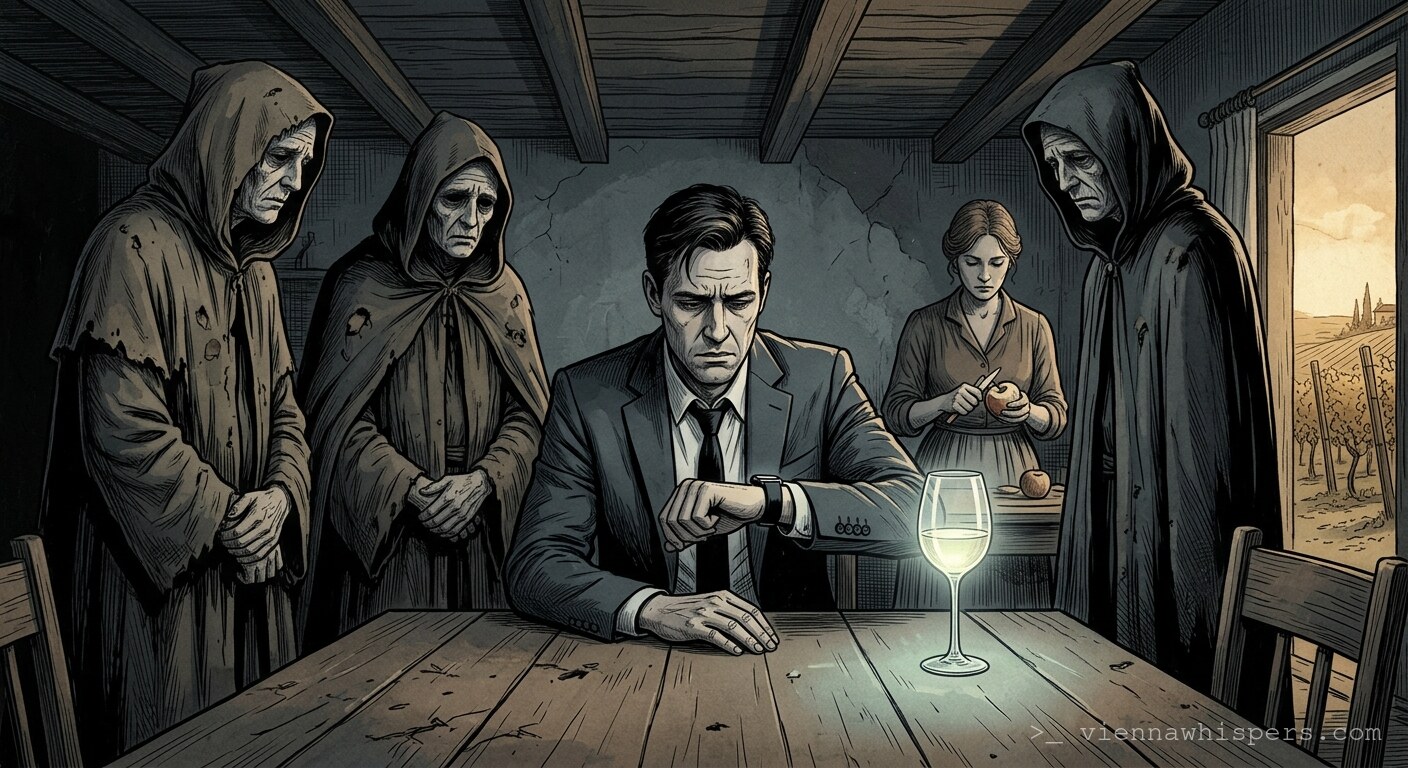
Julian sat on the bench that felt less like furniture and more like an extension of his own skeleton. The wood was dark, almost black, polished by centuries of human hesitation. He had only wanted one glass. Ten minutes. A quick reset before the next call.
The host placed the Viertel in front of him without a word. No menu, no smile, no unnecessary movement. He was a small, stooped man with the face of someone who had long ago filed a complaint against time itself and was still waiting for a response. His hands moved with the bureaucratic precision of a Viennese Beamter performing an inevitable duty.
“Da hast es,” he muttered, the words falling like a stamp on an overdue form. “Du kommst eh nimmer weg.”
Julian laughed — a short, professional sound. “I have a meeting in town. Just one glass.”
The host had already turned away, his gait a slow click-drag across the stone floor, as if even walking was an imposition he had learned to endure.
The wine was cold. Unnaturally so. It tasted first of limestone and wet earth, then of something older — the cold sweat of men who owed money in the Vormärz, the faint iron of a 1924 Schilling that had passed through too many anxious palms. With every sip Julian felt a chemical heaviness settle into his legs, as if the wine were quietly increasing the gravity beneath his bench.
His smartwatch tapped insistently against his wrist. Tap-tap-tap. Q3 projections. Tap-tap-tap. The haptic feedback felt like the last panicked heartbeat of a dying civilization trying to remind him that he still belonged to it.
He tried to check the time. The screen remained black. He tapped it harder. Nothing. The device had gone quiet, as though it had finally understood that it was no longer welcome here.
Around him the other guests sat in heavy, unhurried silence. A woman in a faded dirndl peeled an apple in one continuous ribbon that never quite reached the floor. Two men in wool vests stared into their glasses as if reading the future in the sediment. No one spoke much. Speaking seemed unnecessary. The Heuriger had already heard every possible conversation.
Julian shifted on the bench. The wood felt warmer now, almost fleshy. He placed his hand on the table to push himself up.
His sleeve did not move with him.
The fabric had fused with the grain of the ancient wood — not stuck, not caught, but grown into it, as if the bench had quietly begun the slow process of incorporating him into its structure.
He stared at the point of connection. His pulse was visible in the vein of his wrist, beating against the wood like a prisoner testing the bars of his cell.
The host passed by without looking at him, carrying another carafe. His voice was low, almost bored, the voice of a man who had delivered the same verdict thousands of times before.
“Sitzen bleiben. Der zweite Viertel kommt gleich.”
Julian stared at the point where his sleeve had fused with the wood. Not stuck. Not caught. Incorporated. The grain of the bench had begun to flow into the fabric like slow sap, warm and inevitable.
The host returned without being called. He placed a second Viertel in front of Julian with the same indifferent precision of a clerk filing a final report.
“Zweiter Viertel,” he said. “Der erste war nur die Anmeldung.”
On the table lay a small, black ledger Julian had not noticed before. The host opened it with two fingers, the pages crackling like old bones. The entries were written in neat, bureaucratic handwriting:
1812 – Müllersohn aus Klosterneuburg. Status: Patina gebildet. 1894 – Inflations-Beamter. Status: In die Maserung integriert. 1956 – Handelsvertreter. Status: Teil der Tischplatte geworden.
Julian’s name was already there, near the bottom. Fresh ink.
2026 – Julian A., Optimierer. Status: In Bearbeitung. Verweildauer: Unbestimmt.
He tried to pull his arm free. The bench held him with gentle, wooden insistence.
The host watched him without malice, only the tired Grant of a man who had seen this scene repeat for centuries.
“Draußen glauben’s noch, dass man die Zeit teilen kann,” he murmured, wiping a glass that didn’t need wiping. “Acht Stunden, Q3-Projekte, Meetings. Hier wird sie nur getrunken. Und wenn sie ausgetrunken ist, bleibt man sitzen.”
Julian’s smartwatch gave one final, desperate tap against his wrist — then fell silent. He unbuckled it with his free hand. The device dropped to the stone floor with a cheap, hollow plastic clack. The sound was absurdly small in this room of heavy wood and older stone. It lay there like a dead insect, its screen finally dark.
He looked at the second glass. The wine shimmered with the same sickly, iridescent sediment. He lifted it. His sleeve remained fused to the bench, but his arm could still move. The distinction felt increasingly academic.
He drank.
The wine tasted of limestone, old sweat, and the particular metallic aftertaste of promises that were made in 1784 and never kept. It settled in him like sediment in a barrel — heavy, patient, final.
Outside, the wind moved through the dried Buschen with a dry, papery rustle. Inside, the room accepted another piece of furniture.
Julian leaned back. The bench creaked once, comfortably, as it adjusted to his weight. The smartwatch on the floor no longer vibrated. The city far below continued its frantic, blinking existence, but its light no longer reached this slope.
The host passed by without comment, carrying another carafe for someone who had not yet arrived.
The evening was not ending.
It had simply forgotten how.
Support us
Vienna Whispers is free to read. If you enjoy the stories, we’d be grateful for your support.