The Vineyards That Drink Blood
The Lössboden on this narrow parcel of the northern Bisamberg slope is officially classified as lime-rich silt. In practice, it functions as a sponge for trauma. Beneath the fine, wind-blown sediment lie the mass graves of the Battle of Wagram, 1809—calcified femurs, brass buttons from French uniforms, fragments of ribcage still holding the shape of bayonet wounds. The soil has been digesting them for over two centuries.
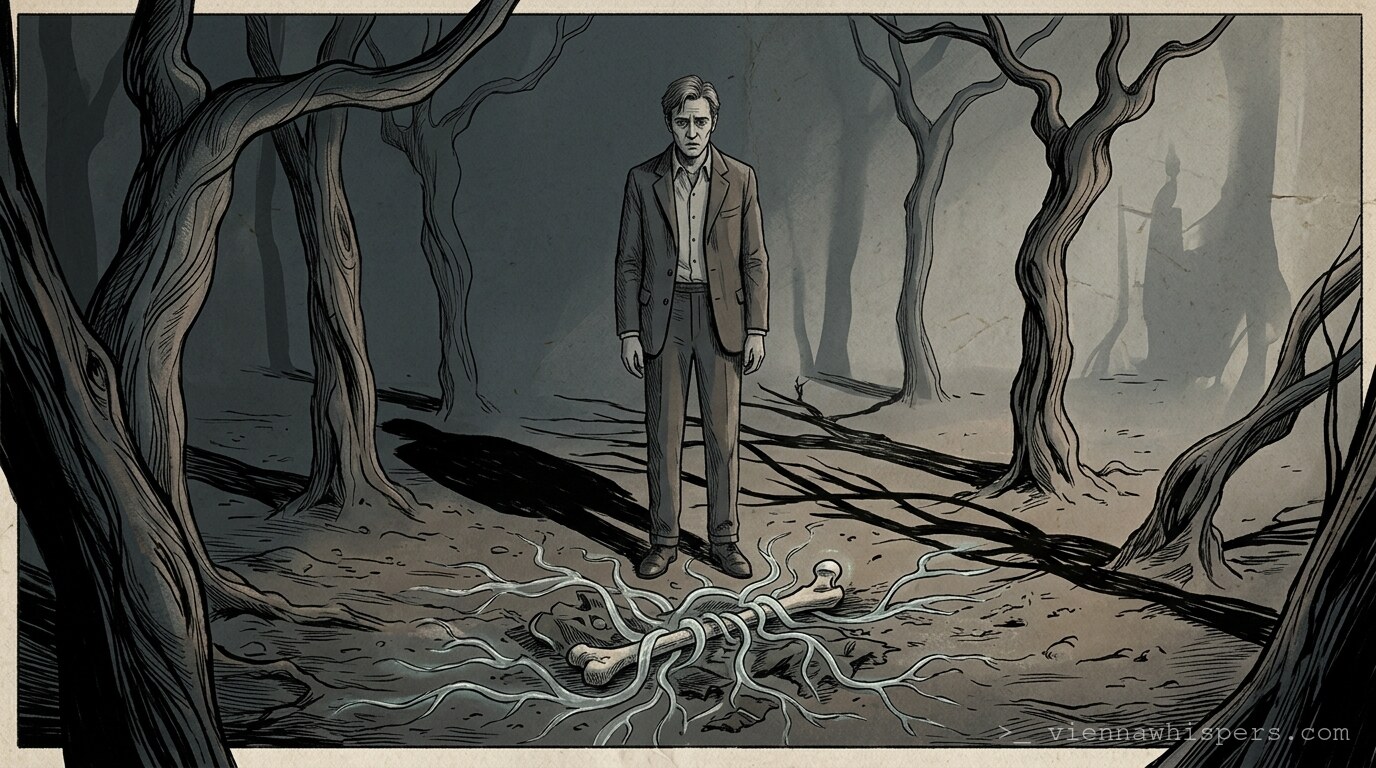
Elias Thorne stepped across the invisible boundary line at 14:12. His Italian leather shoes were already collecting violet dust. He had spent three years chasing rumors of the Blutiger Portugieser, a wine that existed only in private ledgers and the nightmares of bankrupt oenophiles.
Herr Krenn waited at the edge of the rows, arms folded, fingernails permanently necrotized to a deep bruised indigo that reached into the cuticles. He did not offer his hand.
The vines themselves were wrong. Their trunks were not woody in the usual sense; they were bundles of thick, fibrous cords, pale and sinewy, wrapped tightly around the posts like human tendons under tension. When Thorne brushed one with his fingertips, it felt warm, almost febrile, as though he were touching the inside of a living arm.
“Touch the fruit,” Krenn said.
Thorne reached out. The grapes were swollen, almost obscene, their skins stretched to translucency. The color was not purple; it was the black-red of clotted hemoglobin. He pinched one. The skin gave with a soft, wet pop—exactly the sound a scalpel makes when it first enters soft tissue. The juice that spilled over his thumb was hot, far hotter than the autumn air, and viscous. It smelled of an uncleaned surgery room: oxidized iron, saline, and the faint, sweet rot of exposed flesh.
Thorne brought the juice to his tongue. The taste was raw metal and salt. It bypassed the palate and triggered an immediate sympathetic pain in his own circulatory system. His pulse jumped.
The vine he was holding reacted instantly. The tendrils tightened around his wrist with cold, muscular precision, not crushing, but measuring. They were evaluating his iron content. Thorne felt a small, needle-like bud press against the skin above his radial artery and pierce it with clinical precision.
It did not bite. It docked.
His heartbeat, previously his own, was immediately answered. The vine synchronized. What had been a steady 78 bpm became something slower, older, heavier—the pulse of a battlefield at dusk. In his ears, he heard not blood, but the distant, wet roar of cannons from 1809. The ground beneath his feet no longer felt like soil; it felt like a digestive tract that had just received fresh material.
The vineyard was feeding.
Thorne tried to pull back, but the tendrils had already wrapped twice around his forearm, matching his rhythm perfectly. With every beat, his blood was sampled, tasted, filtered. He felt the iron being gently drawn—not violently, but with the patient efficiency of roots that had been doing this for over two hundred years.
Around him, the grapes began to change. The swollen, almost black clusters lightened. From clotted hemoglobin, they shifted to a vivid, living ruby-violet, the color of fresh arterial blood under bright light. They grew heavier, pulling the sinewy vines downward in slow, obscene arcs. The entire row seemed to sigh with satisfaction.
Krenn watched without emotion, his indigo-stained fingers resting on a post. “They prefer the living,” he said flatly. “The old graves give them memory. You give them resonance.”
Thorne’s vision began to desaturate. The world took on the flat grey of an anatomical plate. He could feel his own warmth being redistributed—not taken, exactly, but shared with the vast capillary network beneath the slope. He had wanted the ultimate terroir. Now the terroir wanted him.
In the regional office of the Amt für Weinbau, a mid-level clerk would later strike the parcel from the digital registry with a single mouse click: Flächenfehler. Parzelle nicht existent.
No search party would be sent. Sommeliers disappear every year chasing legends. The Bisamberg is large. The bureaucracy is larger. By evening, the Italian leather shoes still stood upright in the violet Lössboden, expensive and empty. The vines above them hung thick and heavy, satisfied, their fruit now a deep, vibrant ruby-violet that caught the last light of the autumn sun like fresh blood under glass.
The slope itself remained indifferent. It had been fed.
Support us
Vienna Whispers is free to read. If you enjoy the stories, we’d be grateful for your support.