The Last Lamplighter
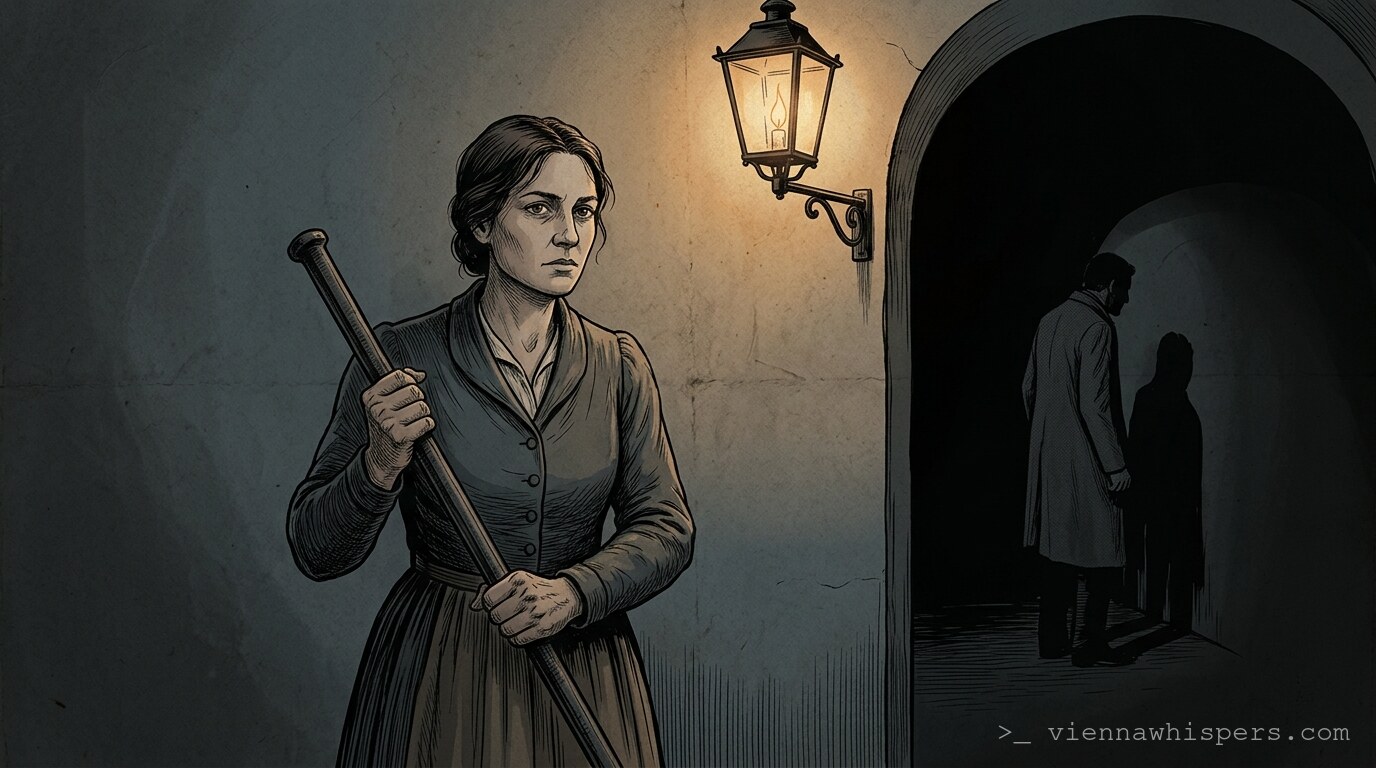
Therese’s right shoulder had been higher than her left for twenty-nine years. The Lulatsch had done that — thirty-four years of lifting, hooking, and twisting the heavy iron pole had slowly deformed her body into its own instrument. Her right arm was thicker, the muscle knotted and permanent, while her left remained almost delicate. The soot of Stadtgas had long since tattooed itself into the pores of her hands; no amount of scrubbing could remove the deep grey-black lines that followed every crease and callus. She was not a romantic figure. She was a machine made of meat and habit.
The Spittelberg lay in the deep blue of true Blue Hour, that fragile moment when the sky was neither day nor night, but a cold, bruised indigo that made every gas flame look feverish by comparison. Therese moved through the narrow alleys like a ghost that had forgotten to die. Behind her, the future advanced with brutal efficiency. Municipal workers in reflective vests were unspooling thick black cables through the gutters, their movements sharp and impatient. They smelled of ozone, hot metal, and the cheap optimism of progress. The cables lay across the cobblestones like black intestinal loops, ready to strangle the old city’s breathing.
She did not look back.
Each lantern was a patient.
She approached the first one at the corner of Gutenberggasse. The gas hissed as she hooked the Lulatsch into the mechanism — a living, wet sound, like lungs filling with heavy air. She twisted. The flame caught with a soft pop and settled into its familiar, warm, sulfurous glow. For a few seconds the alley breathed again. The light did not banish the darkness; it caressed it, giving the shadows depth and mercy. In this light, the cracks in the façades became elegant rather than ugly. The damp stains on the walls looked like watercolor instead of decay.
Therese moved on.
The second lantern, the third. Every twist of the pole was a small act of defiance against the sterile white future creeping up behind her. She could hear the workers now — the clank of tools, the low cursing, the occasional spark as they tested connections. They were only two blocks away, dragging their dead, merciless light toward her.
She paused at the entrance to a Durchhaus. The gas flame above her head zischte and gurgled, releasing that heavy, sweet-rot smell of Stadtgas that had accompanied her entire adult life. It smelled like home. Like secrets. Like a city that still allowed itself to hide.
The new electric lamps had no smell. They had no breath. They simply existed — cold, white, unforgiving. They would turn every alley into an operating theater.
Therese felt a sudden, sharp wave of grant rise in her chest. “Sie glauben, sie machen es hell”, she muttered to the flame, “dabei machen sie es nur nackt.”
She continued her route. Her left knee ached with the damp. Her right shoulder burned. But the rhythm of the Lulatsch kept her moving — clack-hiss, clack-hiss — the sound of a woman performing the last rites for an entire way of seeing the world.
She reached the final gas lantern at the end of Zollergasse.
It stood alone, slightly crooked, its glass chimney already blackened by decades of use. Behind her, fifty meters away, the electricians had already raised the first new arc lamp on its pole. It waited there like a guillotine, cold and ready.
Therese hooked the Lulatsch into the mechanism. Her calloused fingers found the familiar notch. She looked up at the flame burning inside the glass. It flickered gently, alive, breathing.
For one long moment she simply stood there, the pole raised, the Blue Hour pressing down around her like cool, heavy velvet. The silence was so dense it felt physical.
She did not turn the lever yet.
A figure stepped out of the Durchhaus behind her.
He wore a charcoal-grey frock coat cut in a style no tailor had made in a hundred years. His face was soft at the edges, as if the gaslight itself had gently blurred him over decades. He did not fully enter the circle of light. He remained in the border zone where the glow began to fray.
“They’re almost here,” he said. His voice was quiet, almost courteous. “They think they are bringing clarity.”
Therese did not turn around. She kept her eyes on the flame.
“They call it progress,” she answered, her voice rough. “I call it undressing the city in public.”
The man gave a small, tired sound — not quite a laugh. “You’re extinguishing more than a flame tonight, Therese. You’re erasing the pauses. The city used to be allowed to hide. Now it will be forced to confess everything, whether it wants to or not.”
She felt the weight of the pole in her hands. Thirty-four years. Thousands of nights. Countless secrets kept alive by this small, hissing fire.
The electricians were only thirty meters away now. She could hear the sharp click of switches being tested. The first bank of arc lamps stood ready like executioners.
Therese twisted the lever.
The gas sighed one last time — a long, wet exhalation — and the flame shrank, trembled, and died. The alley was plunged into sudden, absolute darkness for two full seconds.
Then the new lights came on.
They were brutal. White, shadowless, clinical. The alley was instantly transformed into an operating theater. Every crack in the plaster, every smear of urine on the wall, every tired line on Therese’s face was exposed without mercy. The warm mystery of the gaslight was gone. What remained was raw, ugly, and mercilessly honest.
The man in the frock coat was no longer there. Only a faint distortion in the air where he had stood, quickly burned away by the new light.
Therese lowered the Lulatsch. It felt heavier than it ever had.
At the collection point two streets away, the foreman barely looked at her.
“Finally,” he grunted. “Put it on the pile, Oma. Scrap yard picks up Monday.”
She laid the pole down among dozens of others. They lay there like the bones of extinct animals — blackened, worn, useless. Her Lulatsch looked no different from the rest.
She reached into her coat pocket for her cigarettes. Her fingers found the pack, but no lighter. She had left it on the shelf in her small apartment in the 16th district.
Therese stood under the cold white glare of the new lamps, the city suddenly naked around her. She put an unlit cigarette between her lips anyway.
For the first time in thirty-four years, the night offered her no shelter.
She turned and walked into the over-lit street, just another old woman carrying nothing but the memory of a warmer darkness that no longer existed.
Support us
Vienna Whispers is free to read. If you enjoy the stories, we’d be grateful for your support.