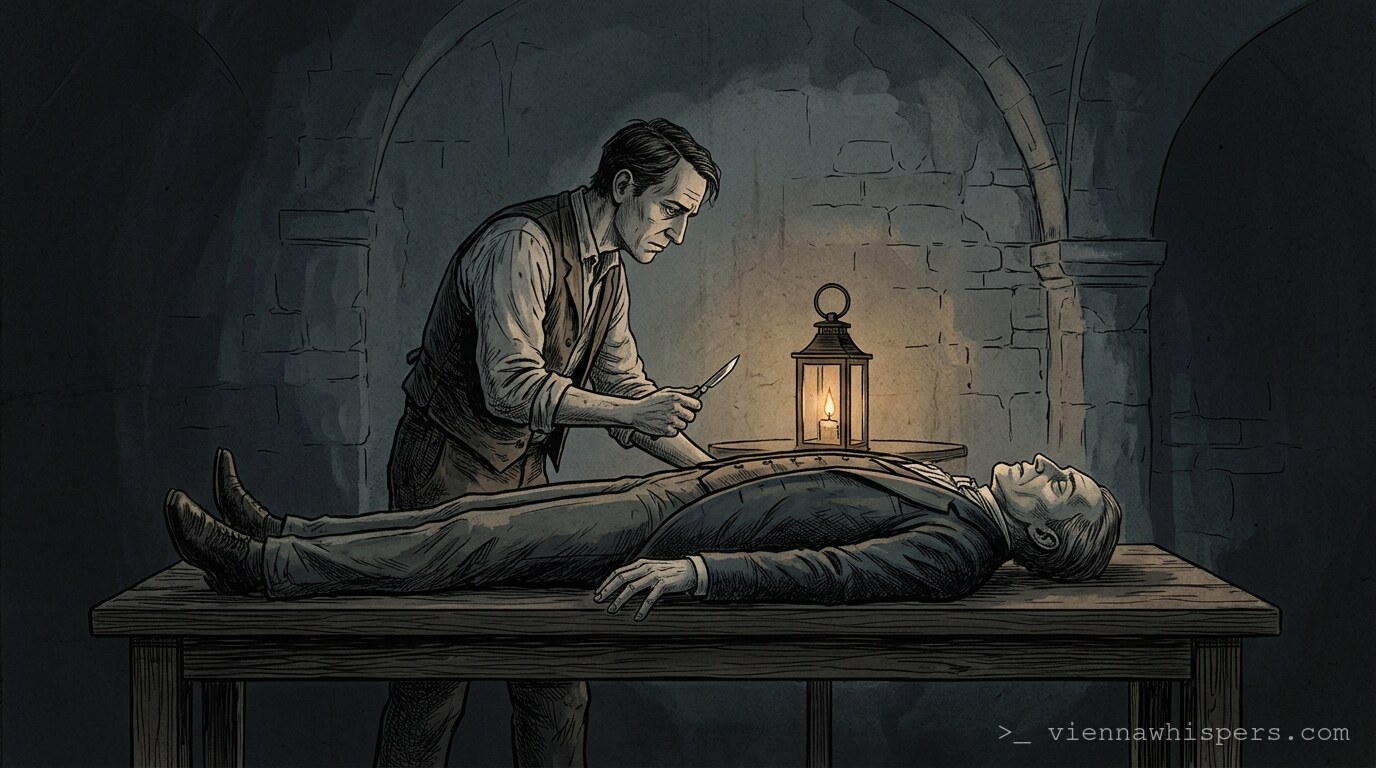
The Corpse Examiner
The year is 1784. My ledger is bound in calfskin, stained with tallow and the dark, iron-scented seepage of the departed. The mandate of Emperor Joseph II is clear: to prevent the premature burial of those merely catatonic, the Totenbeschauer must ensure that death is not a mistake but a finality. It is a work of administrative precision. One checks the pupils for reaction to the needle; one listens for the rattle in the lungs; one waits for the cooling of the extremities to reach a state of absolute, unyielding parity with the stone floor.
The morgue at the General Hospital is, by its nature, a place of profound silence. Yet, lately, the silence has been leaking.
It began on a Tuesday with a seamstress, no older than twenty, brought in from the Leopoldstadt with a complexion like curdled milk. Her lungs had failed, or so the physician swore. My duty was to confirm the expiration. I applied the small, silver probe to the carotid artery, a routine maneuver intended to elicit a flinch or a rhythm. The skin was cold—a dry, winter-baked cold—but as the steel tip pressed against the hollow of her throat, the flesh didn’t merely yield; it seemed to shrink away, a reflexive shudder that sent a ripple through the blue-veined lace of her collar.
I recorded Deceased: Pulmonary Collapse with a steady hand. My penmanship, sharpened by years of bureaucratic discipline, did not waver. I am a man of the Enlightenment; I believe in the clockwork of the anatomy. If the heart stops, the engine is spent. Anything else is merely the lingering electricity of the nerves, a spasm of the biological machine.
But then there are the eyes.
Last night, a nobleman was delivered, draped in heavy velvet that smelled of damp cellar earth. He had died in a carriage, his face twisted into a mask of sudden, indignant realization. When I moved the lantern closer to inspect the cloudiness of his corneas, the left eye tracked the movement. It was a slow, oily rotation, the iris catching the amber light of the flame. I stood perfectly still. My own pulse, usually a metronome, skipped. I felt the familiar weight of the city pressing against the thick stone walls of the morgue—that ancient, limestone-filtered dampness that seems to seep into the very marrow of the Viennese.
Is it the water? The pipes of the city are old, fed by springs that have seen the rise and fall of empires, carrying the runoff of centuries through the subterranean dark. Or is it the soil, so packed with the remains of those who came before that the earth itself has become saturated with a memory of life?
I picked up the scalpel. The steel was cold, familiar as a prayer. To verify death, one must sometimes look deeper. I made the initial incision across the sternum, a clean, clinical line. As the blade parted the skin, the nobleman’s hand—stiffened in rigor—flexed. The index finger tapped the table, three distinct, rhythmic clicks against the wood. Tap. Tap. Tap.
I did not scream. I am a civil servant of the Crown. I wiped the blade on a rag. I wrote, Deceased: Myocardial Infarction.
My desk is cluttered with these reports. My inkwell is nearly dry. I have begun to notice that the bodies do not look at me with malice, nor with the frantic desperation of the living. They look at me with a sort of weary curiosity, as if I am the one failing to grasp the nature of the situation.
There is a specific smell to this room now. It is not the smell of rot—I know rot; I have lived with the scent of decay since my apprenticeship. This is something else. It is the smell of a winter morning, of wet wool, of damp stone, and of a candle that has been snuffed out but continues to smoke. It is the smell of a soul that has been told to depart but has found the gates of the next world locked or indifferent. They are staying, anchored to the flesh, watching me work.
Sometimes, when the wind howls down the narrow streets of the city, I hear the Totenbeschauer—my predecessors—whispering in the rafters. They have left their marks on the ledgers, notes in the margins, ink smeared by trembling fingers. ‘Still listening,’ one had written in 1720. ‘They are not gone,’ another scribbled in 1755. I burned those pages, for they were unscientific and lacked the proper protocol.
Tonight, I am alone. The air is so cold that my breath hangs in the room like a ghost. There are three bodies on the tables. A child, a baker, and a woman whose name I did not record because I did not want to know it. I have finished my inspections. The forms are signed, the seals of the state pressed into the hot, red wax.
But as I gather my things to leave, I hear it.
A sound from the table behind me. It is not a gasp for air. It is not a groan of agony. It is the sound of a throat clearing—a small, polite, distinctly human sound.
I do not turn around. I know the etiquette of this place. If I turn, I acknowledge that they are waiting for me to join them. If I remain still, focused on the door, I am still the examiner and they are the examined. It is a fragile boundary, maintained only by the thickness of my own skin and the coldness of my logic.
I walk toward the exit. The floorboards moan under my boots. From the darkness of the morgue, I hear a soft shuffling, the sound of bodies shifting their weight on the wooden tables, settling in for a long, cold night.
I reach for the handle of the iron door. My fingers tremble, just once. I wonder, if I were to fall here, if I were to die this very second, would I also remain? Would I watch the next man, with his quill and his vanity, walk through this room with his flickering lantern?
I push the door open and step out into the Vienna night. The snow is falling, thick and silent, covering the cobblestones in a shroud of perfect, indifferent white. I start to walk home, but the sound of the metal latch clicking shut behind me is loud, final, and entirely too close to my ear.
I do not look back. One must remain professional. One must maintain the records.
But as I walk, I realize with a sickening, clinical clarity that I am not breathing, and I have not been for some time. I reach up to touch my own neck. The skin is as cold as the seamstress’s. There is no pulse. There is only the persistent, maddening silence of the city, waiting for the next report to be filed.
I keep walking. The streetlamps are dim, and the shadows they cast are long, reaching out to pull me back toward the morgue, toward the tables, toward the long, slow wait.
The report is complete. There is nothing left to verify.
Support us
Vienna Whispers is free to read. If you enjoy the stories, we’d be grateful for your support.