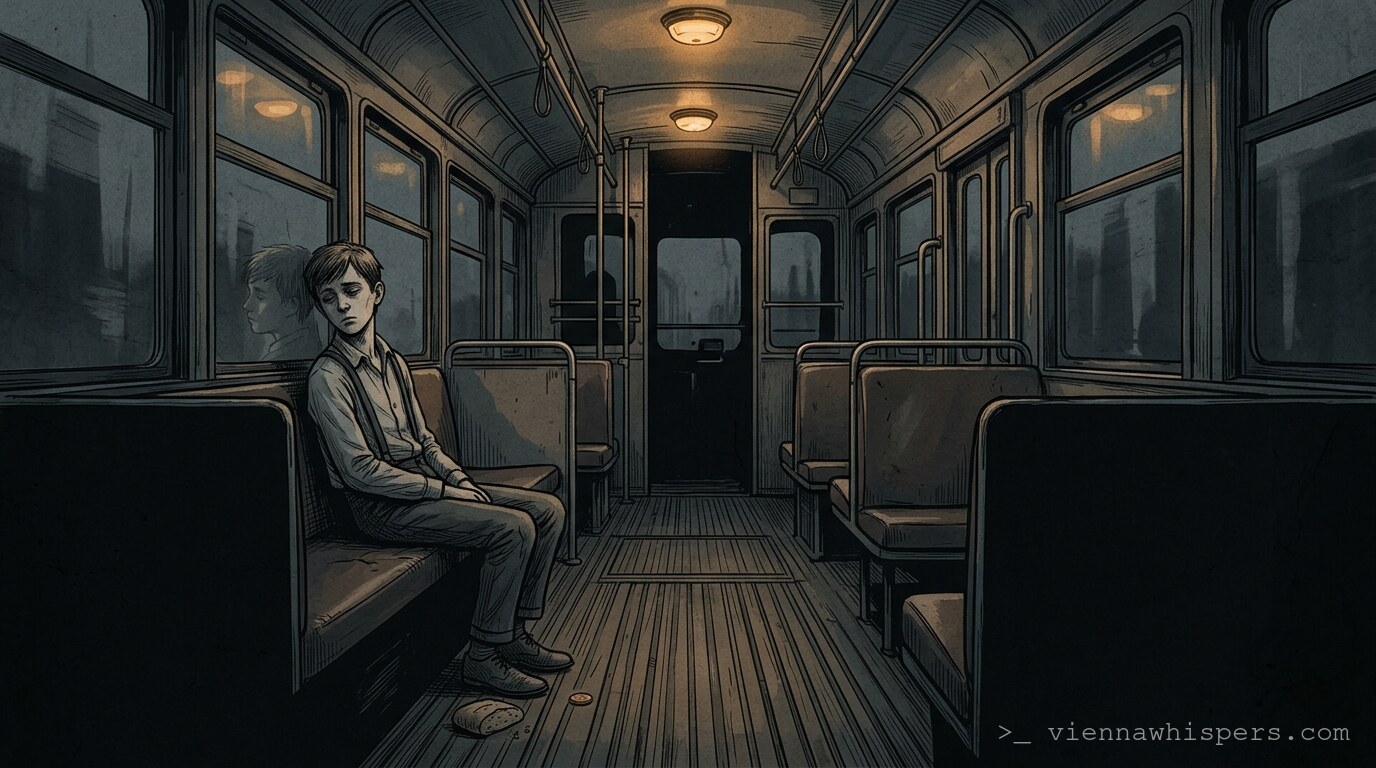
The Boy Who Fed the Tram
Lukas stood in the tall, damp grass where the asphalt of the Simmering depot surrendered to the dark. He was fourteen, an age that still felt like an ill-fitting coat, and he had become quietly convinced that things only continued to work because someone still noticed them.
The last tram of the night — an old E2 with peeling paint and a permanent smell of wet wool and ozone — hissed to a stop. The driver locked the cab and disappeared into the night office without looking back. Leo waited until the depot fell into its uneasy silence, then climbed the fence with the practiced grace of someone who had done this many times before.
The doors of the tram were left slightly ajar. He stepped inside.
The car smelled of damp leather, stale cigarette smoke, and the accumulated exhaustion of thousands of strangers. Leo reached into his coat pocket and took out a crust of dark rye bread, a single copper groschen from the sixties, and a small scrap of paper on which he had written: I heard the rain on the roof like a hundred fingers.
He placed them carefully beneath the seat near the heater grilles.
“You’ve had a long day,” he whispered.
The tram answered.
It was not a mechanical sound. It was a deep, rhythmic thrumming that rose through the floorboards into the soles of his sneakers. The lights didn’t flicker — they pulsed, a soft, warm amber glow like a slow heartbeat. The seat heater beneath him, long disconnected according to every official manual, suddenly bloomed with gentle heat.
Lukas sat down. For the first time all day, the world felt steady.
He leaned his forehead against the cool window. Outside, the depot was a graveyard of silent iron. Inside, the air felt thick and purposeful. The tram was taking his offering — the bread, the coin, the words — and in return it gave him this small pocket of quiet grace.
He closed his eyes. The static in the overhead wires intensified into a lullaby of sparks and ancient currents. He felt the phantom resistance of curves taken at speed, the weight of ghost-passengers long turned to dust. The tram was remembering every journey it had ever made, and for a moment Lukas was part of that memory.
When he opened his eyes, the route display — which should have read KEIN EINSTIEG — showed a single, perfect glowing circle.
“I have to go home,” Lukas said softly.
The lights dimmed, then flared once, brightly, before returning to their usual dull state. The warmth in the seat faded.
Lukas slipped out of the tram and climbed back over the fence. As he reached the street, he glanced back. The doors were now tightly sealed, as if they had never been open.
He walked home through the narrow streets of Simmering, his heart beating hard. Halfway there he stopped under a streetlamp. The overhead wires for the entire block were pulsing in a slow, deliberate rhythm — the same heartbeat he had felt inside the car.
He reached into his pocket. The copper groschen was still there. It was warm.
Lukas dropped the coin into a storm drain. He kept walking, faster now, listening to the city — the distant screech of metal on metal, the hum of the wires, the rhythmic pulse of the streetlights.
It was a cold, mechanical night.
And yet, for the first time in a long time, Leo felt entirely, terrifyingly at home.
Support us
Vienna Whispers is free to read. If you enjoy the stories, we’d be grateful for your support.