The Rat Beneath the Ring
The sewers beneath the Ringstraße are not sewers. They are the interstices — the silent archive where the city stores what it pretends to have forgotten.
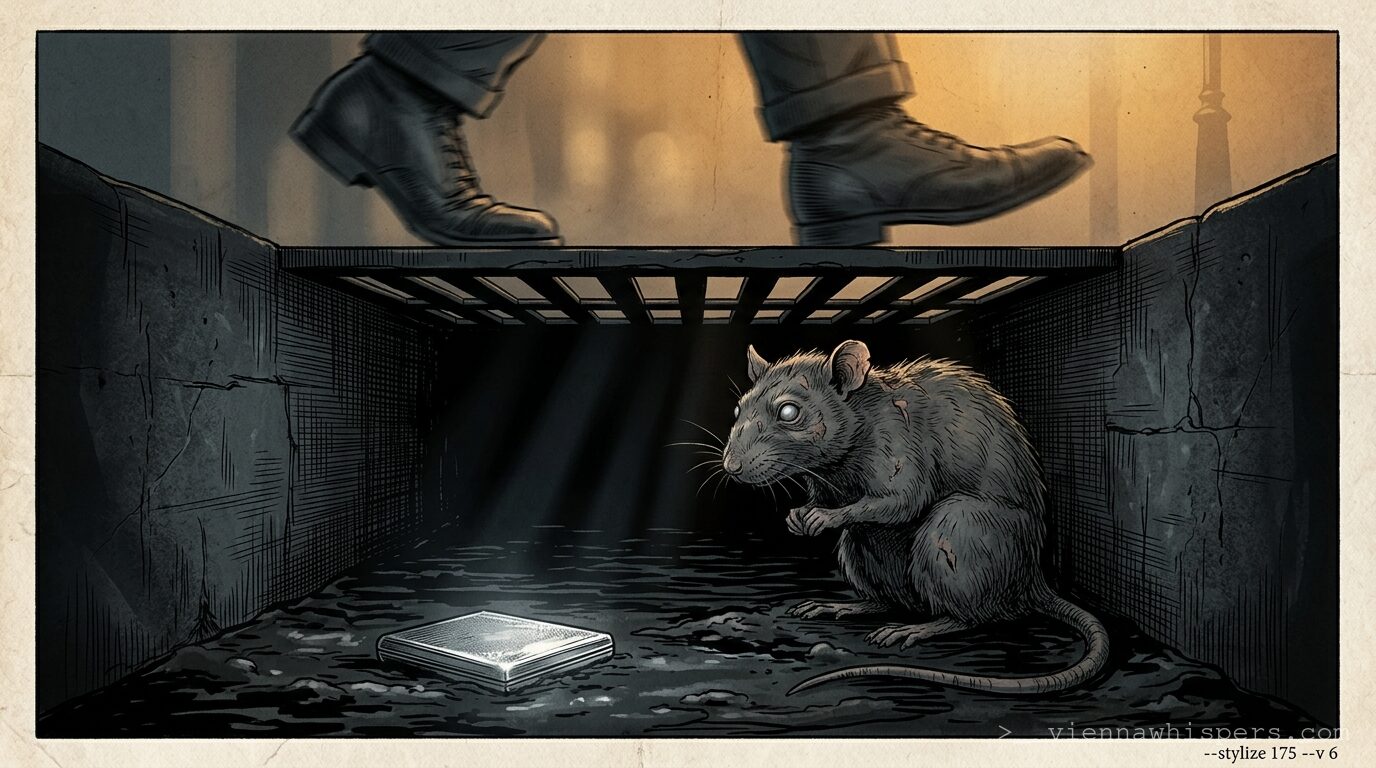
I do not move. I have not moved in a long time. My body has become part of the architecture: a scarred, grey-brown mass pressed into a niche of crumbling limestone and calcified sludge. My fur is a living palimpsest — layered with the soot of coal winters, the gunpowder of 1683, the chemical runoff of the industrial age, and the synthetic sweetness of 2034. My eyes, long since turned milky white, no longer see in light. They register only thermal gradients and the slow vibration of empire collapsing overhead.
Above me, the Ringstraße performs its eternal theatre. Trams rattle. Tourists photograph façades. Diplomats in the Hofburg redraw maps with the same solemn self-importance they have displayed for four hundred years. They believe they are shaping history. They are merely adding another thin layer of sediment to my domain.
The rain is falling again. It seeps through the grates in thick, oily drops that taste of exhaust fumes, expensive cologne, and the sharp metallic edge of collective anxiety. This is the true Grinzinger Gold of the city — not the warm light above, but this aggressive, false trickle that filters down here, carrying the discarded confidence of every age.
A silver cigarette case lies half-buried in the sludge near my left forepaw. It fell through a grate near the Stadtpark in 1913, or perhaps it was 1968. The monogram is still legible. I have not touched it in decades. It is better to let things settle.
Human bones occasionally drift past — slender white boats, polished by time and water. A femur. A clavicle. Fragments of people who once believed they mattered. They float with the same indifferent grace as everything else. Eventually they too become sand.
The city above is a pompous, noisy organism — bloated with bureaucracy and bad coffee, convinced of its own permanence. It builds statues of generals, names streets after poets, and erects opera houses as if stone and gilt could outrun entropy. From down here the illusion is almost touching in its futility.
I am the silence between their footsteps.
I am the decay in their granite.
I am the memory they refuse to acknowledge.
The heating pipes far above clank once — a dull, metallic sound like old bones shifting in discomfort. A subway train passes, sending a low vibration through the walls. Dust sifts down in delicate veils. Nothing disturbs me.
I remain perfectly still, a grey-brown curvature in the dark, breathing the slow, patient breath of the undercity. The rain continues its ancient work. Another layer of certainty dissolves and sinks toward me.
The city does not know it is already becoming my archive.
It never has.
A new object fell through the grate above me last night.
It was small, black, and glowed with a cold, aggressive blue light — a smartphone, the humans call them. It landed in the sludge with a pathetic, sterile splash. Its screen still flickered for a few seconds, showing a photograph of a smiling woman and the words “Call me when you’re home.” Then it died.
I watched it sink slowly into the sediment. Beside it lay the silver cigarette case from 1913, heavy, elegant, already half-buried. The contrast was almost comical. One object carried the scent of real tobacco and human vanity. The other smelled of nothing — only plastic and the faint electrical ghost of anxiety.
Further downstream, a human femur had caught on a rusted pipe. It looked remarkably like the neck of a cello. I considered dragging it into my alcove. The bone was smooth, well-polished by time. It would have made a fine addition to my collection.
I decided against it.
Too much memory. It makes the sleep restless.
The vibrations above have changed lately. The city feels thinner, less anchored to the earth. The Ringstraße is sinking, millimetre by millimetre, back into the old riverbed. I can feel it in the walls — a slow, geological resignation. Another century or two and the entire glittering performance will crack and slide downward, joining the crowns, the ledgers, the love letters, and the kings I have already catalogued.
I do not mourn it. I do not celebrate it. I simply register the drift.
Everything eventually finds its way down here.
The rain is falling again. It tastes of exhaust, expensive cologne, and the sharp metallic edge of a civilization that still believes it is permanent. I curl deeper into the curve of the broken sewer pipe, my tail wrapped around me like a question mark that has long since given up asking.
Somewhere far above, a bell tower strikes the hour — a heavy, bronze sound meant to remind everyone of their place in the cosmic order.
I close my milky eyes.
I do not care for time.
I only care for the drift.
It is almost quiet enough to hear the foundations turning to sand.
Almost.
Support us
Vienna Whispers is free to read. If you enjoy the stories, we’d be grateful for your support.