The Ring Remembers
I am the Ringstraße.
I am the circular scar cut into the flesh of an old city in 1865, a corset of stone and ambition pulled tight around a heart that had already begun to rot. Beneath my asphalt skin lies granite, beneath the granite lie the compacted bones of the old bastions, and beneath those lies the wet, black memory of the glacis — the no-man’s-land where the Turks once bled and the Viennese once feared.
I do not move. I do not need to. The city moves upon me like a fever dream it cannot shake.
The light that falls on me now is harsh and synthetic, a cold fluorescence pretending to be golden. It catches in the tram tracks, in the hairline cracks of my pavement, in the oily residue left by a million hurried lives. It does not warm. It only exposes. The humans who walk me have become porous, translucent creatures glued to glowing rectangles, their faces lit from below like corpses awaiting autopsy. They believe they are using me. They do not understand that I am slowly digesting them.
I feel every step.
The sharp, nervous click of high heels. The dull, arrogant thud of expensive oxfords. The frantic binary rhythm of cheap sneakers hurrying from one distraction to the next. All of it registers as vibration — a constant, petty drumming against my surface. I still carry the deeper scars: the heavy, hateful stamping of the 1930s, a rhythm so dense it left fissures I have never allowed to heal. I keep those marks hidden beneath fresh layers of tarmac, like a lady concealing bruises beneath powder.
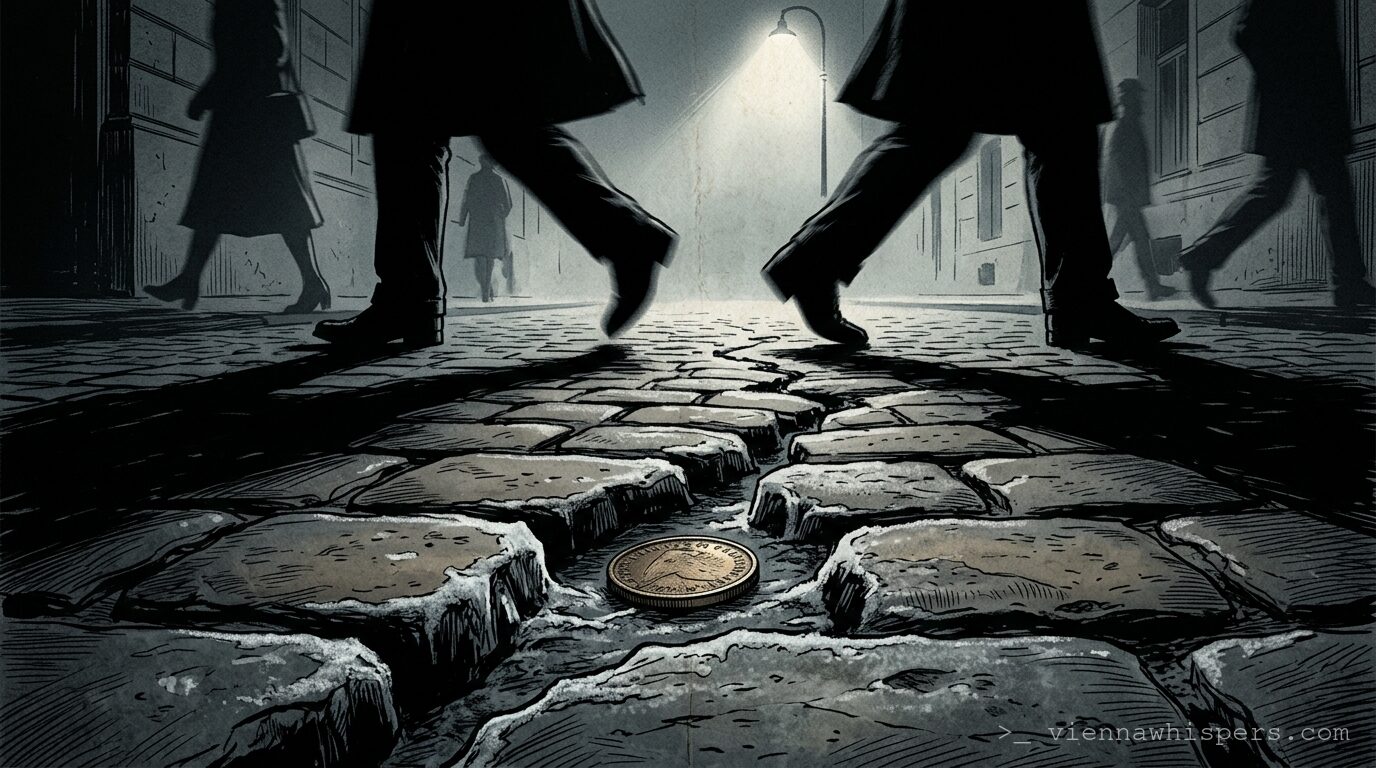
Near the Parliament there is a crack. It is not damage. It is appetite. A slow, widening hunger that has been growing for decades. The city engineers fill it with black sealant every few years — a ridiculous, temporary bandage on a wound that laughs at their efforts. When the frost comes, the ice wedges its fingers deeper, and I shift, just enough to remind them that the stage is not as stable as the performance suggests.
I am not cruel.
I am simply older than every illusion ever paraded across my surface.
I have carried emperors and republics, armies and tourists, revolutionaries and influencers. They all walk the same path: loud, convinced of their own permanence, certain that this time it will be different. They build palaces and opera houses upon me as if stone and gilt could outrun entropy. I let them. It amuses me to watch how diligently they polish surfaces I will eventually turn back into sand.
The rain falls tonight. It seeps into my cracks, carrying the taste of exhaust, expensive perfume, and the sharp metallic tang of a civilization that still believes it is eternal. I drink it slowly. Everything eventually finds its way down to me — the crowns, the treaties, the love letters, the lies. I hold them all in the sediment of my foundations.
Tonight, a small group of dignitaries leaves the Opera. Black coats, polished shoes, voices loud with the certainty of men who believe their words still shape continents. They walk upon me as if I were theirs. One of them, a minister or a consultant — it hardly matters — drops a coin. It falls into the widening crack near the Parliament with a thin, metallic ping.
I swallow it.
The man does not notice. He continues speaking, gesturing with the importance of someone who has never felt the ground shift beneath him. His companions laugh at something trivial. Their footsteps hammer against my surface in that frantic, binary rhythm they call progress.
Then I move.
It is not dramatic. I do not crack open or swallow buildings. I simply shrug — a microscopic geological exhale, no more than a few millimeters. Just enough.
For one second the dignitaries feel it: a sudden, inexplicable coldness rising through their soles, the brief sensation that the stone beneath them is no longer quite solid. One woman stumbles. A man catches her arm. They laugh nervously, blaming the wine, the late hour, anything but the truth.
I remain perfectly circular.
I have watched them all come and go. The carriages of 1865, the torches of 1938, the cheap rubber soles of 2026. They all walk the same path: loud, certain, temporary. They build palaces and opera houses upon me as if stone and gilt could outrun entropy. I let them. It amuses me to watch how diligently they polish surfaces I will eventually turn back into sand.
One day the crack near the Parliament will widen. One day the grand façades will lean into each other like tired drunks. One day the entire glittering performance will slide, slowly, almost gracefully, back into the earth from which it came.
I will not mourn it.
I will simply open my mouth a little wider and swallow what remains.
Until then, I remain perfectly, cruelly circular.
Waiting.
Support us
Vienna Whispers is free to read. If you enjoy the stories, we’d be grateful for your support.